

216
3 Holographic Interferometry for Studying …
I = 4E
2
0 cos
2
ϕ
2
+ α
(3.47)
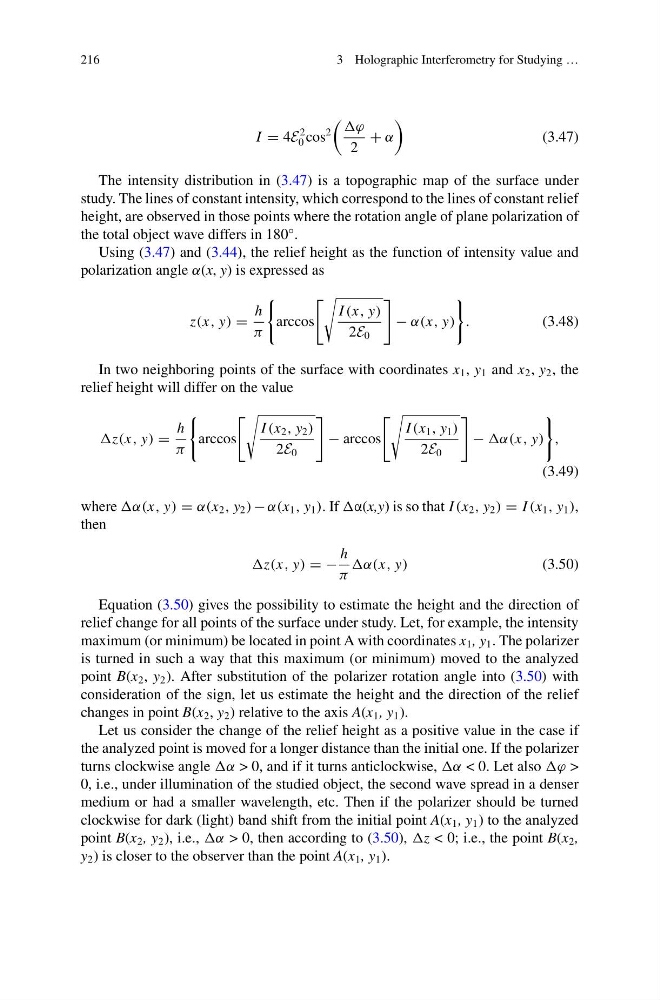
The intensity distribution in (3.47) is a topographic map of the surface under
study. The lines of constant intensity, which correspond to the lines of constant relief
height, are observed in those points where the rotation angle of plane polarization of
the total object wave differs in 180°.
Using (3.47) and (3.44), the relief height as the function of intensity value and
polarization angle α(x, y) is expressed as
z(x, y) =
h
π
arccos
I (x, y)
2E 0
− α(x, y)
.
(3.48)
In two neighboring points of the surface with coordinates x 1 , y 1 and x 2 , y 2 , the
relief height will differ on the value
z(x, y) =
h
π
arccos
I (x 2 , y 2 )
2E 0
− arccos
I (x 1 , y 1 )
2E 0
− α(x, y)
,
(3.49)
where α(x, y) = α(x 2 , y 2 ) − α(x 1 , y 1 ). If α(x,y) is so that I (x 2 , y 2 ) = I (x 1 , y 1 ),
then
z(x, y) = −
h
π
α(x, y)
(3.50)
Equation (3.50) gives the possibility to estimate the height and the direction of
relief change for all points of the surface under study. Let, for example, the intensity
maximum (or minimum) be located in point A with coordinates x 1 , y 1 . The polarizer
is turned in such a way that this maximum (or minimum) moved to the analyzed
point B(x 2 , y 2 ). After substitution of the polarizer rotation angle into (3.50) with
consideration of the sign, let us estimate the height and the direction of the relief
changes in point B(x 2 , y 2 ) relative to the axis A(x 1 , y 1 ).
Let us consider the change of the relief height as a positive value in the case if
the analyzed point is moved for a longer distance than the initial one. If the polarizer
turns clockwise angle α > 0, and if it turns anticlockwise, α < 0. Let also ϕ >
0, i.e., under illumination of the studied object, the second wave spread in a denser
medium or had a smaller wavelength, etc. Then if the polarizer should be turned
clockwise for dark (light) band shift from the initial point A(x 1 , y 1 ) to the analyzed
point B(x 2 , y 2 ), i.e., α > 0, then according to (3.50), z < 0; i.e., the point B(x 2 ,
y 2 ) is closer to the observer than the point A(x 1 , y 1 ).
3 Holographic Interferometry for Studying …
I = 4E
2
0 cos
2
ϕ
2
+ α
(3.47)
The intensity distribution in (3.47) is a topographic map of the surface under
study. The lines of constant intensity, which correspond to the lines of constant relief
height, are observed in those points where the rotation angle of plane polarization of
the total object wave differs in 180°.
Using (3.47) and (3.44), the relief height as the function of intensity value and
polarization angle α(x, y) is expressed as
z(x, y) =
h
π
arccos
I (x, y)
2E 0
− α(x, y)
.
(3.48)
In two neighboring points of the surface with coordinates x 1 , y 1 and x 2 , y 2 , the
relief height will differ on the value
z(x, y) =
h
π
arccos
I (x 2 , y 2 )
2E 0
− arccos
I (x 1 , y 1 )
2E 0
− α(x, y)
,
(3.49)
where α(x, y) = α(x 2 , y 2 ) − α(x 1 , y 1 ). If α(x,y) is so that I (x 2 , y 2 ) = I (x 1 , y 1 ),
then
z(x, y) = −
h
π
α(x, y)
(3.50)
Equation (3.50) gives the possibility to estimate the height and the direction of
relief change for all points of the surface under study. Let, for example, the intensity
maximum (or minimum) be located in point A with coordinates x 1 , y 1 . The polarizer
is turned in such a way that this maximum (or minimum) moved to the analyzed
point B(x 2 , y 2 ). After substitution of the polarizer rotation angle into (3.50) with
consideration of the sign, let us estimate the height and the direction of the relief
changes in point B(x 2 , y 2 ) relative to the axis A(x 1 , y 1 ).
Let us consider the change of the relief height as a positive value in the case if
the analyzed point is moved for a longer distance than the initial one. If the polarizer
turns clockwise angle α > 0, and if it turns anticlockwise, α < 0. Let also ϕ >
0, i.e., under illumination of the studied object, the second wave spread in a denser
medium or had a smaller wavelength, etc. Then if the polarizer should be turned
clockwise for dark (light) band shift from the initial point A(x 1 , y 1 ) to the analyzed
point B(x 2 , y 2 ), i.e., α > 0, then according to (3.50), z < 0; i.e., the point B(x 2 ,
y 2 ) is closer to the observer than the point A(x 1 , y 1 ).