

214
3 Holographic Interferometry for Studying …
As it has been shown, one of the possible problem solutions of detection of
relief height sign is the implementation of the immersion method, and the absorbing
medium is used as immersion [34, 38]. The implementation of absorbing media
made it possible to detect the direction of relief change. Meanwhile, the accuracy
of estimation of the relief height in more remote surface areas was significantly
decreasing because the band contrast on these areas was lowering. The holographic
contouring is suggested, which uses optically active medium as immersion during
one of the exposures. And the relief direction is determined by the direction of the
rotation angle of the polarizer, through which the holographic topogram is observed
when the maximal contrast of interference fringes is reached on the analyzed area
of the surface under study. As a result of using this method the polarization plane
of total (resultant) object beam in each point of the reconstructed image appears
to be turned at the angle, the value of which is proportional to the relief height in
this point, and the direction of the rotation angle determines the direction of relief
change. This method gives the possibility to detect not only the value but also the
sign of the relief height, as well as to enhance the resolution and the measurement
accuracy. Generally, the phase difference of two reconstructed forms, which form
contour lines of constant relief height, can be connected with the height of the relief
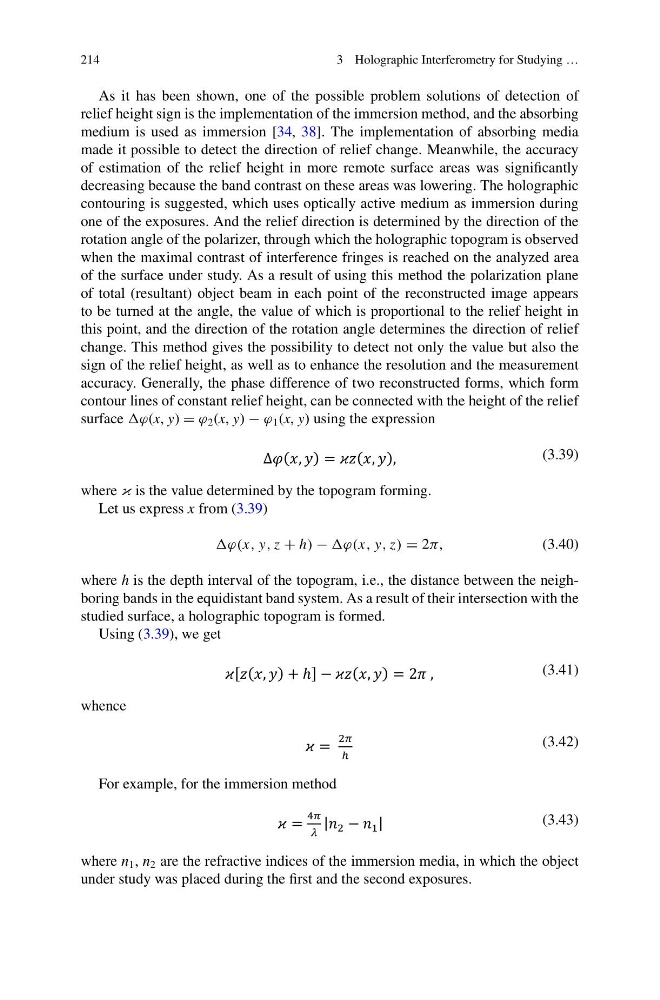
surface y) = ϕ 2 (x, y) − ϕ 1 (x, y) using the expression
(3.39)
where κ is the value determined by the topogram forming.
Let us express x from (3.39)
ϕ(x, y, z + h) − ϕ(x, y, z) = 2π,
(3.40)
where h is the depth interval of the topogram, i.e., the distance between the neighboring bands in the equidistant band system. As a result of their intersection with the
studied surface, a holographic topogram is formed.
Using (3.39), we get
(3.41)
whence
(3.42)
For example, for the immersion method
(3.43)
where n 1 , n 2 are the refractive indices of the immersion media, in which the object
under study was placed during the first and the second exposures.
3 Holographic Interferometry for Studying …
As it has been shown, one of the possible problem solutions of detection of
relief height sign is the implementation of the immersion method, and the absorbing
medium is used as immersion [34, 38]. The implementation of absorbing media
made it possible to detect the direction of relief change. Meanwhile, the accuracy
of estimation of the relief height in more remote surface areas was significantly
decreasing because the band contrast on these areas was lowering. The holographic
contouring is suggested, which uses optically active medium as immersion during
one of the exposures. And the relief direction is determined by the direction of the
rotation angle of the polarizer, through which the holographic topogram is observed
when the maximal contrast of interference fringes is reached on the analyzed area
of the surface under study. As a result of using this method the polarization plane
of total (resultant) object beam in each point of the reconstructed image appears
to be turned at the angle, the value of which is proportional to the relief height in
this point, and the direction of the rotation angle determines the direction of relief
change. This method gives the possibility to detect not only the value but also the
sign of the relief height, as well as to enhance the resolution and the measurement
accuracy. Generally, the phase difference of two reconstructed forms, which form
contour lines of constant relief height, can be connected with the height of the relief
surface y) = ϕ 2 (x, y) − ϕ 1 (x, y) using the expression
(3.39)
where κ is the value determined by the topogram forming.
Let us express x from (3.39)
ϕ(x, y, z + h) − ϕ(x, y, z) = 2π,
(3.40)
where h is the depth interval of the topogram, i.e., the distance between the neighboring bands in the equidistant band system. As a result of their intersection with the
studied surface, a holographic topogram is formed.
Using (3.39), we get
(3.41)
whence
(3.42)
For example, for the immersion method
(3.43)
where n 1 , n 2 are the refractive indices of the immersion media, in which the object
under study was placed during the first and the second exposures.