

54
2 Model of Quasi-Steady Weld Pool Dynamics and Numerical Simulation
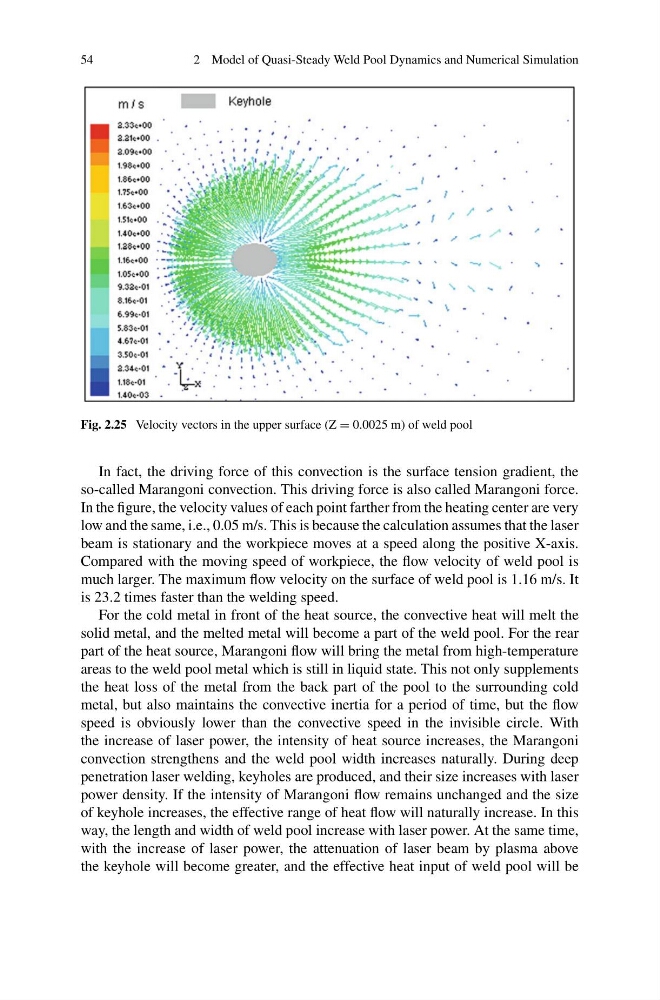
Fig. 2.25 Velocity vectors in the upper surface (Z = 0.0025 m) of weld pool
In fact, the driving force of this convection is the surface tension gradient, the
so-called Marangoni convection. This driving force is also called Marangoni force.
In the figure, the velocity values of each point farther from the heating center are very
low and the same, i.e., 0.05 m/s. This is because the calculation assumes that the laser
beam is stationary and the workpiece moves at a speed along the positive X-axis.
Compared with the moving speed of workpiece, the flow velocity of weld pool is
much larger. The maximum flow velocity on the surface of weld pool is 1.16 m/s. It
is 23.2 times faster than the welding speed.
For the cold metal in front of the heat source, the convective heat will melt the
solid metal, and the melted metal will become a part of the weld pool. For the rear
part of the heat source, Marangoni flow will bring the metal from high-temperature
areas to the weld pool metal which is still in liquid state. This not only supplements
the heat loss of the metal from the back part of the pool to the surrounding cold
metal, but also maintains the convective inertia for a period of time, but the flow
speed is obviously lower than the convective speed in the invisible circle. With
the increase of laser power, the intensity of heat source increases, the Marangoni
convection strengthens and the weld pool width increases naturally. During deep
penetration laser welding, keyholes are produced, and their size increases with laser
power density. If the intensity of Marangoni flow remains unchanged and the size
of keyhole increases, the effective range of heat flow will naturally increase. In this
way, the length and width of weld pool increase with laser power. At the same time,
with the increase of laser power, the attenuation of laser beam by plasma above
the keyhole will become greater, and the effective heat input of weld pool will be
2 Model of Quasi-Steady Weld Pool Dynamics and Numerical Simulation
Fig. 2.25 Velocity vectors in the upper surface (Z = 0.0025 m) of weld pool
In fact, the driving force of this convection is the surface tension gradient, the
so-called Marangoni convection. This driving force is also called Marangoni force.
In the figure, the velocity values of each point farther from the heating center are very
low and the same, i.e., 0.05 m/s. This is because the calculation assumes that the laser
beam is stationary and the workpiece moves at a speed along the positive X-axis.
Compared with the moving speed of workpiece, the flow velocity of weld pool is
much larger. The maximum flow velocity on the surface of weld pool is 1.16 m/s. It
is 23.2 times faster than the welding speed.
For the cold metal in front of the heat source, the convective heat will melt the
solid metal, and the melted metal will become a part of the weld pool. For the rear
part of the heat source, Marangoni flow will bring the metal from high-temperature
areas to the weld pool metal which is still in liquid state. This not only supplements
the heat loss of the metal from the back part of the pool to the surrounding cold
metal, but also maintains the convective inertia for a period of time, but the flow
speed is obviously lower than the convective speed in the invisible circle. With
the increase of laser power, the intensity of heat source increases, the Marangoni
convection strengthens and the weld pool width increases naturally. During deep
penetration laser welding, keyholes are produced, and their size increases with laser
power density. If the intensity of Marangoni flow remains unchanged and the size
of keyhole increases, the effective range of heat flow will naturally increase. In this
way, the length and width of weld pool increase with laser power. At the same time,
with the increase of laser power, the attenuation of laser beam by plasma above
the keyhole will become greater, and the effective heat input of weld pool will be