

48
2 Model of Quasi-Steady Weld Pool Dynamics and Numerical Simulation
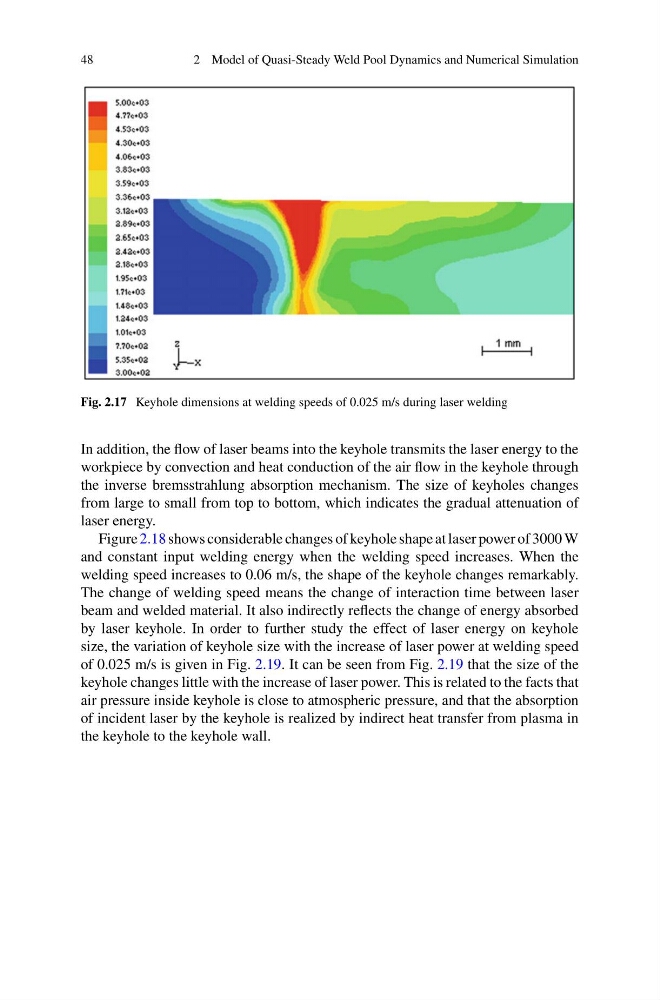
Fig. 2.17 Keyhole dimensions at welding speeds of 0.025 m/s during laser welding
In addition, the flow of laser beams into the keyhole transmits the laser energy to the
workpiece by convection and heat conduction of the air flow in the keyhole through
the inverse bremsstrahlung absorption mechanism. The size of keyholes changes
from large to small from top to bottom, which indicates the gradual attenuation of
laser energy.
Figure 2.18 shows considerable changes of keyhole shape at laser power of 3000 W
and constant input welding energy when the welding speed increases. When the
welding speed increases to 0.06 m/s, the shape of the keyhole changes remarkably.
The change of welding speed means the change of interaction time between laser
beam and welded material. It also indirectly reflects the change of energy absorbed
by laser keyhole. In order to further study the effect of laser energy on keyhole
size, the variation of keyhole size with the increase of laser power at welding speed
of 0.025 m/s is given in Fig. 2.19. It can be seen from Fig. 2.19 that the size of the
keyhole changes little with the increase of laser power. This is related to the facts that
air pressure inside keyhole is close to atmospheric pressure, and that the absorption
of incident laser by the keyhole is realized by indirect heat transfer from plasma in
the keyhole to the keyhole wall.
2 Model of Quasi-Steady Weld Pool Dynamics and Numerical Simulation
Fig. 2.17 Keyhole dimensions at welding speeds of 0.025 m/s during laser welding
In addition, the flow of laser beams into the keyhole transmits the laser energy to the
workpiece by convection and heat conduction of the air flow in the keyhole through
the inverse bremsstrahlung absorption mechanism. The size of keyholes changes
from large to small from top to bottom, which indicates the gradual attenuation of
laser energy.
Figure 2.18 shows considerable changes of keyhole shape at laser power of 3000 W
and constant input welding energy when the welding speed increases. When the
welding speed increases to 0.06 m/s, the shape of the keyhole changes remarkably.
The change of welding speed means the change of interaction time between laser
beam and welded material. It also indirectly reflects the change of energy absorbed
by laser keyhole. In order to further study the effect of laser energy on keyhole
size, the variation of keyhole size with the increase of laser power at welding speed
of 0.025 m/s is given in Fig. 2.19. It can be seen from Fig. 2.19 that the size of the
keyhole changes little with the increase of laser power. This is related to the facts that
air pressure inside keyhole is close to atmospheric pressure, and that the absorption
of incident laser by the keyhole is realized by indirect heat transfer from plasma in
the keyhole to the keyhole wall.