

20
2 Model of Quasi-Steady Weld Pool Dynamics and Numerical Simulation
existence of the keyhole and in process of formation and disappearance of the keyhole
affect directly the existence state and morphology of the keyhole.
This chapter takes titanium alloy laser welding as the research subject, focusing
on research of the temperature field model in the quasi-steady state in laser keyhole
welding, the fluid dynamics model of the weld pool in quasi-steady state and the
solving techniques, distribution of the welding temperature field and of the velocity
in quasi steady state.
2.2 Basic Models of Quasi-Steady Laser Welding
When the energy density of the focused laser beam is greater than 10
6 W/cm
2 , the
metal is melted rapidly and evaporated and gasified. The strong evaporative recoil
force pushes out the melted metal around it, forming a keyhole in a very short time.
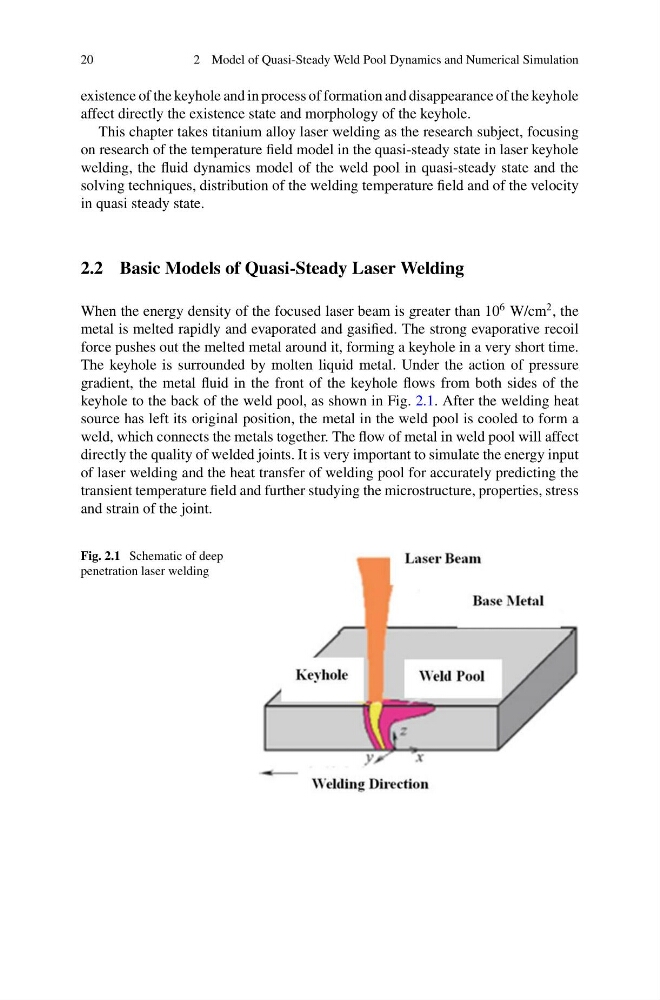
The keyhole is surrounded by molten liquid metal. Under the action of pressure
gradient, the metal fluid in the front of the keyhole flows from both sides of the
keyhole to the back of the weld pool, as shown in Fig. 2.1. After the welding heat
source has left its original position, the metal in the weld pool is cooled to form a
weld, which connects the metals together. The flow of metal in weld pool will affect
directly the quality of welded joints. It is very important to simulate the energy input
of laser welding and the heat transfer of welding pool for accurately predicting the
transient temperature field and further studying the microstructure, properties, stress
and strain of the joint.
Fig. 2.1 Schematic of deep
penetration laser welding
2 Model of Quasi-Steady Weld Pool Dynamics and Numerical Simulation
existence of the keyhole and in process of formation and disappearance of the keyhole
affect directly the existence state and morphology of the keyhole.
This chapter takes titanium alloy laser welding as the research subject, focusing
on research of the temperature field model in the quasi-steady state in laser keyhole
welding, the fluid dynamics model of the weld pool in quasi-steady state and the
solving techniques, distribution of the welding temperature field and of the velocity
in quasi steady state.
2.2 Basic Models of Quasi-Steady Laser Welding
When the energy density of the focused laser beam is greater than 10
6 W/cm
2 , the
metal is melted rapidly and evaporated and gasified. The strong evaporative recoil
force pushes out the melted metal around it, forming a keyhole in a very short time.
The keyhole is surrounded by molten liquid metal. Under the action of pressure
gradient, the metal fluid in the front of the keyhole flows from both sides of the
keyhole to the back of the weld pool, as shown in Fig. 2.1. After the welding heat
source has left its original position, the metal in the weld pool is cooled to form a
weld, which connects the metals together. The flow of metal in weld pool will affect
directly the quality of welded joints. It is very important to simulate the energy input
of laser welding and the heat transfer of welding pool for accurately predicting the
transient temperature field and further studying the microstructure, properties, stress
and strain of the joint.
Fig. 2.1 Schematic of deep
penetration laser welding