

9.2 Transient Coupling Model of Keyhole and Weld Pool in Vacuum
255
The pressure at the free surface during laser welding under vacuum and atmospheric conditions can both be calculated using the surface pressure model. The
coupling model of keyhole and weld pool dynamics in vacuum laser welding is
similar to that in atmospheric laser welding.
9.2.1 Governing Equations in Vacuum Laser Welding
Similar to laser welding under atmospheric pressure, the mixture model is used to
treat the solid–liquid interface. Besides, the fluid flow in weld pool is assumed to be
incompressible, and the density of the fluid flow is assumed to change slightly during
the solid–liquid phase transition. Thus, the mass conservation of any element on the
workpiece (including the weld pool and the unmelted region) can be described as
follows:
∇ ·
− →
U = 0
( 9 . 2 )
where
− →
U is the three-dimensional velocity vector.
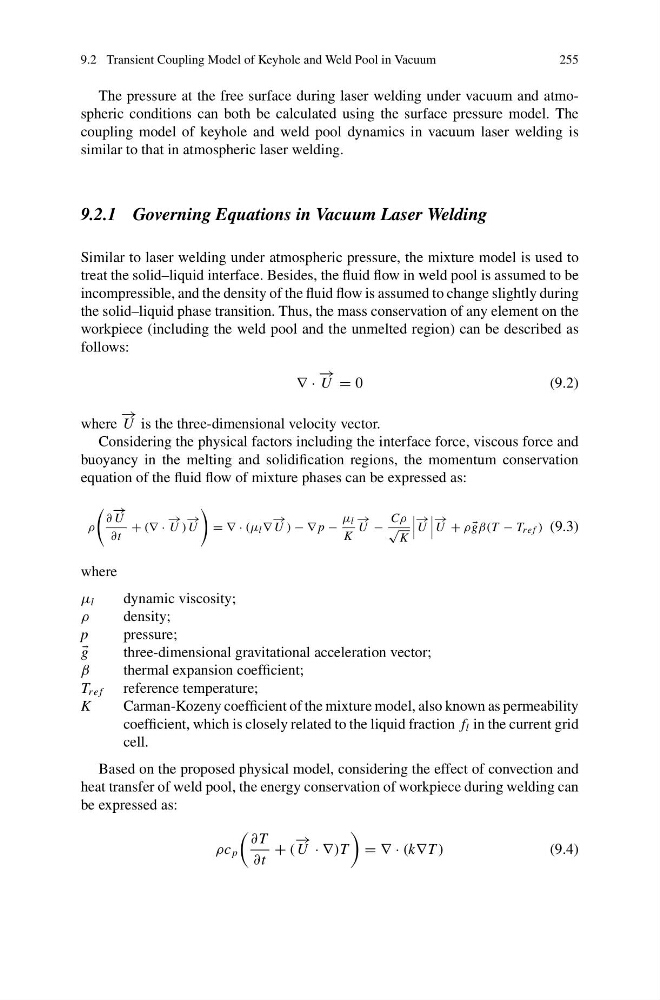
Considering the physical factors including the interface force, viscous force and
buoyancy in the melting and solidification regions, the momentum conservation
equation of the fluid flow of mixture phases can be expressed as:
ρ
∂
− →
U
∂t
+ (∇ ·
− →
U )
− →
U
= ∇ · (μ l ∇
− →
U ) − ∇ p −
μ l
K
− →
U −
Cρ
√
K
− →
U
− →
U + ρ
gβ(T − T re f ) (9.3)
where
μ l
dynamic viscosity;
ρ
density;
p
pressure;
g
three-dimensional gravitational acceleration vector;
β
thermal expansion coefficient;
T re f reference temperature;
K
Carman-Kozeny coefficient of the mixture model, also known as permeability
coefficient, which is closely related to the liquid fraction f l in the current grid
cell.
Based on the proposed physical model, considering the effect of convection and
heat transfer of weld pool, the energy conservation of workpiece during welding can
be expressed as:
ρc p
∂ T
∂t
+ (
− →
U · ∇)T
= ∇ · (k∇T )
(9.4)
255
The pressure at the free surface during laser welding under vacuum and atmospheric conditions can both be calculated using the surface pressure model. The
coupling model of keyhole and weld pool dynamics in vacuum laser welding is
similar to that in atmospheric laser welding.
9.2.1 Governing Equations in Vacuum Laser Welding
Similar to laser welding under atmospheric pressure, the mixture model is used to
treat the solid–liquid interface. Besides, the fluid flow in weld pool is assumed to be
incompressible, and the density of the fluid flow is assumed to change slightly during
the solid–liquid phase transition. Thus, the mass conservation of any element on the
workpiece (including the weld pool and the unmelted region) can be described as
follows:
∇ ·
− →
U = 0
( 9 . 2 )
where
− →
U is the three-dimensional velocity vector.
Considering the physical factors including the interface force, viscous force and
buoyancy in the melting and solidification regions, the momentum conservation
equation of the fluid flow of mixture phases can be expressed as:
ρ
∂
− →
U
∂t
+ (∇ ·
− →
U )
− →
U
= ∇ · (μ l ∇
− →
U ) − ∇ p −
μ l
K
− →
U −
Cρ
√
K
− →
U
− →
U + ρ
gβ(T − T re f ) (9.3)
where
μ l
dynamic viscosity;
ρ
density;
p
pressure;
g
three-dimensional gravitational acceleration vector;
β
thermal expansion coefficient;
T re f reference temperature;
K
Carman-Kozeny coefficient of the mixture model, also known as permeability
coefficient, which is closely related to the liquid fraction f l in the current grid
cell.
Based on the proposed physical model, considering the effect of convection and
heat transfer of weld pool, the energy conservation of workpiece during welding can
be expressed as:
ρc p
∂ T
∂t
+ (
− →
U · ∇)T
= ∇ · (k∇T )
(9.4)