

8.5 Dynamic Dilution Behavior of Moving Weld Pools …
235
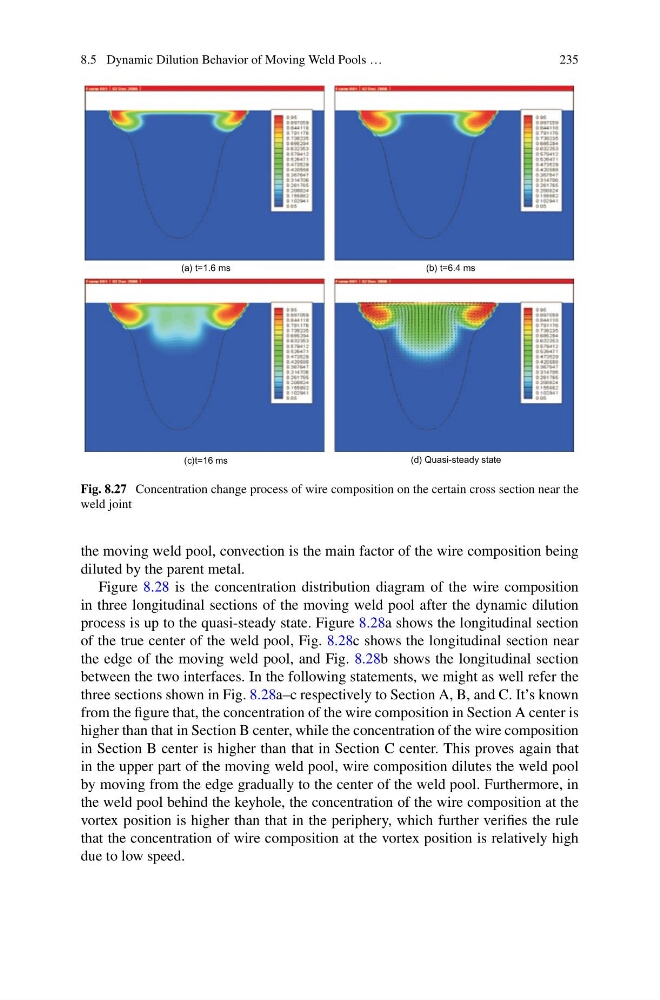
(d) Quasi-steady state
(c)t=16 ms
(b) t=6.4 ms
(a) t=1.6 ms
Fig. 8.27 Concentration change process of wire composition on the certain cross section near the
weld joint
the moving weld pool, convection is the main factor of the wire composition being
diluted by the parent metal.
Figure 8.28 is the concentration distribution diagram of the wire composition
in three longitudinal sections of the moving weld pool after the dynamic dilution
process is up to the quasi-steady state. Figure 8.28a shows the longitudinal section
of the true center of the weld pool, Fig. 8.28c shows the longitudinal section near
the edge of the moving weld pool, and Fig. 8.28b shows the longitudinal section
between the two interfaces. In the following statements, we might as well refer the
three sections shown in Fig. 8.28a–c respectively to Section A, B, and C. It’s known
from the figure that, the concentration of the wire composition in Section A center is
higher than that in Section B center, while the concentration of the wire composition
in Section B center is higher than that in Section C center. This proves again that
in the upper part of the moving weld pool, wire composition dilutes the weld pool
by moving from the edge gradually to the center of the weld pool. Furthermore, in
the weld pool behind the keyhole, the concentration of the wire composition at the
vortex position is higher than that in the periphery, which further verifies the rule
that the concentration of wire composition at the vortex position is relatively high
due to low speed.
235
(d) Quasi-steady state
(c)t=16 ms
(b) t=6.4 ms
(a) t=1.6 ms
Fig. 8.27 Concentration change process of wire composition on the certain cross section near the
weld joint
the moving weld pool, convection is the main factor of the wire composition being
diluted by the parent metal.
Figure 8.28 is the concentration distribution diagram of the wire composition
in three longitudinal sections of the moving weld pool after the dynamic dilution
process is up to the quasi-steady state. Figure 8.28a shows the longitudinal section
of the true center of the weld pool, Fig. 8.28c shows the longitudinal section near
the edge of the moving weld pool, and Fig. 8.28b shows the longitudinal section
between the two interfaces. In the following statements, we might as well refer the
three sections shown in Fig. 8.28a–c respectively to Section A, B, and C. It’s known
from the figure that, the concentration of the wire composition in Section A center is
higher than that in Section B center, while the concentration of the wire composition
in Section B center is higher than that in Section C center. This proves again that
in the upper part of the moving weld pool, wire composition dilutes the weld pool
by moving from the edge gradually to the center of the weld pool. Furthermore, in
the weld pool behind the keyhole, the concentration of the wire composition at the
vortex position is higher than that in the periphery, which further verifies the rule
that the concentration of wire composition at the vortex position is relatively high
due to low speed.