

228
8 Keyhole and Weld Pool Dynamics in Laser Welding with Filler Wires
diffusion coefficients depending on the chemical composition in a weld pool, the
high-temperature weld pool exists for a very short time (usually tens of milliseconds).
In addition, given the high-speed fluid dynamics in the moving weld pool, convection
is likely to have a dominant influence on the movement of chemical compositions of
a wire. Therefore, the model in this study is established based on assumption that the
chemical compositions of wires have the same diffusion coefficients in the moving
weld pool. The model ignores solid-phase diffusion, considering small diffusion
coefficients of chemical compositions in solid alloys. In addition, in non-self-fluxing
laser welding, there is little difference between wire density and the density of parent
metal. Therefore, in the numerical simulation process, we assume that wire density
and the density of parent metal are always equal. Based on the above assumptions, the
two-phase flow equation of the wire fluid and the parent metal fluid in a moving weld
pool can be defined by single-phase flow Navier–Stokes equations in combination
with a conservation of concentration field equation.
The flow and diffusion of the metallic liquid formed when the wire is melted
(different from the metallic liquid formed when the parent metal is melted) in the
weld pool is regarded as an indivisible “chemical composition”. Comprehensively
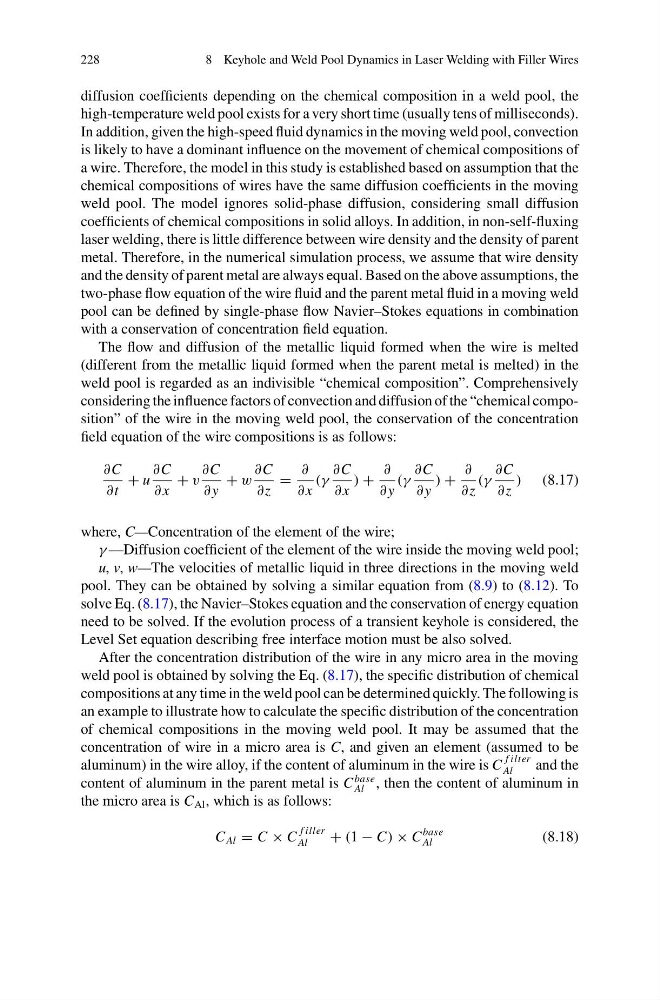
considering the influence factors of convection and diffusion of the “chemical composition” of the wire in the moving weld pool, the conservation of the concentration
field equation of the wire compositions is as follows:
∂C
∂t
+ u
∂C
∂ x
+ v
∂C
∂ y
+ w
∂C
∂z
=
∂
∂ x
(γ
∂C
∂ x
) +
∂
∂ y
(γ
∂C
∂ y
) +
∂
∂z
(γ
∂C
∂z
) (8.17)
where, C—Concentration of the element of the wire;
γ —Diffusion coefficient of the element of the wire inside the moving weld pool;
u, v, w—The velocities of metallic liquid in three directions in the moving weld
pool. They can be obtained by solving a similar equation from (8.9) to (8.12). To
solve Eq. (8.17), the Navier–Stokes equation and the conservation of energy equation
need to be solved. If the evolution process of a transient keyhole is considered, the
Level Set equation describing free interface motion must be also solved.
After the concentration distribution of the wire in any micro area in the moving
weld pool is obtained by solving the Eq. (8.17), the specific distribution of chemical
compositions at any time in the weld pool can be determined quickly. The following is
an example to illustrate how to calculate the specific distribution of the concentration
of chemical compositions in the moving weld pool. It may be assumed that the
concentration of wire in a micro area is C, and given an element (assumed to be
aluminum) in the wire alloy, if the content of aluminum in the wire is C
f ilter
Al
and the
content of aluminum in the parent metal is C
base
Al , then the content of aluminum in
the micro area is C Al , which is as follows:
C Al = C × C
f iller
Al
+ (1 − C) × C
base
Al
(8.18)
8 Keyhole and Weld Pool Dynamics in Laser Welding with Filler Wires
diffusion coefficients depending on the chemical composition in a weld pool, the
high-temperature weld pool exists for a very short time (usually tens of milliseconds).
In addition, given the high-speed fluid dynamics in the moving weld pool, convection
is likely to have a dominant influence on the movement of chemical compositions of
a wire. Therefore, the model in this study is established based on assumption that the
chemical compositions of wires have the same diffusion coefficients in the moving
weld pool. The model ignores solid-phase diffusion, considering small diffusion
coefficients of chemical compositions in solid alloys. In addition, in non-self-fluxing
laser welding, there is little difference between wire density and the density of parent
metal. Therefore, in the numerical simulation process, we assume that wire density
and the density of parent metal are always equal. Based on the above assumptions, the
two-phase flow equation of the wire fluid and the parent metal fluid in a moving weld
pool can be defined by single-phase flow Navier–Stokes equations in combination
with a conservation of concentration field equation.
The flow and diffusion of the metallic liquid formed when the wire is melted
(different from the metallic liquid formed when the parent metal is melted) in the
weld pool is regarded as an indivisible “chemical composition”. Comprehensively
considering the influence factors of convection and diffusion of the “chemical composition” of the wire in the moving weld pool, the conservation of the concentration
field equation of the wire compositions is as follows:
∂C
∂t
+ u
∂C
∂ x
+ v
∂C
∂ y
+ w
∂C
∂z
=
∂
∂ x
(γ
∂C
∂ x
) +
∂
∂ y
(γ
∂C
∂ y
) +
∂
∂z
(γ
∂C
∂z
) (8.17)
where, C—Concentration of the element of the wire;
γ —Diffusion coefficient of the element of the wire inside the moving weld pool;
u, v, w—The velocities of metallic liquid in three directions in the moving weld
pool. They can be obtained by solving a similar equation from (8.9) to (8.12). To
solve Eq. (8.17), the Navier–Stokes equation and the conservation of energy equation
need to be solved. If the evolution process of a transient keyhole is considered, the
Level Set equation describing free interface motion must be also solved.
After the concentration distribution of the wire in any micro area in the moving
weld pool is obtained by solving the Eq. (8.17), the specific distribution of chemical
compositions at any time in the weld pool can be determined quickly. The following is
an example to illustrate how to calculate the specific distribution of the concentration
of chemical compositions in the moving weld pool. It may be assumed that the
concentration of wire in a micro area is C, and given an element (assumed to be
aluminum) in the wire alloy, if the content of aluminum in the wire is C
f ilter
Al
and the
content of aluminum in the parent metal is C
base
Al , then the content of aluminum in
the micro area is C Al , which is as follows:
C Al = C × C
f iller
Al
+ (1 − C) × C
base
Al
(8.18)