

8.4 Instability of Keyhole and Weld Pool in Welding with Filler Wires
225
established in this chapter, which confirms the mechanism, proposed in Sect. 8.3 in
this chapter, that the addition of wire weakens the maximum velocity fluctuation in
the weld pool and improves the stability of the weld pool is reasonable.
8.4.2 Weld Pool Dynamics in Welding with Filler Wires
Under Different Wire Feed Speeds
In this section, the weld pool dynamics during laser welding with filler wires at
different wire feed rates is studied through a high-speed photography test, and then
the simulation results obtained in Sect. 8.3 are verified qualitatively. Consistent with
Sect. 8.4.1, in the welding test, a fiber laser is used as the laser, and the material is
aluminum alloy; the diameter of the wire is 1 mm and the material is SA1-Mg5; in
addition, argon gas is used to protect the weld pool during the welding process.
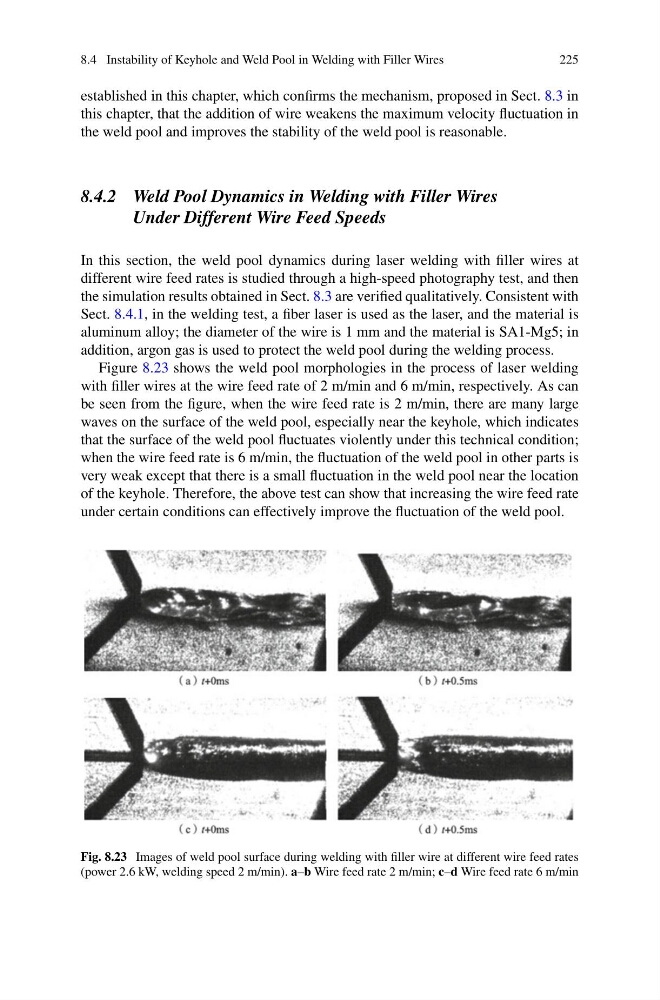
Figure 8.23 shows the weld pool morphologies in the process of laser welding
with filler wires at the wire feed rate of 2 m/min and 6 m/min, respectively. As can
be seen from the figure, when the wire feed rate is 2 m/min, there are many large
waves on the surface of the weld pool, especially near the keyhole, which indicates
that the surface of the weld pool fluctuates violently under this technical condition;
when the wire feed rate is 6 m/min, the fluctuation of the weld pool in other parts is
very weak except that there is a small fluctuation in the weld pool near the location
of the keyhole. Therefore, the above test can show that increasing the wire feed rate
under certain conditions can effectively improve the fluctuation of the weld pool.
Fig. 8.23 Images of weld pool surface during welding with filler wire at different wire feed rates
(power 2.6 kW, welding speed 2 m/min). a–b Wire feed rate 2 m/min; c–d Wire feed rate 6 m/min
225
established in this chapter, which confirms the mechanism, proposed in Sect. 8.3 in
this chapter, that the addition of wire weakens the maximum velocity fluctuation in
the weld pool and improves the stability of the weld pool is reasonable.
8.4.2 Weld Pool Dynamics in Welding with Filler Wires
Under Different Wire Feed Speeds
In this section, the weld pool dynamics during laser welding with filler wires at
different wire feed rates is studied through a high-speed photography test, and then
the simulation results obtained in Sect. 8.3 are verified qualitatively. Consistent with
Sect. 8.4.1, in the welding test, a fiber laser is used as the laser, and the material is
aluminum alloy; the diameter of the wire is 1 mm and the material is SA1-Mg5; in
addition, argon gas is used to protect the weld pool during the welding process.
Figure 8.23 shows the weld pool morphologies in the process of laser welding
with filler wires at the wire feed rate of 2 m/min and 6 m/min, respectively. As can
be seen from the figure, when the wire feed rate is 2 m/min, there are many large
waves on the surface of the weld pool, especially near the keyhole, which indicates
that the surface of the weld pool fluctuates violently under this technical condition;
when the wire feed rate is 6 m/min, the fluctuation of the weld pool in other parts is
very weak except that there is a small fluctuation in the weld pool near the location
of the keyhole. Therefore, the above test can show that increasing the wire feed rate
under certain conditions can effectively improve the fluctuation of the weld pool.
Fig. 8.23 Images of weld pool surface during welding with filler wire at different wire feed rates
(power 2.6 kW, welding speed 2 m/min). a–b Wire feed rate 2 m/min; c–d Wire feed rate 6 m/min