

1.1 Interaction of Lasers and Materials
7
change of the moving laser surface using the static laser surface temperature, the
constant C can be properly adjusted, usually equal to 1.25.
When the laser equivalent action time τ
∗
= 1.25r/v is substituted to Eq. (1.7),
the maximum temperature at the center of the light spot can be obtained.
T =
AP
kπ 3/2 r
arctan
5α
vr
(1.12)
The characteristic velocity v 0 = 5α/r is introduced. Generally, in the actual lasering
heat treatment, the laser scanning speed is near v 0 , in which case, Eq. (1.12) can be
rewritten as:
T =
AP
kπ 3/2 r
arctan
v 0
v
(1.13)
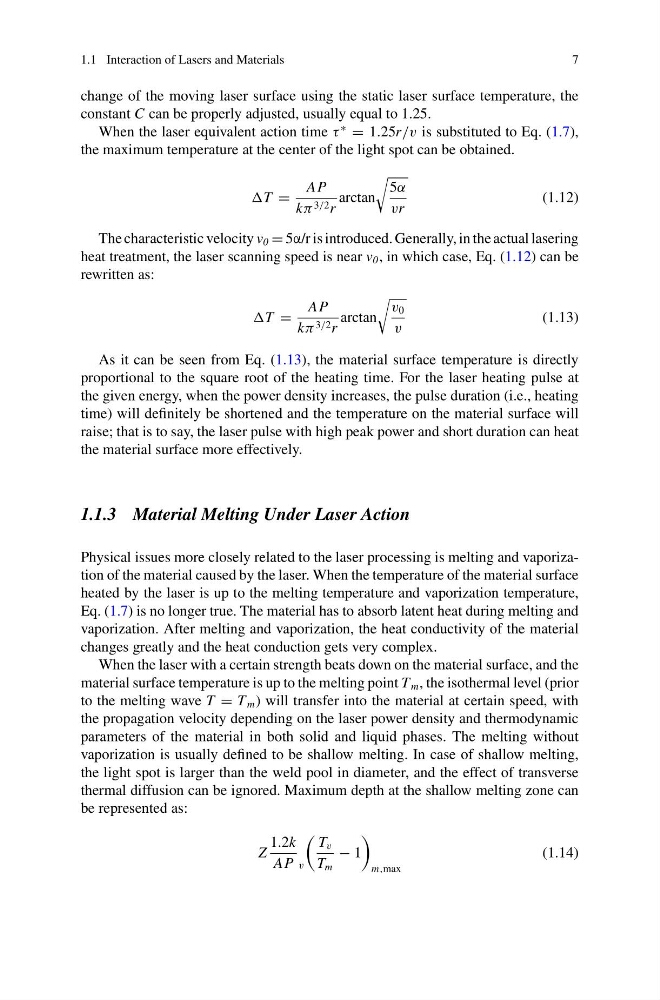
As it can be seen from Eq. (1.13), the material surface temperature is directly
proportional to the square root of the heating time. For the laser heating pulse at
the given energy, when the power density increases, the pulse duration (i.e., heating
time) will definitely be shortened and the temperature on the material surface will
raise; that is to say, the laser pulse with high peak power and short duration can heat
the material surface more effectively.
1.1.3 Material Melting Under Laser Action
Physical issues more closely related to the laser processing is melting and vaporization of the material caused by the laser. When the temperature of the material surface
heated by the laser is up to the melting temperature and vaporization temperature,
Eq. (1.7) is no longer true. The material has to absorb latent heat during melting and
vaporization. After melting and vaporization, the heat conductivity of the material
changes greatly and the heat conduction gets very complex.
When the laser with a certain strength beats down on the material surface, and the
material surface temperature is up to the melting point T m , the isothermal level (prior
to the melting wave T = T m ) will transfer into the material at certain speed, with
the propagation velocity depending on the laser power density and thermodynamic
parameters of the material in both solid and liquid phases. The melting without
vaporization is usually defined to be shallow melting. In case of shallow melting,
the light spot is larger than the weld pool in diameter, and the effect of transverse
thermal diffusion can be ignored. Maximum depth at the shallow melting zone can
be represented as:
Z
1.2k
AP v
T v
T m
− 1
m,max
(1.14)
7
change of the moving laser surface using the static laser surface temperature, the
constant C can be properly adjusted, usually equal to 1.25.
When the laser equivalent action time τ
∗
= 1.25r/v is substituted to Eq. (1.7),
the maximum temperature at the center of the light spot can be obtained.
T =
AP
kπ 3/2 r
arctan
5α
vr
(1.12)
The characteristic velocity v 0 = 5α/r is introduced. Generally, in the actual lasering
heat treatment, the laser scanning speed is near v 0 , in which case, Eq. (1.12) can be
rewritten as:
T =
AP
kπ 3/2 r
arctan
v 0
v
(1.13)
As it can be seen from Eq. (1.13), the material surface temperature is directly
proportional to the square root of the heating time. For the laser heating pulse at
the given energy, when the power density increases, the pulse duration (i.e., heating
time) will definitely be shortened and the temperature on the material surface will
raise; that is to say, the laser pulse with high peak power and short duration can heat
the material surface more effectively.
1.1.3 Material Melting Under Laser Action
Physical issues more closely related to the laser processing is melting and vaporization of the material caused by the laser. When the temperature of the material surface
heated by the laser is up to the melting temperature and vaporization temperature,
Eq. (1.7) is no longer true. The material has to absorb latent heat during melting and
vaporization. After melting and vaporization, the heat conductivity of the material
changes greatly and the heat conduction gets very complex.
When the laser with a certain strength beats down on the material surface, and the
material surface temperature is up to the melting point T m , the isothermal level (prior
to the melting wave T = T m ) will transfer into the material at certain speed, with
the propagation velocity depending on the laser power density and thermodynamic
parameters of the material in both solid and liquid phases. The melting without
vaporization is usually defined to be shallow melting. In case of shallow melting,
the light spot is larger than the weld pool in diameter, and the effect of transverse
thermal diffusion can be ignored. Maximum depth at the shallow melting zone can
be represented as:
Z
1.2k
AP v
T v
T m
− 1
m,max
(1.14)