

200
7 Keyhole and Weld Pool Dynamics in Dual-Beam Laser Welding
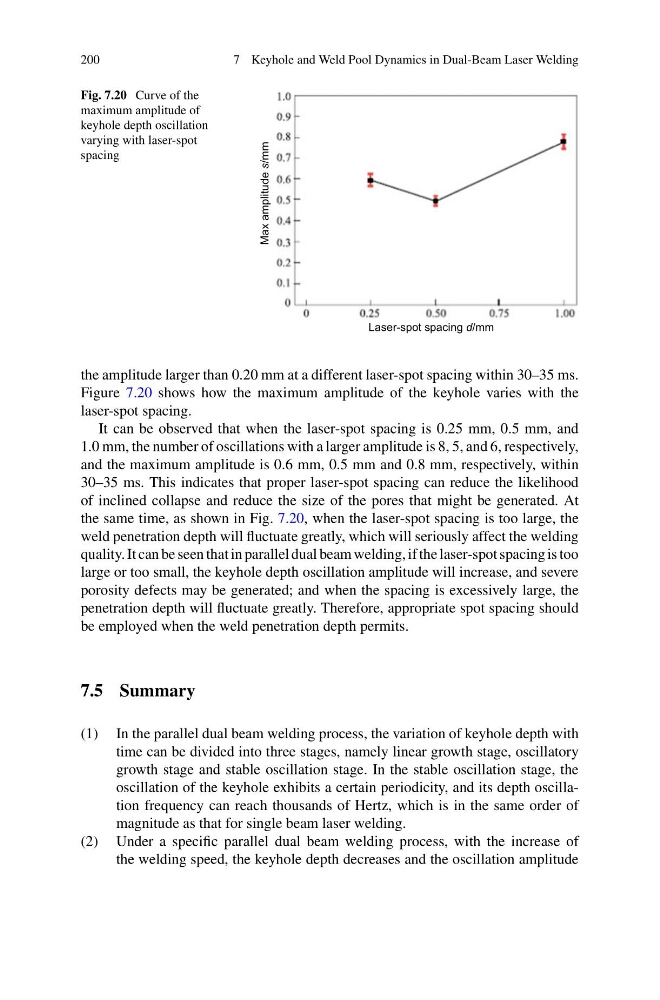
Fig. 7.20 Curve of the
maximum amplitude of
keyhole depth oscillation
varying with laser-spot
spacing
Laser-spot spacing d/mm
Max amplitude
s/mm
the amplitude larger than 0.20 mm at a different laser-spot spacing within 30–35 ms.
Figure 7.20 shows how the maximum amplitude of the keyhole varies with the
laser-spot spacing.
It can be observed that when the laser-spot spacing is 0.25 mm, 0.5 mm, and
1.0 mm, the number of oscillations with a larger amplitude is 8, 5, and 6, respectively,
and the maximum amplitude is 0.6 mm, 0.5 mm and 0.8 mm, respectively, within
30–35 ms. This indicates that proper laser-spot spacing can reduce the likelihood
of inclined collapse and reduce the size of the pores that might be generated. At
the same time, as shown in Fig. 7.20, when the laser-spot spacing is too large, the
weld penetration depth will fluctuate greatly, which will seriously affect the welding
quality. It can be seen that in parallel dual beam welding, if the laser-spot spacing is too
large or too small, the keyhole depth oscillation amplitude will increase, and severe
porosity defects may be generated; and when the spacing is excessively large, the
penetration depth will fluctuate greatly. Therefore, appropriate spot spacing should
be employed when the weld penetration depth permits.
7.5 Summary
(1) In the parallel dual beam welding process, the variation of keyhole depth with
time can be divided into three stages, namely linear growth stage, oscillatory
growth stage and stable oscillation stage. In the stable oscillation stage, the
oscillation of the keyhole exhibits a certain periodicity, and its depth oscillation frequency can reach thousands of Hertz, which is in the same order of
magnitude as that for single beam laser welding.
(2) Under a specific parallel dual beam welding process, with the increase of
the welding speed, the keyhole depth decreases and the oscillation amplitude
7 Keyhole and Weld Pool Dynamics in Dual-Beam Laser Welding
Fig. 7.20 Curve of the
maximum amplitude of
keyhole depth oscillation
varying with laser-spot
spacing
Laser-spot spacing d/mm
Max amplitude
s/mm
the amplitude larger than 0.20 mm at a different laser-spot spacing within 30–35 ms.
Figure 7.20 shows how the maximum amplitude of the keyhole varies with the
laser-spot spacing.
It can be observed that when the laser-spot spacing is 0.25 mm, 0.5 mm, and
1.0 mm, the number of oscillations with a larger amplitude is 8, 5, and 6, respectively,
and the maximum amplitude is 0.6 mm, 0.5 mm and 0.8 mm, respectively, within
30–35 ms. This indicates that proper laser-spot spacing can reduce the likelihood
of inclined collapse and reduce the size of the pores that might be generated. At
the same time, as shown in Fig. 7.20, when the laser-spot spacing is too large, the
weld penetration depth will fluctuate greatly, which will seriously affect the welding
quality. It can be seen that in parallel dual beam welding, if the laser-spot spacing is too
large or too small, the keyhole depth oscillation amplitude will increase, and severe
porosity defects may be generated; and when the spacing is excessively large, the
penetration depth will fluctuate greatly. Therefore, appropriate spot spacing should
be employed when the weld penetration depth permits.
7.5 Summary
(1) In the parallel dual beam welding process, the variation of keyhole depth with
time can be divided into three stages, namely linear growth stage, oscillatory
growth stage and stable oscillation stage. In the stable oscillation stage, the
oscillation of the keyhole exhibits a certain periodicity, and its depth oscillation frequency can reach thousands of Hertz, which is in the same order of
magnitude as that for single beam laser welding.
(2) Under a specific parallel dual beam welding process, with the increase of
the welding speed, the keyhole depth decreases and the oscillation amplitude