

174
6 Behaviors of Keyhole and Weld Pool Under the Effect …
Y
X
Z
absolute-pressure
102125
102100
102050
102025
102000
101950
101900
101850
101800
101700
101650
101580
101500
(Pa)
Melt
pool
Weld
Base
Metal
102100
102000
101800
101650
101580
101500
101400
101350
101325
101300
(Pa)
Base metal
Ar
Ar
Laser
Beam
Weld
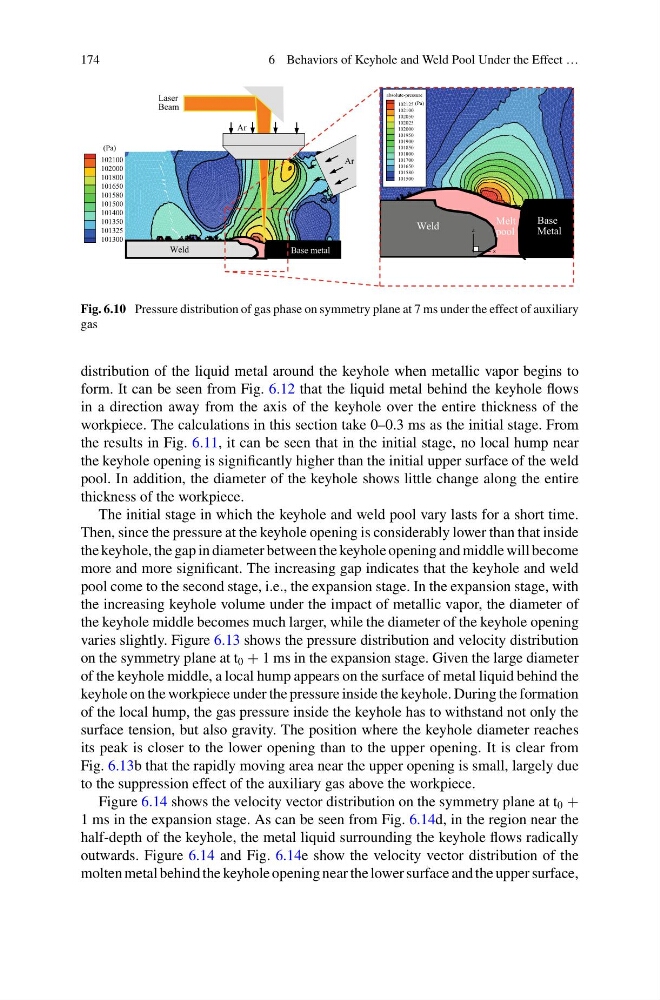
Fig. 6.10 Pressure distribution of gas phase on symmetry plane at 7 ms under the effect of auxiliary
gas
distribution of the liquid metal around the keyhole when metallic vapor begins to
form. It can be seen from Fig. 6.12 that the liquid metal behind the keyhole flows
in a direction away from the axis of the keyhole over the entire thickness of the
workpiece. The calculations in this section take 0–0.3 ms as the initial stage. From
the results in Fig. 6.11, it can be seen that in the initial stage, no local hump near
the keyhole opening is significantly higher than the initial upper surface of the weld
pool. In addition, the diameter of the keyhole shows little change along the entire
thickness of the workpiece.
The initial stage in which the keyhole and weld pool vary lasts for a short time.
Then, since the pressure at the keyhole opening is considerably lower than that inside
the keyhole, the gap in diameter between the keyhole opening and middle will become
more and more significant. The increasing gap indicates that the keyhole and weld
pool come to the second stage, i.e., the expansion stage. In the expansion stage, with
the increasing keyhole volume under the impact of metallic vapor, the diameter of
the keyhole middle becomes much larger, while the diameter of the keyhole opening
varies slightly. Figure 6.13 shows the pressure distribution and velocity distribution
on the symmetry plane at t 0 + 1 ms in the expansion stage. Given the large diameter
of the keyhole middle, a local hump appears on the surface of metal liquid behind the
keyhole on the workpiece under the pressure inside the keyhole. During the formation
of the local hump, the gas pressure inside the keyhole has to withstand not only the
surface tension, but also gravity. The position where the keyhole diameter reaches
its peak is closer to the lower opening than to the upper opening. It is clear from
Fig. 6.13b that the rapidly moving area near the upper opening is small, largely due
to the suppression effect of the auxiliary gas above the workpiece.
Figure 6.14 shows the velocity vector distribution on the symmetry plane at t 0 +
1 ms in the expansion stage. As can be seen from Fig. 6.14d, in the region near the
half-depth of the keyhole, the metal liquid surrounding the keyhole flows radically
outwards. Figure 6.14 and Fig. 6.14e show the velocity vector distribution of the
molten metal behind the keyhole opening near the lower surface and the upper surface,
6 Behaviors of Keyhole and Weld Pool Under the Effect …
Y
X
Z
absolute-pressure
102125
102100
102050
102025
102000
101950
101900
101850
101800
101700
101650
101580
101500
(Pa)
Melt
pool
Weld
Base
Metal
102100
102000
101800
101650
101580
101500
101400
101350
101325
101300
(Pa)
Base metal
Ar
Ar
Laser
Beam
Weld
Fig. 6.10 Pressure distribution of gas phase on symmetry plane at 7 ms under the effect of auxiliary
gas
distribution of the liquid metal around the keyhole when metallic vapor begins to
form. It can be seen from Fig. 6.12 that the liquid metal behind the keyhole flows
in a direction away from the axis of the keyhole over the entire thickness of the
workpiece. The calculations in this section take 0–0.3 ms as the initial stage. From
the results in Fig. 6.11, it can be seen that in the initial stage, no local hump near
the keyhole opening is significantly higher than the initial upper surface of the weld
pool. In addition, the diameter of the keyhole shows little change along the entire
thickness of the workpiece.
The initial stage in which the keyhole and weld pool vary lasts for a short time.
Then, since the pressure at the keyhole opening is considerably lower than that inside
the keyhole, the gap in diameter between the keyhole opening and middle will become
more and more significant. The increasing gap indicates that the keyhole and weld
pool come to the second stage, i.e., the expansion stage. In the expansion stage, with
the increasing keyhole volume under the impact of metallic vapor, the diameter of
the keyhole middle becomes much larger, while the diameter of the keyhole opening
varies slightly. Figure 6.13 shows the pressure distribution and velocity distribution
on the symmetry plane at t 0 + 1 ms in the expansion stage. Given the large diameter
of the keyhole middle, a local hump appears on the surface of metal liquid behind the
keyhole on the workpiece under the pressure inside the keyhole. During the formation
of the local hump, the gas pressure inside the keyhole has to withstand not only the
surface tension, but also gravity. The position where the keyhole diameter reaches
its peak is closer to the lower opening than to the upper opening. It is clear from
Fig. 6.13b that the rapidly moving area near the upper opening is small, largely due
to the suppression effect of the auxiliary gas above the workpiece.
Figure 6.14 shows the velocity vector distribution on the symmetry plane at t 0 +
1 ms in the expansion stage. As can be seen from Fig. 6.14d, in the region near the
half-depth of the keyhole, the metal liquid surrounding the keyhole flows radically
outwards. Figure 6.14 and Fig. 6.14e show the velocity vector distribution of the
molten metal behind the keyhole opening near the lower surface and the upper surface,