

6.2 Flow Field of Side-Blown Shielding Gas (for Titanium Alloy)
169
Fig. 6.5 Velocity
distribution of gas phase on
symmetry plane at t 0 +
0.1 ms in the initial stage
with metallic vapors in the
keyhole considered
area is located near the intersection point between the axis of the “bell jar” and
the surface of the weld pool. The pressure in this area exceeds 101,500 Pa. The
other one is over the keyhole, also with a pressure more than 101,500 Pa. Between
this high-pressure area and keyhole opening, there are two local low-pressure areas
with a pressure smaller than 101,000 Pa. The velocity vector diagram on the side
of gas phase on symmetry plane at t 0 + 0.1 ms presented in Fig. 6.4 shows that the
flow directions of auxiliary gas and metallic vapors suddenly change at the position
indicated by the red dashed line, demonstrating that auxiliary gas flow effectively
suppresses metallic vapors flowing upwards. By comparing Fig. 6.3 with Fig. 6.4,
the local high-pressure area over the keyhole is located above the red dashed line
in Fig. 6.4. It can be observed from Fig. 6.4 that the area below the red dashed
line shows two vortexes on both sides of the axis of the keyhole. In Fig. 6.3, two
local low-pressure areas with pressure lower than 101,000 Pa over the keyhole are
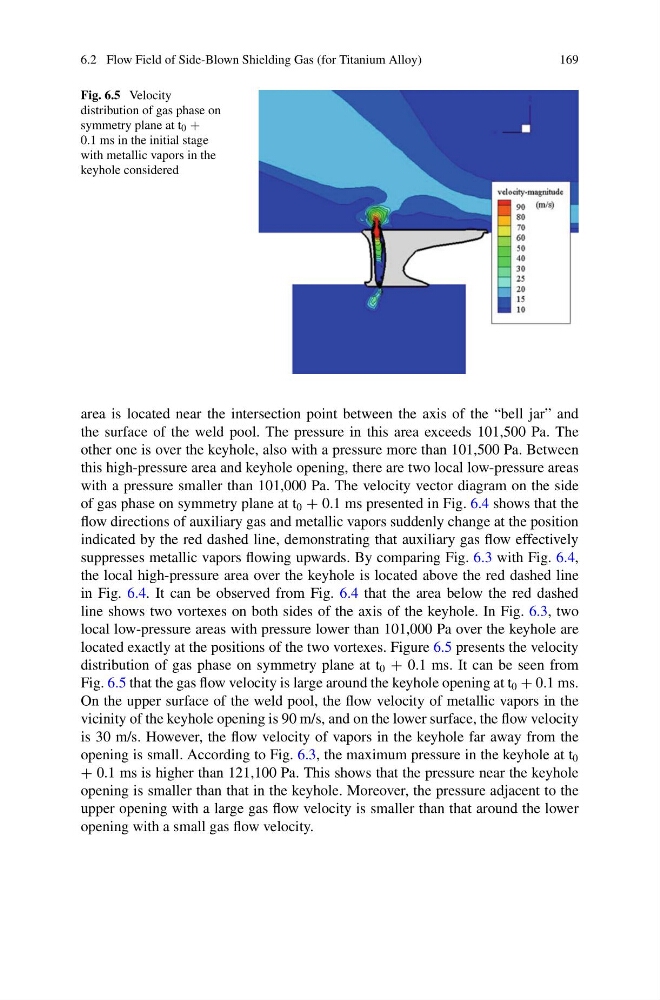
located exactly at the positions of the two vortexes. Figure 6.5 presents the velocity
distribution of gas phase on symmetry plane at t 0 + 0.1 ms. It can be seen from
Fig. 6.5 that the gas flow velocity is large around the keyhole opening at t 0 + 0.1 ms.
On the upper surface of the weld pool, the flow velocity of metallic vapors in the
vicinity of the keyhole opening is 90 m/s, and on the lower surface, the flow velocity
is 30 m/s. However, the flow velocity of vapors in the keyhole far away from the
opening is small. According to Fig. 6.3, the maximum pressure in the keyhole at t 0
+ 0.1 ms is higher than 121,100 Pa. This shows that the pressure near the keyhole
opening is smaller than that in the keyhole. Moreover, the pressure adjacent to the
upper opening with a large gas flow velocity is smaller than that around the lower
opening with a small gas flow velocity.
169
Fig. 6.5 Velocity
distribution of gas phase on
symmetry plane at t 0 +
0.1 ms in the initial stage
with metallic vapors in the
keyhole considered
area is located near the intersection point between the axis of the “bell jar” and
the surface of the weld pool. The pressure in this area exceeds 101,500 Pa. The
other one is over the keyhole, also with a pressure more than 101,500 Pa. Between
this high-pressure area and keyhole opening, there are two local low-pressure areas
with a pressure smaller than 101,000 Pa. The velocity vector diagram on the side
of gas phase on symmetry plane at t 0 + 0.1 ms presented in Fig. 6.4 shows that the
flow directions of auxiliary gas and metallic vapors suddenly change at the position
indicated by the red dashed line, demonstrating that auxiliary gas flow effectively
suppresses metallic vapors flowing upwards. By comparing Fig. 6.3 with Fig. 6.4,
the local high-pressure area over the keyhole is located above the red dashed line
in Fig. 6.4. It can be observed from Fig. 6.4 that the area below the red dashed
line shows two vortexes on both sides of the axis of the keyhole. In Fig. 6.3, two
local low-pressure areas with pressure lower than 101,000 Pa over the keyhole are
located exactly at the positions of the two vortexes. Figure 6.5 presents the velocity
distribution of gas phase on symmetry plane at t 0 + 0.1 ms. It can be seen from
Fig. 6.5 that the gas flow velocity is large around the keyhole opening at t 0 + 0.1 ms.
On the upper surface of the weld pool, the flow velocity of metallic vapors in the
vicinity of the keyhole opening is 90 m/s, and on the lower surface, the flow velocity
is 30 m/s. However, the flow velocity of vapors in the keyhole far away from the
opening is small. According to Fig. 6.3, the maximum pressure in the keyhole at t 0
+ 0.1 ms is higher than 121,100 Pa. This shows that the pressure near the keyhole
opening is smaller than that in the keyhole. Moreover, the pressure adjacent to the
upper opening with a large gas flow velocity is smaller than that around the lower
opening with a small gas flow velocity.