

4.3 Effects of Physical Factors on the Coupling Behavior
127
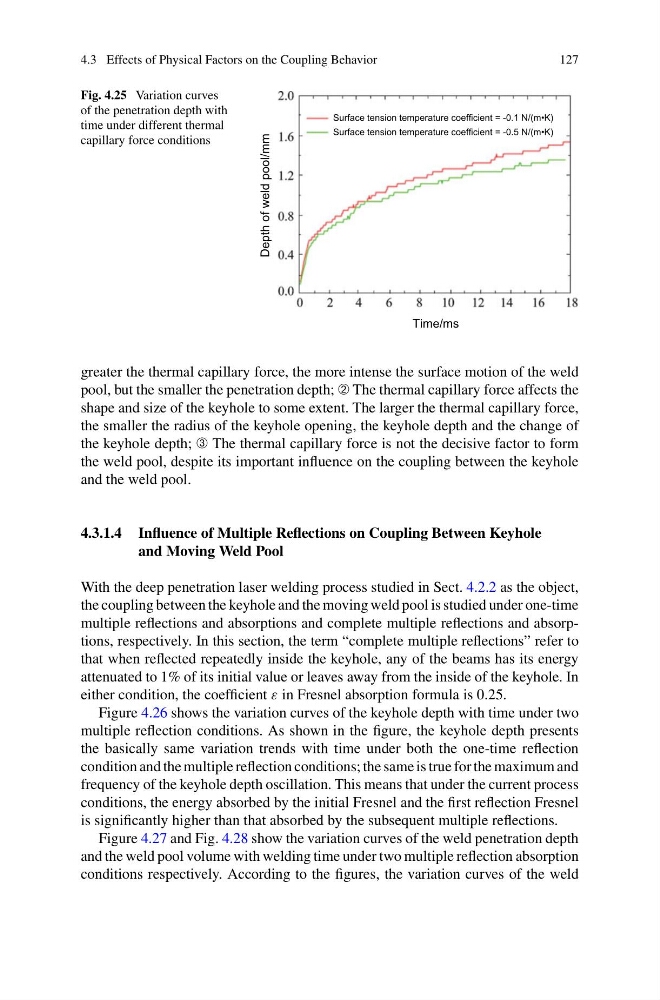
Fig. 4.25 Variation curves
of the penetration depth with
time under different thermal
capillary force conditions
Time/ms
Depth of weld pool/mm
Surface tension temperature coefficient = -0.1 N/(m•K)
Surface tension temperature coefficient = -0.5 N/(m•K)
greater the thermal capillary force, the more intense the surface motion of the weld
pool, but the smaller the penetration depth; ➁ The thermal capillary force affects the
shape and size of the keyhole to some extent. The larger the thermal capillary force,
the smaller the radius of the keyhole opening, the keyhole depth and the change of
the keyhole depth; ➂ The thermal capillary force is not the decisive factor to form
the weld pool, despite its important influence on the coupling between the keyhole
and the weld pool.
4.3.1.4 Influence of Multiple Reflections on Coupling Between Keyhole
and Moving Weld Pool
With the deep penetration laser welding process studied in Sect. 4.2.2 as the object,
the coupling between the keyhole and the moving weld pool is studied under one-time
multiple reflections and absorptions and complete multiple reflections and absorptions, respectively. In this section, the term “complete multiple reflections” refer to
that when reflected repeatedly inside the keyhole, any of the beams has its energy
attenuated to 1% of its initial value or leaves away from the inside of the keyhole. In
either condition, the coefficient ε in Fresnel absorption formula is 0.25.
Figure 4.26 shows the variation curves of the keyhole depth with time under two
multiple reflection conditions. As shown in the figure, the keyhole depth presents
the basically same variation trends with time under both the one-time reflection
condition and the multiple reflection conditions; the same is true for the maximum and
frequency of the keyhole depth oscillation. This means that under the current process
conditions, the energy absorbed by the initial Fresnel and the first reflection Fresnel
is significantly higher than that absorbed by the subsequent multiple reflections.
Figure 4.27 and Fig. 4.28 show the variation curves of the weld penetration depth
and the weld pool volume with welding time under two multiple reflection absorption
conditions respectively. According to the figures, the variation curves of the weld
127
Fig. 4.25 Variation curves
of the penetration depth with
time under different thermal
capillary force conditions
Time/ms
Depth of weld pool/mm
Surface tension temperature coefficient = -0.1 N/(m•K)
Surface tension temperature coefficient = -0.5 N/(m•K)
greater the thermal capillary force, the more intense the surface motion of the weld
pool, but the smaller the penetration depth; ➁ The thermal capillary force affects the
shape and size of the keyhole to some extent. The larger the thermal capillary force,
the smaller the radius of the keyhole opening, the keyhole depth and the change of
the keyhole depth; ➂ The thermal capillary force is not the decisive factor to form
the weld pool, despite its important influence on the coupling between the keyhole
and the weld pool.
4.3.1.4 Influence of Multiple Reflections on Coupling Between Keyhole
and Moving Weld Pool
With the deep penetration laser welding process studied in Sect. 4.2.2 as the object,
the coupling between the keyhole and the moving weld pool is studied under one-time
multiple reflections and absorptions and complete multiple reflections and absorptions, respectively. In this section, the term “complete multiple reflections” refer to
that when reflected repeatedly inside the keyhole, any of the beams has its energy
attenuated to 1% of its initial value or leaves away from the inside of the keyhole. In
either condition, the coefficient ε in Fresnel absorption formula is 0.25.
Figure 4.26 shows the variation curves of the keyhole depth with time under two
multiple reflection conditions. As shown in the figure, the keyhole depth presents
the basically same variation trends with time under both the one-time reflection
condition and the multiple reflection conditions; the same is true for the maximum and
frequency of the keyhole depth oscillation. This means that under the current process
conditions, the energy absorbed by the initial Fresnel and the first reflection Fresnel
is significantly higher than that absorbed by the subsequent multiple reflections.
Figure 4.27 and Fig. 4.28 show the variation curves of the weld penetration depth
and the weld pool volume with welding time under two multiple reflection absorption
conditions respectively. According to the figures, the variation curves of the weld