

4.3 Effects of Physical Factors on the Coupling Behavior
125
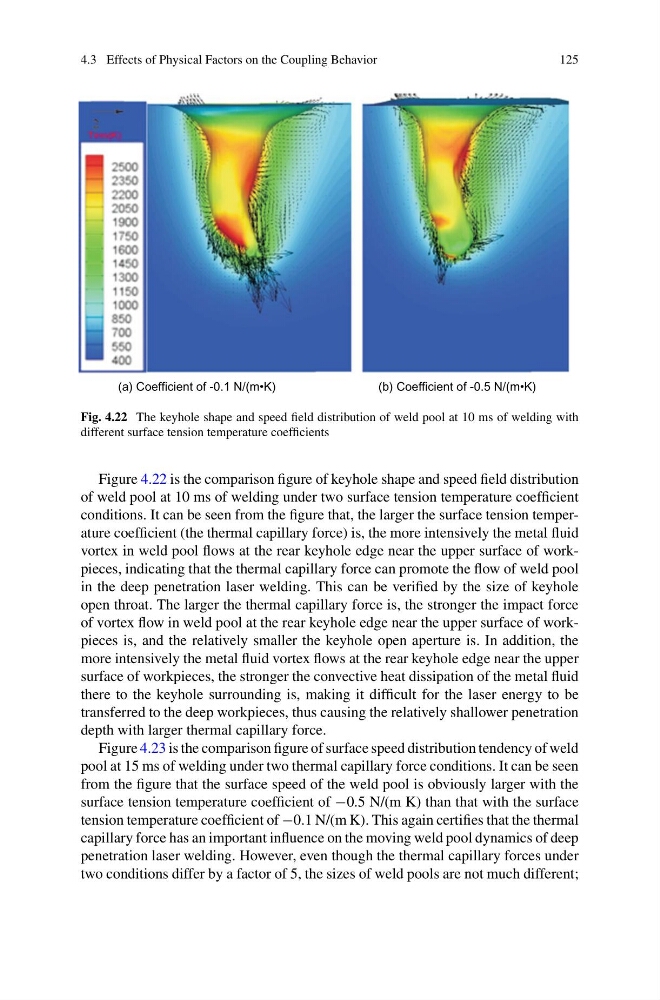
(a) Coefficient of -0.1 N/(m•K)
(b) Coefficient of -0.5 N/(m•K)
Fig. 4.22 The keyhole shape and speed field distribution of weld pool at 10 ms of welding with
different surface tension temperature coefficients
Figure 4.22 is the comparison figure of keyhole shape and speed field distribution
of weld pool at 10 ms of welding under two surface tension temperature coefficient
conditions. It can be seen from the figure that, the larger the surface tension temperature coefficient (the thermal capillary force) is, the more intensively the metal fluid
vortex in weld pool flows at the rear keyhole edge near the upper surface of workpieces, indicating that the thermal capillary force can promote the flow of weld pool
in the deep penetration laser welding. This can be verified by the size of keyhole
open throat. The larger the thermal capillary force is, the stronger the impact force
of vortex flow in weld pool at the rear keyhole edge near the upper surface of workpieces is, and the relatively smaller the keyhole open aperture is. In addition, the
more intensively the metal fluid vortex flows at the rear keyhole edge near the upper
surface of workpieces, the stronger the convective heat dissipation of the metal fluid
there to the keyhole surrounding is, making it difficult for the laser energy to be
transferred to the deep workpieces, thus causing the relatively shallower penetration
depth with larger thermal capillary force.
Figure 4.23 is the comparison figure of surface speed distribution tendency of weld
pool at 15 ms of welding under two thermal capillary force conditions. It can be seen
from the figure that the surface speed of the weld pool is obviously larger with the
surface tension temperature coefficient of −0.5 N/(m K) than that with the surface
tension temperature coefficient of −0.1 N/(m K). This again certifies that the thermal
capillary force has an important influence on the moving weld pool dynamics of deep
penetration laser welding. However, even though the thermal capillary forces under
two conditions differ by a factor of 5, the sizes of weld pools are not much different;
125
(a) Coefficient of -0.1 N/(m•K)
(b) Coefficient of -0.5 N/(m•K)
Fig. 4.22 The keyhole shape and speed field distribution of weld pool at 10 ms of welding with
different surface tension temperature coefficients
Figure 4.22 is the comparison figure of keyhole shape and speed field distribution
of weld pool at 10 ms of welding under two surface tension temperature coefficient
conditions. It can be seen from the figure that, the larger the surface tension temperature coefficient (the thermal capillary force) is, the more intensively the metal fluid
vortex in weld pool flows at the rear keyhole edge near the upper surface of workpieces, indicating that the thermal capillary force can promote the flow of weld pool
in the deep penetration laser welding. This can be verified by the size of keyhole
open throat. The larger the thermal capillary force is, the stronger the impact force
of vortex flow in weld pool at the rear keyhole edge near the upper surface of workpieces is, and the relatively smaller the keyhole open aperture is. In addition, the
more intensively the metal fluid vortex flows at the rear keyhole edge near the upper
surface of workpieces, the stronger the convective heat dissipation of the metal fluid
there to the keyhole surrounding is, making it difficult for the laser energy to be
transferred to the deep workpieces, thus causing the relatively shallower penetration
depth with larger thermal capillary force.
Figure 4.23 is the comparison figure of surface speed distribution tendency of weld
pool at 15 ms of welding under two thermal capillary force conditions. It can be seen
from the figure that the surface speed of the weld pool is obviously larger with the
surface tension temperature coefficient of −0.5 N/(m K) than that with the surface
tension temperature coefficient of −0.1 N/(m K). This again certifies that the thermal
capillary force has an important influence on the moving weld pool dynamics of deep
penetration laser welding. However, even though the thermal capillary forces under
two conditions differ by a factor of 5, the sizes of weld pools are not much different;