

104
3 Coupling Model and Numerical Computation Method of Keyhole and Weld Pool
Save and exit
End of calculation
Process the velocity boundary conditions
of the free interface and update the Level
Set function
Identify the flow area, process boundary
conditions such as recoil pressure, and
solve the flow field
Discretely solve the temperature field,
and process the latent heat and other
energy boundary conditions
Calculate the Energy density distribution
on the free surface by ray tracing
Initialize the speed, pressure,
temperature and Level Set function of
the free surface
Yes
No
Update the time step
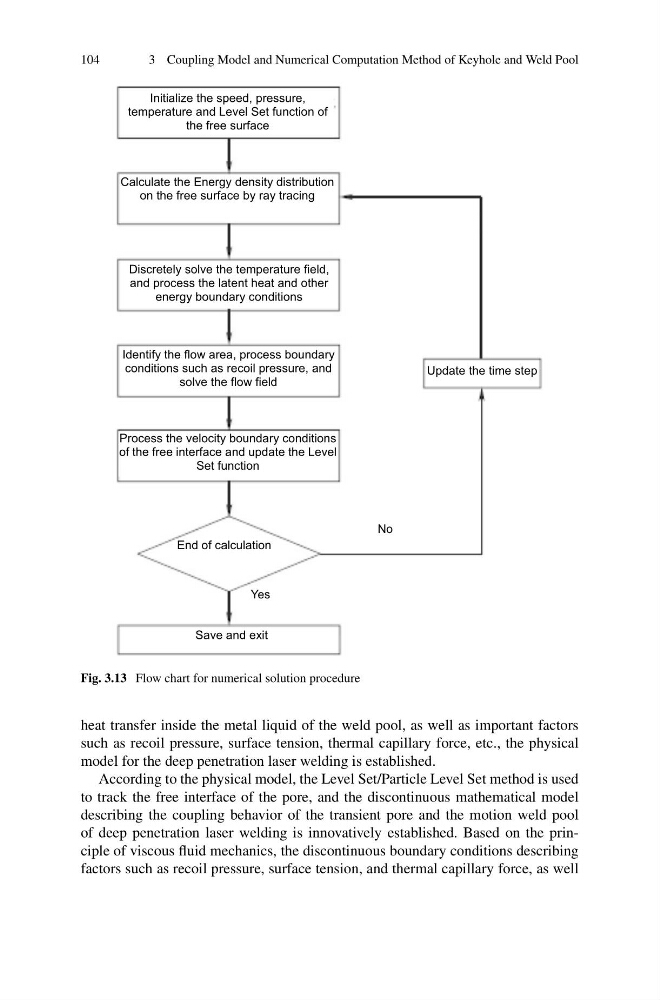
Fig. 3.13 Flow chart for numerical solution procedure
heat transfer inside the metal liquid of the weld pool, as well as important factors
such as recoil pressure, surface tension, thermal capillary force, etc., the physical
model for the deep penetration laser welding is established.
According to the physical model, the Level Set/Particle Level Set method is used
to track the free interface of the pore, and the discontinuous mathematical model
describing the coupling behavior of the transient pore and the motion weld pool
of deep penetration laser welding is innovatively established. Based on the principle of viscous fluid mechanics, the discontinuous boundary conditions describing
factors such as recoil pressure, surface tension, and thermal capillary force, as well
3 Coupling Model and Numerical Computation Method of Keyhole and Weld Pool
Save and exit
End of calculation
Process the velocity boundary conditions
of the free interface and update the Level
Set function
Identify the flow area, process boundary
conditions such as recoil pressure, and
solve the flow field
Discretely solve the temperature field,
and process the latent heat and other
energy boundary conditions
Calculate the Energy density distribution
on the free surface by ray tracing
Initialize the speed, pressure,
temperature and Level Set function of
the free surface
Yes
No
Update the time step
Fig. 3.13 Flow chart for numerical solution procedure
heat transfer inside the metal liquid of the weld pool, as well as important factors
such as recoil pressure, surface tension, thermal capillary force, etc., the physical
model for the deep penetration laser welding is established.
According to the physical model, the Level Set/Particle Level Set method is used
to track the free interface of the pore, and the discontinuous mathematical model
describing the coupling behavior of the transient pore and the motion weld pool
of deep penetration laser welding is innovatively established. Based on the principle of viscous fluid mechanics, the discontinuous boundary conditions describing
factors such as recoil pressure, surface tension, and thermal capillary force, as well