

3.5 Numerical Method
97
and the radius of the sphere is defined to be 30 unit lengths, the width and depth of
the notch are respectively 5 unit lengths and 55 unit lengths. Assuming that there is
a three-dimensional flow field in the calculation space as follows:
u(x, y, z) = π(50 − y)/314
v(x, y, z) = π(x − 50)/314
w(x, y, z) = 0
(3.98)
Due to the effect of convection speed, the sphere will rotate in the flow field.
For the sphere is rigid, the shape of it ideally will not change, but as a matter of
fact, the sharp corner of the notched sphere may be severely rounded due to the
influence of numerical dissipation. In the numerical test, with the calculation grid
equal to 1 unit length, the interface of the Zalesak sphere is tracked using the Level Set
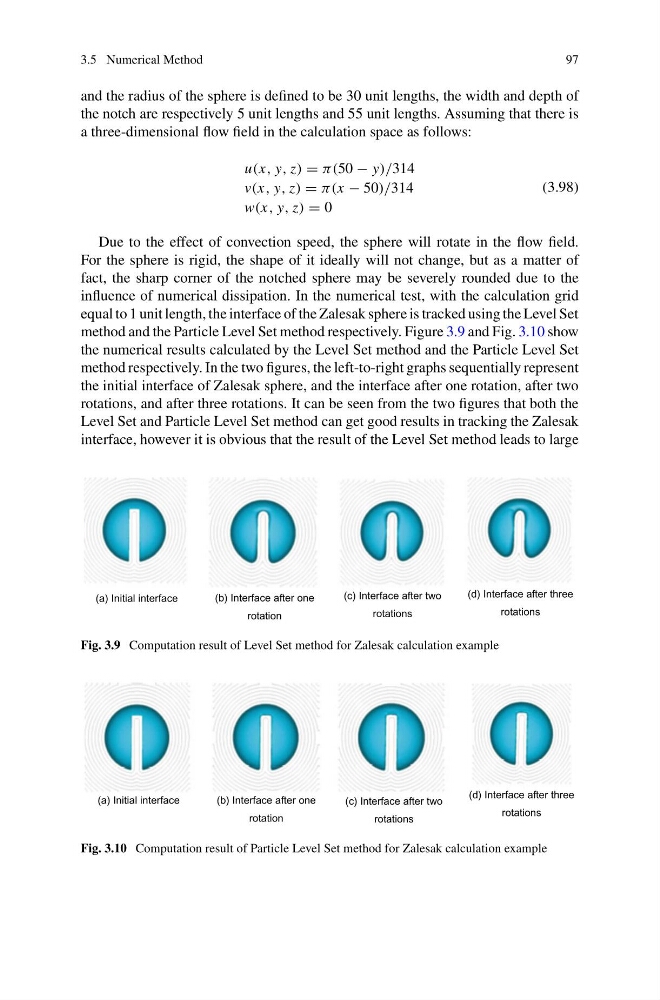
method and the Particle Level Set method respectively. Figure 3.9 and Fig. 3.10 show
the numerical results calculated by the Level Set method and the Particle Level Set
method respectively. In the two figures, the left-to-right graphs sequentially represent
the initial interface of Zalesak sphere, and the interface after one rotation, after two
rotations, and after three rotations. It can be seen from the two figures that both the
Level Set and Particle Level Set method can get good results in tracking the Zalesak
interface, however it is obvious that the result of the Level Set method leads to large
(a) Initial interface
(b) Interface after one
rotation
(c) Interface after two
rotations
(d) Interface after three
rotations
Fig. 3.9 Computation result of Level Set method for Zalesak calculation example
(a) Initial interface
(b) Interface after one
rotation
(c) Interface after two
rotations
(d) Interface after three
rotations
Fig. 3.10 Computation result of Particle Level Set method for Zalesak calculation example
97
and the radius of the sphere is defined to be 30 unit lengths, the width and depth of
the notch are respectively 5 unit lengths and 55 unit lengths. Assuming that there is
a three-dimensional flow field in the calculation space as follows:
u(x, y, z) = π(50 − y)/314
v(x, y, z) = π(x − 50)/314
w(x, y, z) = 0
(3.98)
Due to the effect of convection speed, the sphere will rotate in the flow field.
For the sphere is rigid, the shape of it ideally will not change, but as a matter of
fact, the sharp corner of the notched sphere may be severely rounded due to the
influence of numerical dissipation. In the numerical test, with the calculation grid
equal to 1 unit length, the interface of the Zalesak sphere is tracked using the Level Set
method and the Particle Level Set method respectively. Figure 3.9 and Fig. 3.10 show
the numerical results calculated by the Level Set method and the Particle Level Set
method respectively. In the two figures, the left-to-right graphs sequentially represent
the initial interface of Zalesak sphere, and the interface after one rotation, after two
rotations, and after three rotations. It can be seen from the two figures that both the
Level Set and Particle Level Set method can get good results in tracking the Zalesak
interface, however it is obvious that the result of the Level Set method leads to large
(a) Initial interface
(b) Interface after one
rotation
(c) Interface after two
rotations
(d) Interface after three
rotations
Fig. 3.9 Computation result of Level Set method for Zalesak calculation example
(a) Initial interface
(b) Interface after one
rotation
(c) Interface after two
rotations
(d) Interface after three
rotations
Fig. 3.10 Computation result of Particle Level Set method for Zalesak calculation example