

90
3 Coupling Model and Numerical Computation Method of Keyhole and Weld Pool
appropriately enhance the numerical dissipation of approximate solution; conversely,
when the discrete approximate solution is relatively flat, the TVD scheme can reduce
the numerical dissipation and obtain an accurate discontinuous solution.
At present, the Runge–Kutta WENO scheme, a TVD scheme that has third-order
accuracy in time and fifth-order accuracy in space, is an effective high-precision
calculation scheme to solve the Level Set equation. This is also the main scheme for
the discrete convection equations used in this section. The following is a detailed
introduction of the discrete process of the Level Set formula using the high-precision
TVD Runge–Kutta WENO scheme.
A fifth-order WENO scheme discrete
∂φ
∂ x
is taken as an example to illustrate
the discrete process of the convective term in the Level Set equation. For the
node of (i, j, k), the direction of the velocity value at the current node position
should be determined first in the discrete process. With the idea of the upwind
scheme, the left-hand derivative φ
−
x and the right-hand derivative φ
+
x of space are
respectively taken according to the different directions. For the node of (i, j, k),
its left-hand derivative φ
−
x is made of the node template interpolation composed
of the following 6 nodes
φ i−3, j,k , φ i−2, j,k , φ i−1, j,k , φ i, j,k , φ i+1, j,k , φ i+2, j,k
,
while the right-hand derivative φ
−
x
is calculated by the node template
φ i−2, j,k , φ i−1, j,k , φ i, j,k , φ i+1, j,k , φ i+2, j,k , φ i+3, j,k
. Assuming that the computing
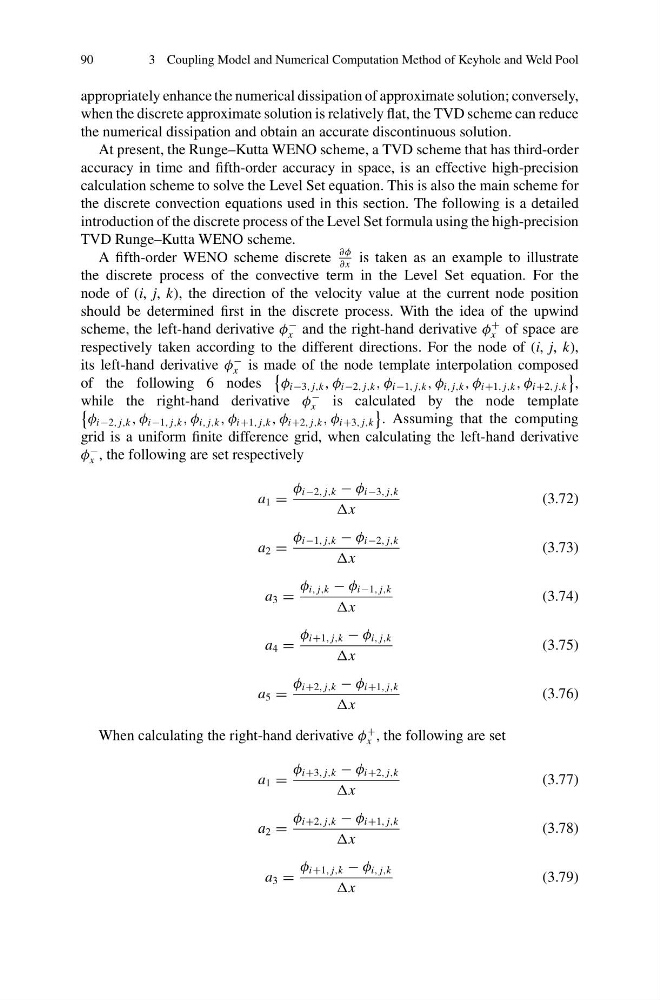
grid is a uniform finite difference grid, when calculating the left-hand derivative
φ
−
x , the following are set respectively
a 1 =
φ i−2, j,k − φ i−3, j,k
x
(3.72)
a 2 =
φ i−1, j,k − φ i−2, j,k
x
(3.73)
a 3 =
φ i, j,k − φ i−1, j,k
x
(3.74)
a 4 =
φ i+1, j,k − φ i, j,k
x
(3.75)
a 5 =
φ i+2, j,k − φ i+1, j,k
x
(3.76)
When calculating the right-hand derivative φ
+
x , the following are set
a 1 =
φ i+3, j,k − φ i+2, j,k
x
(3.77)
a 2 =
φ i+2, j,k − φ i+1, j,k
x
(3.78)
a 3 =
φ i+1, j,k − φ i, j,k
x
(3.79)
3 Coupling Model and Numerical Computation Method of Keyhole and Weld Pool
appropriately enhance the numerical dissipation of approximate solution; conversely,
when the discrete approximate solution is relatively flat, the TVD scheme can reduce
the numerical dissipation and obtain an accurate discontinuous solution.
At present, the Runge–Kutta WENO scheme, a TVD scheme that has third-order
accuracy in time and fifth-order accuracy in space, is an effective high-precision
calculation scheme to solve the Level Set equation. This is also the main scheme for
the discrete convection equations used in this section. The following is a detailed
introduction of the discrete process of the Level Set formula using the high-precision
TVD Runge–Kutta WENO scheme.
A fifth-order WENO scheme discrete
∂φ
∂ x
is taken as an example to illustrate
the discrete process of the convective term in the Level Set equation. For the
node of (i, j, k), the direction of the velocity value at the current node position
should be determined first in the discrete process. With the idea of the upwind
scheme, the left-hand derivative φ
−
x and the right-hand derivative φ
+
x of space are
respectively taken according to the different directions. For the node of (i, j, k),
its left-hand derivative φ
−
x is made of the node template interpolation composed
of the following 6 nodes
φ i−3, j,k , φ i−2, j,k , φ i−1, j,k , φ i, j,k , φ i+1, j,k , φ i+2, j,k
,
while the right-hand derivative φ
−
x
is calculated by the node template
φ i−2, j,k , φ i−1, j,k , φ i, j,k , φ i+1, j,k , φ i+2, j,k , φ i+3, j,k
. Assuming that the computing
grid is a uniform finite difference grid, when calculating the left-hand derivative
φ
−
x , the following are set respectively
a 1 =
φ i−2, j,k − φ i−3, j,k
x
(3.72)
a 2 =
φ i−1, j,k − φ i−2, j,k
x
(3.73)
a 3 =
φ i, j,k − φ i−1, j,k
x
(3.74)
a 4 =
φ i+1, j,k − φ i, j,k
x
(3.75)
a 5 =
φ i+2, j,k − φ i+1, j,k
x
(3.76)
When calculating the right-hand derivative φ
+
x , the following are set
a 1 =
φ i+3, j,k − φ i+2, j,k
x
(3.77)
a 2 =
φ i+2, j,k − φ i+1, j,k
x
(3.78)
a 3 =
φ i+1, j,k − φ i, j,k
x
(3.79)