

3.5 Eddy-Current Detection of Prepreg FAWT
69
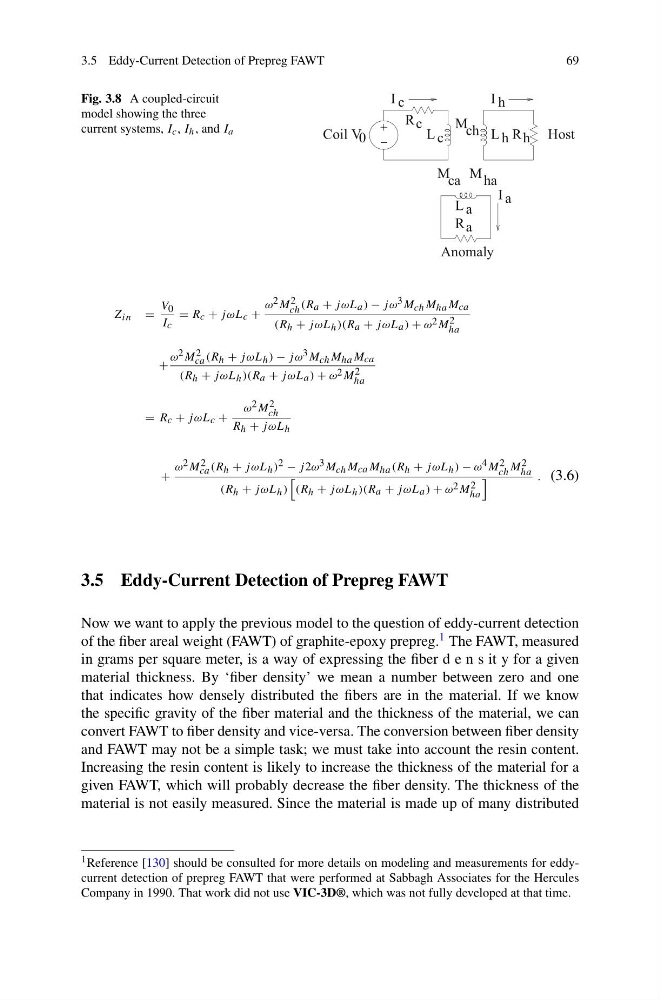
Fig. 3.8 A coupled-circuit
model showing the three
current systems, I c , I h , and I a
+
−
R c
L c
L h
ch
M
R h Host
c
I
I h
L a
R a
a
I
0
Coil V
Anomaly
M ca M ha
Z in =
V 0
I c
= R c + jωL c +
ω 2 M 2
ch (R a + jωL a ) − jω 3 M ch M ha M ca
(R h + jωL h )(R a + jωL a ) + ω 2 M 2
ha
+
ω 2 M 2
ca (R h + jωL h ) − jω 3 M ch M ha M ca
(R h + jωL h )(R a + jωL a ) + ω 2 M 2
ha
= R c + jωL c +
ω 2 M 2
ch
R h + jωL h
+
ω 2 M 2
ca (R h + jωL h ) 2 − j 2ω 3 M ch M ca M ha (R h + jωL h ) − ω 4 M 2
ch M 2
ha
(R h + jωL h )
(R h + jωL h )(R a + jωL a ) + ω 2 M 2
ha
. (3.6)
3.5 Eddy-Current Detection of Prepreg FAWT
Now we want to apply the previous model to the question of eddy-current detection
of the fiber areal weight (FAWT) of graphite-epoxy prepreg. 1 The FAWT, measured
in grams per square meter, is a way of expressing the fiber d e n s it y for a given
material thickness. By ‘fiber density’ we mean a number between zero and one
that indicates how densely distributed the fibers are in the material. If we know
the specific gravity of the fiber material and the thickness of the material, we can
convert FAWT to fiber density and vice-versa. The conversion between fiber density
and FAWT may not be a simple task; we must take into account the resin content.
Increasing the resin content is likely to increase the thickness of the material for a
given FAWT, which will probably decrease the fiber density. The thickness of the
material is not easily measured. Since the material is made up of many distributed
1 Reference [130] should be consulted for more details on modeling and measurements for eddycurrent detection of prepreg FAWT that were performed at Sabbagh Associates for the Hercules
Company in 1990. That work did not use VIC-3D®, which was not fully developed at that time.
69
Fig. 3.8 A coupled-circuit
model showing the three
current systems, I c , I h , and I a
+
−
R c
L c
L h
ch
M
R h Host
c
I
I h
L a
R a
a
I
0
Coil V
Anomaly
M ca M ha
Z in =
V 0
I c
= R c + jωL c +
ω 2 M 2
ch (R a + jωL a ) − jω 3 M ch M ha M ca
(R h + jωL h )(R a + jωL a ) + ω 2 M 2
ha
+
ω 2 M 2
ca (R h + jωL h ) − jω 3 M ch M ha M ca
(R h + jωL h )(R a + jωL a ) + ω 2 M 2
ha
= R c + jωL c +
ω 2 M 2
ch
R h + jωL h
+
ω 2 M 2
ca (R h + jωL h ) 2 − j 2ω 3 M ch M ca M ha (R h + jωL h ) − ω 4 M 2
ch M 2
ha
(R h + jωL h )
(R h + jωL h )(R a + jωL a ) + ω 2 M 2
ha
. (3.6)
3.5 Eddy-Current Detection of Prepreg FAWT
Now we want to apply the previous model to the question of eddy-current detection
of the fiber areal weight (FAWT) of graphite-epoxy prepreg. 1 The FAWT, measured
in grams per square meter, is a way of expressing the fiber d e n s it y for a given
material thickness. By ‘fiber density’ we mean a number between zero and one
that indicates how densely distributed the fibers are in the material. If we know
the specific gravity of the fiber material and the thickness of the material, we can
convert FAWT to fiber density and vice-versa. The conversion between fiber density
and FAWT may not be a simple task; we must take into account the resin content.
Increasing the resin content is likely to increase the thickness of the material for a
given FAWT, which will probably decrease the fiber density. The thickness of the
material is not easily measured. Since the material is made up of many distributed
1 Reference [130] should be consulted for more details on modeling and measurements for eddycurrent detection of prepreg FAWT that were performed at Sabbagh Associates for the Hercules
Company in 1990. That work did not use VIC-3D®, which was not fully developed at that time.