

3.3 Example Calculations Using VIC-3D®
63
0
20
40
60
80
100
120
140
0
0.1 0.2 0.3 0.4 0.5 0.6 0.7 0.8 0.9
1
R(Ohms)
Frequency (MHz)
Frequency Response of Layered Composite Structure
0 degrees
90 degrees
-400
-350
-300
-250
-200
-150
-100
-50
0
0
0.1 0.2 0.3 0.4 0.5 0.6 0.7 0.8 0.9
1
X(Ohms)
Frequency (MHz)
Frequency Response of Layered Composite Structure
0 degrees
90 degrees
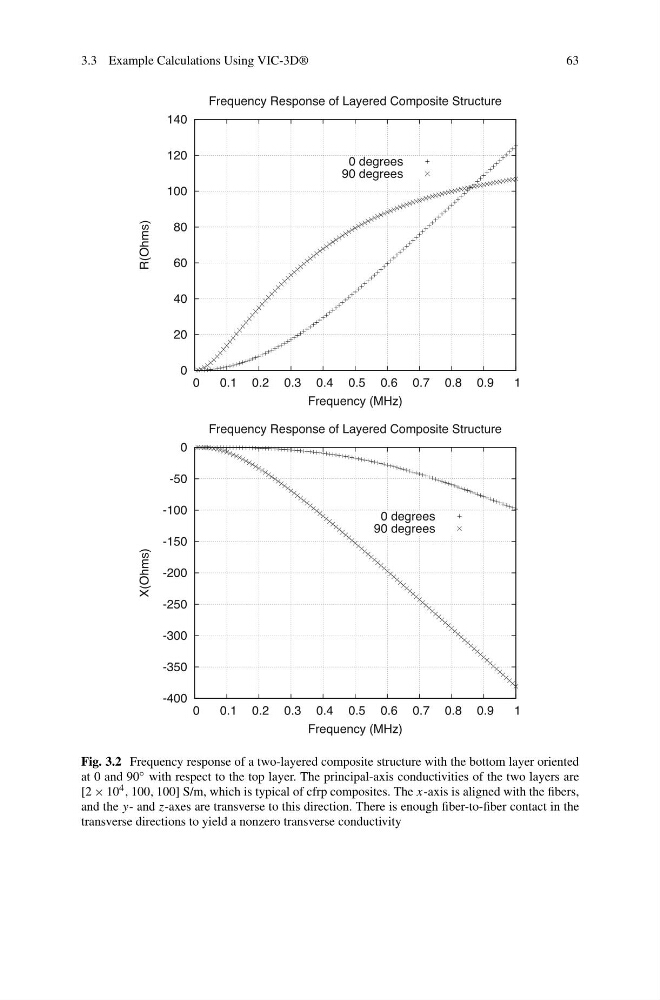
Fig. 3.2 Frequency response of a two-layered composite structure with the bottom layer oriented
at 0 and 90 ◦ with respect to the top layer. The principal-axis conductivities of the two layers are
[2 × 10 4 , 100, 100] S/m, which is typical of cfrp composites. The x-axis is aligned with the fibers,
and the y- and z-axes are transverse to this direction. There is enough fiber-to-fiber contact in the
transverse directions to yield a nonzero transverse conductivity
63
0
20
40
60
80
100
120
140
0
0.1 0.2 0.3 0.4 0.5 0.6 0.7 0.8 0.9
1
R(Ohms)
Frequency (MHz)
Frequency Response of Layered Composite Structure
0 degrees
90 degrees
-400
-350
-300
-250
-200
-150
-100
-50
0
0
0.1 0.2 0.3 0.4 0.5 0.6 0.7 0.8 0.9
1
X(Ohms)
Frequency (MHz)
Frequency Response of Layered Composite Structure
0 degrees
90 degrees
Fig. 3.2 Frequency response of a two-layered composite structure with the bottom layer oriented
at 0 and 90 ◦ with respect to the top layer. The principal-axis conductivities of the two layers are
[2 × 10 4 , 100, 100] S/m, which is typical of cfrp composites. The x-axis is aligned with the fibers,
and the y- and z-axes are transverse to this direction. There is enough fiber-to-fiber contact in the
transverse directions to yield a nonzero transverse conductivity