

2.6 Application to Aircraft Structures
49
0.01
0.1
1
10
-1 -0.8 -0.6 -0.4 -0.2 0 0.2 0.4 0.6 0.8 1
Scale (S)
Normalized anomalous conductivity
Convergence of estimates for cell 86
without forced zeros
with forced zeros
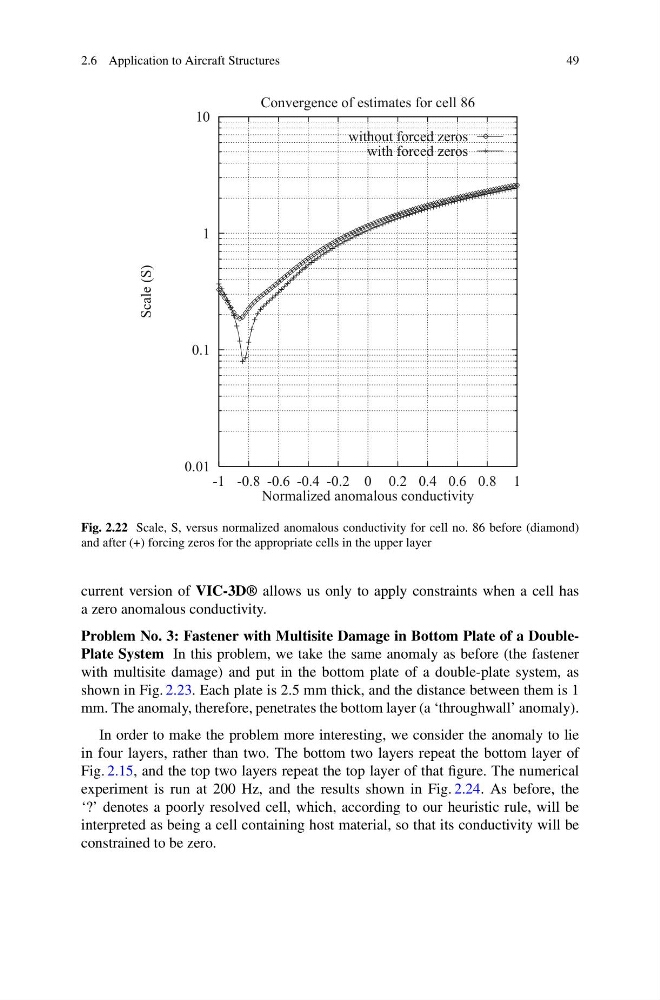
Fig. 2.22 Scale, S, versus normalized anomalous conductivity for cell no. 86 before (diamond)
and after (+) forcing zeros for the appropriate cells in the upper layer
current version of VIC-3D® allows us only to apply constraints when a cell has
a zero anomalous conductivity.
Problem No. 3: Fastener with Multisite Damage in Bottom Plate of a DoublePlate System In this problem, we take the same anomaly as before (the fastener
with multisite damage) and put in the bottom plate of a double-plate system, as
shown in Fig. 2.23. Each plate is 2.5 mm thick, and the distance between them is 1
mm. The anomaly, therefore, penetrates the bottom layer (a ‘throughwall’ anomaly).
In order to make the problem more interesting, we consider the anomaly to lie
in four layers, rather than two. The bottom two layers repeat the bottom layer of
Fig. 2.15, and the top two layers repeat the top layer of that figure. The numerical
experiment is run at 200 Hz, and the results shown in Fig. 2.24. As before, the
‘?’ denotes a poorly resolved cell, which, according to our heuristic rule, will be
interpreted as being a cell containing host material, so that its conductivity will be
constrained to be zero.
49
0.01
0.1
1
10
-1 -0.8 -0.6 -0.4 -0.2 0 0.2 0.4 0.6 0.8 1
Scale (S)
Normalized anomalous conductivity
Convergence of estimates for cell 86
without forced zeros
with forced zeros
Fig. 2.22 Scale, S, versus normalized anomalous conductivity for cell no. 86 before (diamond)
and after (+) forcing zeros for the appropriate cells in the upper layer
current version of VIC-3D® allows us only to apply constraints when a cell has
a zero anomalous conductivity.
Problem No. 3: Fastener with Multisite Damage in Bottom Plate of a DoublePlate System In this problem, we take the same anomaly as before (the fastener
with multisite damage) and put in the bottom plate of a double-plate system, as
shown in Fig. 2.23. Each plate is 2.5 mm thick, and the distance between them is 1
mm. The anomaly, therefore, penetrates the bottom layer (a ‘throughwall’ anomaly).
In order to make the problem more interesting, we consider the anomaly to lie
in four layers, rather than two. The bottom two layers repeat the bottom layer of
Fig. 2.15, and the top two layers repeat the top layer of that figure. The numerical
experiment is run at 200 Hz, and the results shown in Fig. 2.24. As before, the
‘?’ denotes a poorly resolved cell, which, according to our heuristic rule, will be
interpreted as being a cell containing host material, so that its conductivity will be
constrained to be zero.