

12.8 Inverse Problems
337
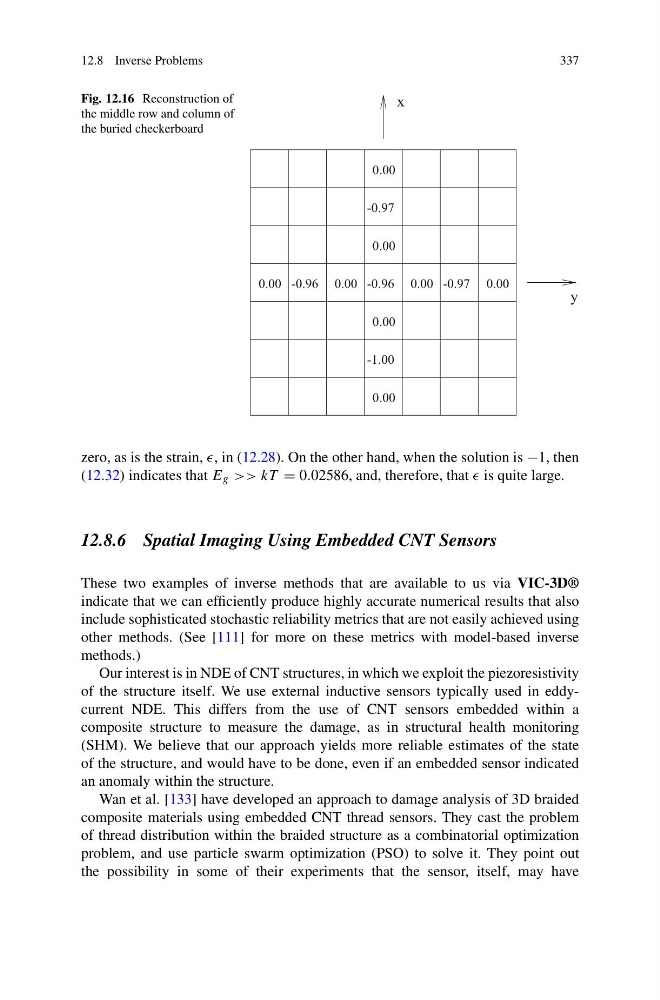
Fig. 12.16 Reconstruction of
the middle row and column of
the buried checkerboard
y
x
-0.97
-0.97
-0.96
-0.96
0.00
0.00
0.00
0.00
-1.00
0.00
0.00
0.00
0.00
zero, as is the strain, , in (12.28). On the other hand, when the solution is −1, then
(12.32) indicates that E g >> kT = 0.02586, and, therefore, that is quite large.
12.8.6 Spatial Imaging Using Embedded CNT Sensors
These two examples of inverse methods that are available to us via VIC-3D®
indicate that we can efficiently produce highly accurate numerical results that also
include sophisticated stochastic reliability metrics that are not easily achieved using
other methods. (See [111] for more on these metrics with model-based inverse
methods.)
Our interest is in NDE of CNT structures, in which we exploit the piezoresistivity
of the structure itself. We use external inductive sensors typically used in eddycurrent NDE. This differs from the use of CNT sensors embedded within a
composite structure to measure the damage, as in structural health monitoring
(SHM). We believe that our approach yields more reliable estimates of the state
of the structure, and would have to be done, even if an embedded sensor indicated
an anomaly within the structure.
Wan et al. [133] have developed an approach to damage analysis of 3D braided
composite materials using embedded CNT thread sensors. They cast the problem
of thread distribution within the braided structure as a combinatorial optimization
problem, and use particle swarm optimization (PSO) to solve it. They point out
the possibility in some of their experiments that the sensor, itself, may have
337
Fig. 12.16 Reconstruction of
the middle row and column of
the buried checkerboard
y
x
-0.97
-0.97
-0.96
-0.96
0.00
0.00
0.00
0.00
-1.00
0.00
0.00
0.00
0.00
zero, as is the strain, , in (12.28). On the other hand, when the solution is −1, then
(12.32) indicates that E g >> kT = 0.02586, and, therefore, that is quite large.
12.8.6 Spatial Imaging Using Embedded CNT Sensors
These two examples of inverse methods that are available to us via VIC-3D®
indicate that we can efficiently produce highly accurate numerical results that also
include sophisticated stochastic reliability metrics that are not easily achieved using
other methods. (See [111] for more on these metrics with model-based inverse
methods.)
Our interest is in NDE of CNT structures, in which we exploit the piezoresistivity
of the structure itself. We use external inductive sensors typically used in eddycurrent NDE. This differs from the use of CNT sensors embedded within a
composite structure to measure the damage, as in structural health monitoring
(SHM). We believe that our approach yields more reliable estimates of the state
of the structure, and would have to be done, even if an embedded sensor indicated
an anomaly within the structure.
Wan et al. [133] have developed an approach to damage analysis of 3D braided
composite materials using embedded CNT thread sensors. They cast the problem
of thread distribution within the braided structure as a combinatorial optimization
problem, and use particle swarm optimization (PSO) to solve it. They point out
the possibility in some of their experiments that the sensor, itself, may have