

12.7 Modeling Paramagnetic Effects in Carbon Nanotubes
325
j/ ¯
h
1 − j (ω 0jk − ω)τ jk
−
j/ ¯
h
1 + j (ω 0jk + ω)τ jk
He
jωt
+
−j/ ¯
h
1+j (ω 0jk −ω)τ jk
−
−j/ ¯
h
1−j (ω 0jk +ω)τ jk
H
∗ e
−jωt
, (12.12)
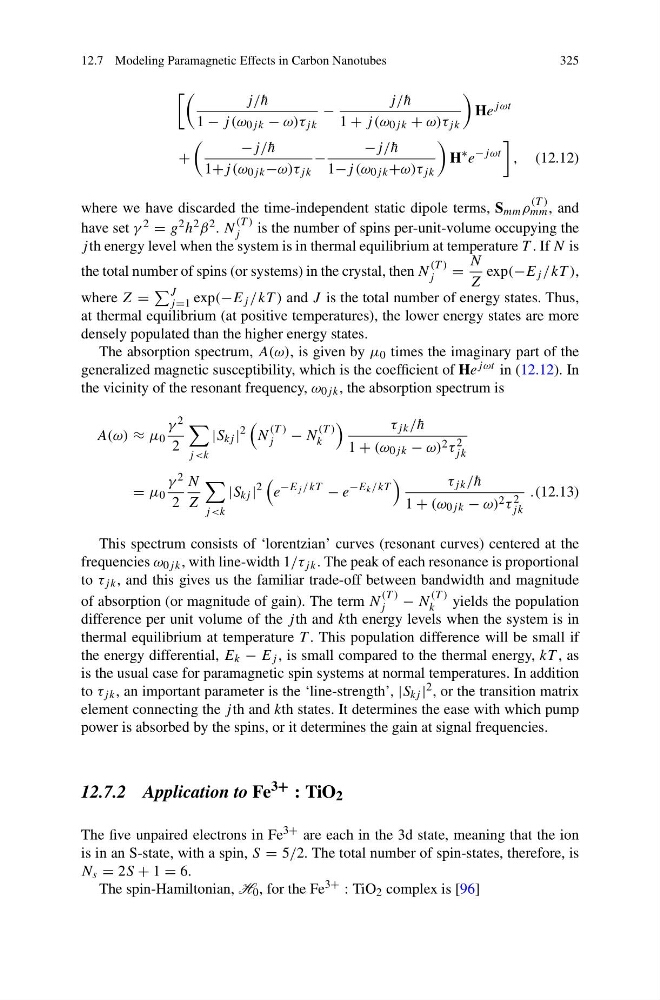
where we have discarded the time-independent static dipole terms, S mm ρ
(T )
mm , and
have set γ 2 = g 2 h 2 β 2 . N
(T )
j
is the number of spins per-unit-volume occupying the
j th energy level when the system is in thermal equilibrium at temperature T . If N is
the total number of spins (or systems) in the crystal, then N
(T )
j
=
N
Z
exp(−E j /kT ),
where Z =
J
j =1 exp(−E j /kT ) and J is the total number of energy states. Thus,
at thermal equilibrium (at positive temperatures), the lower energy states are more
densely populated than the higher energy states.
The absorption spectrum, A(ω), is given by μ 0 times the imaginary part of the
generalized magnetic susceptibility, which is the coefficient of He jωt in (12.12). In
the vicinity of the resonant frequency, ω 0jk , the absorption spectrum is
A(ω) ≈ μ 0
γ 2
2
j
2
N
(T )
j
− N
(T )
k
τ jk / ¯
h
1 + (ω 0jk − ω) 2 τ 2
jk
= μ 0
γ 2
2
N
Z
j
2
e
−E j /kT
− e
−E k /kT
τ jk / ¯
h
1 + (ω 0jk − ω) 2 τ 2
jk
. (12.13)
This spectrum consists of ‘lorentzian’ curves (resonant curves) centered at the
frequencies ω 0jk , with line-width 1/τ jk . The peak of each resonance is proportional
to τ jk , and this gives us the familiar trade-off between bandwidth and magnitude
of absorption (or magnitude of gain). The term N
(T )
j
− N
(T )
k
yields the population
difference per unit volume of the j th and kth energy levels when the system is in
thermal equilibrium at temperature T . This population difference will be small if
the energy differential, E k − E j , is small compared to the thermal energy, kT , as
is the usual case for paramagnetic spin systems at normal temperatures. In addition
to τ jk , an important parameter is the ‘line-strength’, |S kj | 2 , or the transition matrix
element connecting the j th and kth states. It determines the ease with which pump
power is absorbed by the spins, or it determines the gain at signal frequencies.
12.7.2 Application to Fe
3+
: TiO 2
The five unpaired electrons in Fe
3+ are each in the 3d state, meaning that the ion
is in an S-state, with a spin, S = 5/2. The total number of spin-states, therefore, is
N s = 2S + 1 = 6.
The spin-Hamiltonian, H 0 , for the Fe
3+
: TiO 2 complex is [96]
325
j/ ¯
h
1 − j (ω 0jk − ω)τ jk
−
j/ ¯
h
1 + j (ω 0jk + ω)τ jk
He
jωt
+
−j/ ¯
h
1+j (ω 0jk −ω)τ jk
−
−j/ ¯
h
1−j (ω 0jk +ω)τ jk
H
∗ e
−jωt
, (12.12)
where we have discarded the time-independent static dipole terms, S mm ρ
(T )
mm , and
have set γ 2 = g 2 h 2 β 2 . N
(T )
j
is the number of spins per-unit-volume occupying the
j th energy level when the system is in thermal equilibrium at temperature T . If N is
the total number of spins (or systems) in the crystal, then N
(T )
j
=
N
Z
exp(−E j /kT ),
where Z =
J
j =1 exp(−E j /kT ) and J is the total number of energy states. Thus,
at thermal equilibrium (at positive temperatures), the lower energy states are more
densely populated than the higher energy states.
The absorption spectrum, A(ω), is given by μ 0 times the imaginary part of the
generalized magnetic susceptibility, which is the coefficient of He jωt in (12.12). In
the vicinity of the resonant frequency, ω 0jk , the absorption spectrum is
A(ω) ≈ μ 0
γ 2
2
j
2
N
(T )
j
− N
(T )
k
τ jk / ¯
h
1 + (ω 0jk − ω) 2 τ 2
jk
= μ 0
γ 2
2
N
Z
j
2
e
−E j /kT
− e
−E k /kT
τ jk / ¯
h
1 + (ω 0jk − ω) 2 τ 2
jk
. (12.13)
This spectrum consists of ‘lorentzian’ curves (resonant curves) centered at the
frequencies ω 0jk , with line-width 1/τ jk . The peak of each resonance is proportional
to τ jk , and this gives us the familiar trade-off between bandwidth and magnitude
of absorption (or magnitude of gain). The term N
(T )
j
− N
(T )
k
yields the population
difference per unit volume of the j th and kth energy levels when the system is in
thermal equilibrium at temperature T . This population difference will be small if
the energy differential, E k − E j , is small compared to the thermal energy, kT , as
is the usual case for paramagnetic spin systems at normal temperatures. In addition
to τ jk , an important parameter is the ‘line-strength’, |S kj | 2 , or the transition matrix
element connecting the j th and kth states. It determines the ease with which pump
power is absorbed by the spins, or it determines the gain at signal frequencies.
12.7.2 Application to Fe
3+
: TiO 2
The five unpaired electrons in Fe
3+ are each in the 3d state, meaning that the ion
is in an S-state, with a spin, S = 5/2. The total number of spin-states, therefore, is
N s = 2S + 1 = 6.
The spin-Hamiltonian, H 0 , for the Fe
3+
: TiO 2 complex is [96]