

12.7 Modeling Paramagnetic Effects in Carbon Nanotubes
323
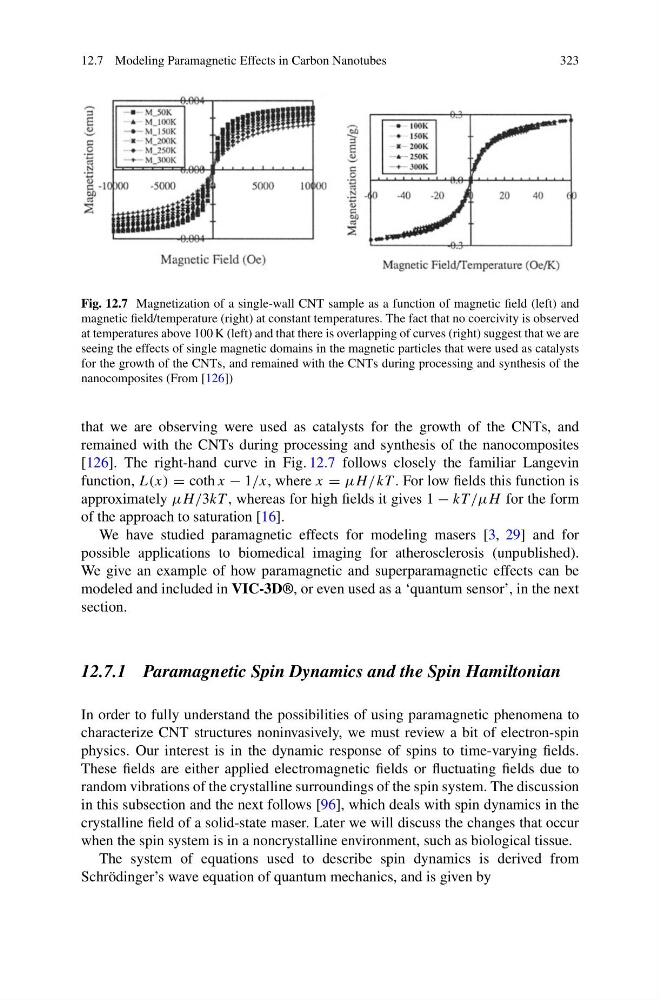
Fig. 12.7 Magnetization of a single-wall CNT sample as a function of magnetic field (left) and
magnetic field/temperature (right) at constant temperatures. The fact that no coercivity is observed
at temperatures above 100 K (left) and that there is overlapping of curves (right) suggest that we are
seeing the effects of single magnetic domains in the magnetic particles that were used as catalysts
for the growth of the CNTs, and remained with the CNTs during processing and synthesis of the
nanocomposites (From [126])
that we are observing were used as catalysts for the growth of the CNTs, and
remained with the CNTs during processing and synthesis of the nanocomposites
[126]. The right-hand curve in Fig. 12.7 follows closely the familiar Langevin
function, L(x) = coth x − 1/x, where x = μH /kT . For low fields this function is
approximately μH /3kT , whereas for high fields it gives 1 − kT /μH for the form
of the approach to saturation [16].
We have studied paramagnetic effects for modeling masers [3, 29] and for
possible applications to biomedical imaging for atherosclerosis (unpublished).
We give an example of how paramagnetic and superparamagnetic effects can be
modeled and included in VIC-3D®, or even used as a ‘quantum sensor’, in the next
section.
12.7.1 Paramagnetic Spin Dynamics and the Spin Hamiltonian
In order to fully understand the possibilities of using paramagnetic phenomena to
characterize CNT structures noninvasively, we must review a bit of electron-spin
physics. Our interest is in the dynamic response of spins to time-varying fields.
These fields are either applied electromagnetic fields or fluctuating fields due to
random vibrations of the crystalline surroundings of the spin system. The discussion
in this subsection and the next follows [96], which deals with spin dynamics in the
crystalline field of a solid-state maser. Later we will discuss the changes that occur
when the spin system is in a noncrystalline environment, such as biological tissue.
The system of equations used to describe spin dynamics is derived from
Schrödinger’s wave equation of quantum mechanics, and is given by
323
Fig. 12.7 Magnetization of a single-wall CNT sample as a function of magnetic field (left) and
magnetic field/temperature (right) at constant temperatures. The fact that no coercivity is observed
at temperatures above 100 K (left) and that there is overlapping of curves (right) suggest that we are
seeing the effects of single magnetic domains in the magnetic particles that were used as catalysts
for the growth of the CNTs, and remained with the CNTs during processing and synthesis of the
nanocomposites (From [126])
that we are observing were used as catalysts for the growth of the CNTs, and
remained with the CNTs during processing and synthesis of the nanocomposites
[126]. The right-hand curve in Fig. 12.7 follows closely the familiar Langevin
function, L(x) = coth x − 1/x, where x = μH /kT . For low fields this function is
approximately μH /3kT , whereas for high fields it gives 1 − kT /μH for the form
of the approach to saturation [16].
We have studied paramagnetic effects for modeling masers [3, 29] and for
possible applications to biomedical imaging for atherosclerosis (unpublished).
We give an example of how paramagnetic and superparamagnetic effects can be
modeled and included in VIC-3D®, or even used as a ‘quantum sensor’, in the next
section.
12.7.1 Paramagnetic Spin Dynamics and the Spin Hamiltonian
In order to fully understand the possibilities of using paramagnetic phenomena to
characterize CNT structures noninvasively, we must review a bit of electron-spin
physics. Our interest is in the dynamic response of spins to time-varying fields.
These fields are either applied electromagnetic fields or fluctuating fields due to
random vibrations of the crystalline surroundings of the spin system. The discussion
in this subsection and the next follows [96], which deals with spin dynamics in the
crystalline field of a solid-state maser. Later we will discuss the changes that occur
when the spin system is in a noncrystalline environment, such as biological tissue.
The system of equations used to describe spin dynamics is derived from
Schrödinger’s wave equation of quantum mechanics, and is given by