

11.4 Fe
3+ and Hund’s Rules
301
3J
exch
2J exch
H
0
H
0
E=1 (S
2
=0)
E=2
E=3
E=4
(S
2
=2)
E=5,6
E=7,8
(S
2 =0.75)
E=1
E=4
(S
2 =3.75)
E=2
E=3
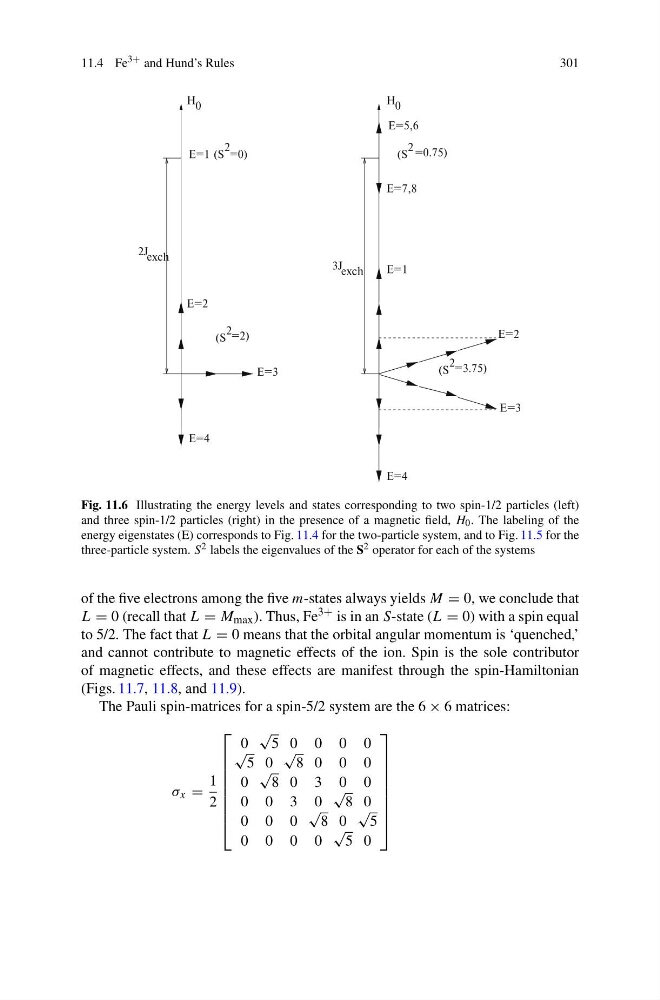
Fig. 11.6 Illustrating the energy levels and states corresponding to two spin-1/2 particles (left)
and three spin-1/2 particles (right) in the presence of a magnetic field, H 0 . The labeling of the
energy eigenstates (E) corresponds to Fig. 11.4 for the two-particle system, and to Fig. 11.5 for the
three-particle system. S 2 labels the eigenvalues of the S 2 operator for each of the systems
of the five electrons among the five m-states always yields M = 0, we conclude that
L = 0 (recall that L = M max ). Thus, Fe
3+ is in an S-state (L = 0) with a spin equal
to 5/2. The fact that L = 0 means that the orbital angular momentum is ‘quenched,’
and cannot contribute to magnetic effects of the ion. Spin is the sole contributor
of magnetic effects, and these effects are manifest through the spin-Hamiltonian
(Figs. 11.7, 11.8, and 11.9).
The Pauli spin-matrices for a spin-5/2 system are the 6 × 6 matrices:
σ x =
1
2
⎡
⎢
⎢
⎢
⎢
⎢
⎢
⎢
⎣
0
√
5 0 0 0 0
√
5 0
√
8 0 0 0
0
√
8 0 3 0 0
0 0 3 0
√
8 0
0 0 0
√
8 0
√
5
0 0 0 0
√
5 0
⎤
⎥
⎥
⎥
⎥
⎥
⎥
⎥
⎦
3+ and Hund’s Rules
301
3J
exch
2J exch
H
0
H
0
E=1 (S
2
=0)
E=2
E=3
E=4
(S
2
=2)
E=5,6
E=7,8
(S
2 =0.75)
E=1
E=4
(S
2 =3.75)
E=2
E=3
Fig. 11.6 Illustrating the energy levels and states corresponding to two spin-1/2 particles (left)
and three spin-1/2 particles (right) in the presence of a magnetic field, H 0 . The labeling of the
energy eigenstates (E) corresponds to Fig. 11.4 for the two-particle system, and to Fig. 11.5 for the
three-particle system. S 2 labels the eigenvalues of the S 2 operator for each of the systems
of the five electrons among the five m-states always yields M = 0, we conclude that
L = 0 (recall that L = M max ). Thus, Fe
3+ is in an S-state (L = 0) with a spin equal
to 5/2. The fact that L = 0 means that the orbital angular momentum is ‘quenched,’
and cannot contribute to magnetic effects of the ion. Spin is the sole contributor
of magnetic effects, and these effects are manifest through the spin-Hamiltonian
(Figs. 11.7, 11.8, and 11.9).
The Pauli spin-matrices for a spin-5/2 system are the 6 × 6 matrices:
σ x =
1
2
⎡
⎢
⎢
⎢
⎢
⎢
⎢
⎢
⎣
0
√
5 0 0 0 0
√
5 0
√
8 0 0 0
0
√
8 0 3 0 0
0 0 3 0
√
8 0
0 0 0
√
8 0
√
5
0 0 0 0
√
5 0
⎤
⎥
⎥
⎥
⎥
⎥
⎥
⎥
⎦