

284
11 Spintronics
either applied electromagnetic fields or fluctuating fields due to random vibrations of
the crystalline surroundings of the spin system. 1
The system of equations used to describe spin dynamics is derived from
Schrödinger’s wave equation of quantum mechanics, and is given by
dρ mn
dt
=
j
¯
h
k
(ρ mk H kn − H mk ρ kn ) +
pq
R mn,pq
ρ pq − ρ
(T )
pq
,
(11.1)
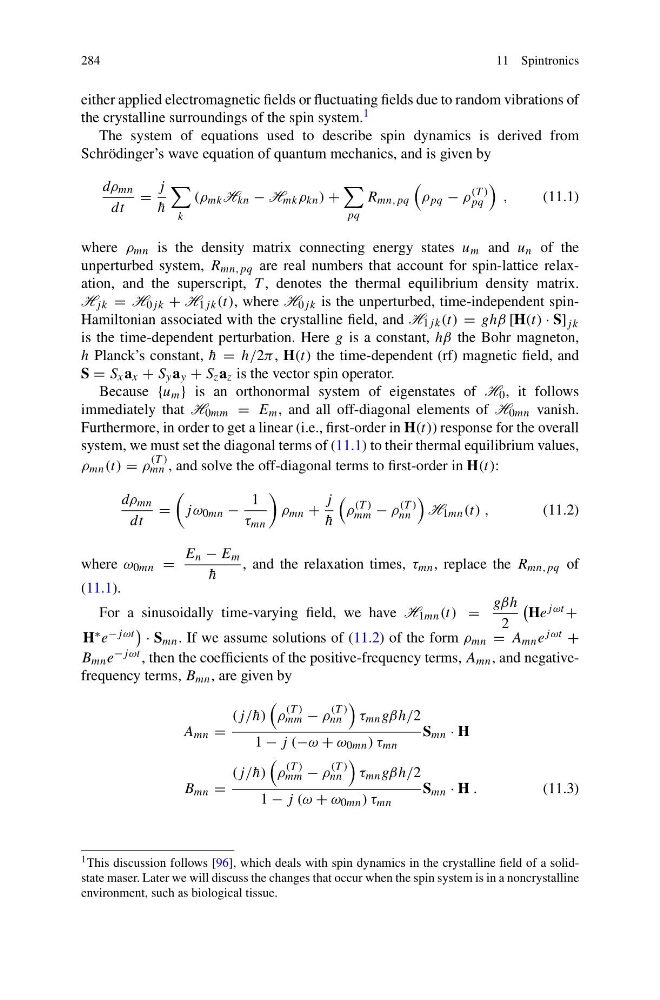
where ρ mn is the density matrix connecting energy states u m and u n of the
unperturbed system, R mn,pq are real numbers that account for spin-lattice relaxation, and the superscript, T , denotes the thermal equilibrium density matrix.
H jk = H 0jk + H 1jk (t), where H 0jk is the unperturbed, time-independent spinHamiltonian associated with the crystalline field, and H 1jk (t) = ghβ [H(t) · S] jk
is the time-dependent perturbation. Here g is a constant, hβ the Bohr magneton,
h Planck’s constant, ¯
h = h/2π , H(t) the time-dependent (rf) magnetic field, and
S = S x a x + S y a y + S z a z is the vector spin operator.
Because {u m } is an orthonormal system of eigenstates of H 0 , it follows
immediately that H 0mm = E m , and all off-diagonal elements of H 0mn vanish.
Furthermore, in order to get a linear (i.e., first-order in H(t)) response for the overall
system, we must set the diagonal terms of (11.1) to their thermal equilibrium values,
ρ mn (t) = ρ
(T )
mn , and solve the off-diagonal terms to first-order in H(t):
dρ mn
dt
=
jω 0mn −
1
τ mn
ρ mn +
j
¯
h
ρ
(T )
mm − ρ
(T )
nn
H 1mn (t) ,
(11.2)
where ω 0mn =
E n − E m
¯
h
, and the relaxation times, τ mn , replace the R mn,pq of
(11.1).
For a sinusoidally time-varying field, we have H 1mn (t) =
gβh
2
He jωt +
H ∗ e −jωt · S mn . If we assume solutions of (11.2) of the form ρ mn = A mn e jωt +
B mn e −jωt , then the coefficients of the positive-frequency terms, A mn , and negativefrequency terms, B mn , are given by
A mn =
(j/ ¯
h)
ρ
(T )
mm − ρ
(T )
nn
τ mn gβh/2
1 − j (−ω + ω 0mn ) τ mn
S mn · H
B mn =
(j/ ¯
h)
ρ
(T )
mm − ρ
(T )
nn
τ mn gβh/2
1 − j (ω + ω 0mn ) τ mn
S mn · H .
(11.3)
1 This discussion follows [96], which deals with spin dynamics in the crystalline field of a solidstate maser. Later we will discuss the changes that occur when the spin system is in a noncrystalline
environment, such as biological tissue.
11 Spintronics
either applied electromagnetic fields or fluctuating fields due to random vibrations of
the crystalline surroundings of the spin system. 1
The system of equations used to describe spin dynamics is derived from
Schrödinger’s wave equation of quantum mechanics, and is given by
dρ mn
dt
=
j
¯
h
k
(ρ mk H kn − H mk ρ kn ) +
pq
R mn,pq
ρ pq − ρ
(T )
pq
,
(11.1)
where ρ mn is the density matrix connecting energy states u m and u n of the
unperturbed system, R mn,pq are real numbers that account for spin-lattice relaxation, and the superscript, T , denotes the thermal equilibrium density matrix.
H jk = H 0jk + H 1jk (t), where H 0jk is the unperturbed, time-independent spinHamiltonian associated with the crystalline field, and H 1jk (t) = ghβ [H(t) · S] jk
is the time-dependent perturbation. Here g is a constant, hβ the Bohr magneton,
h Planck’s constant, ¯
h = h/2π , H(t) the time-dependent (rf) magnetic field, and
S = S x a x + S y a y + S z a z is the vector spin operator.
Because {u m } is an orthonormal system of eigenstates of H 0 , it follows
immediately that H 0mm = E m , and all off-diagonal elements of H 0mn vanish.
Furthermore, in order to get a linear (i.e., first-order in H(t)) response for the overall
system, we must set the diagonal terms of (11.1) to their thermal equilibrium values,
ρ mn (t) = ρ
(T )
mn , and solve the off-diagonal terms to first-order in H(t):
dρ mn
dt
=
jω 0mn −
1
τ mn
ρ mn +
j
¯
h
ρ
(T )
mm − ρ
(T )
nn
H 1mn (t) ,
(11.2)
where ω 0mn =
E n − E m
¯
h
, and the relaxation times, τ mn , replace the R mn,pq of
(11.1).
For a sinusoidally time-varying field, we have H 1mn (t) =
gβh
2
He jωt +
H ∗ e −jωt · S mn . If we assume solutions of (11.2) of the form ρ mn = A mn e jωt +
B mn e −jωt , then the coefficients of the positive-frequency terms, A mn , and negativefrequency terms, B mn , are given by
A mn =
(j/ ¯
h)
ρ
(T )
mm − ρ
(T )
nn
τ mn gβh/2
1 − j (−ω + ω 0mn ) τ mn
S mn · H
B mn =
(j/ ¯
h)
ρ
(T )
mm − ρ
(T )
nn
τ mn gβh/2
1 − j (ω + ω 0mn ) τ mn
S mn · H .
(11.3)
1 This discussion follows [96], which deals with spin dynamics in the crystalline field of a solidstate maser. Later we will discuss the changes that occur when the spin system is in a noncrystalline
environment, such as biological tissue.