

67
side; Kwiitsala, a narrow neck of a mesa top; or Natalöitstix, Rock Hole Through
Planting. In some cases the name is sufficiently descriptive to assist the Sunwatcher’s observations; in other cases the name refers to such a small detail (a perforated rock) that the description alone does not suffice to identify the marker. The
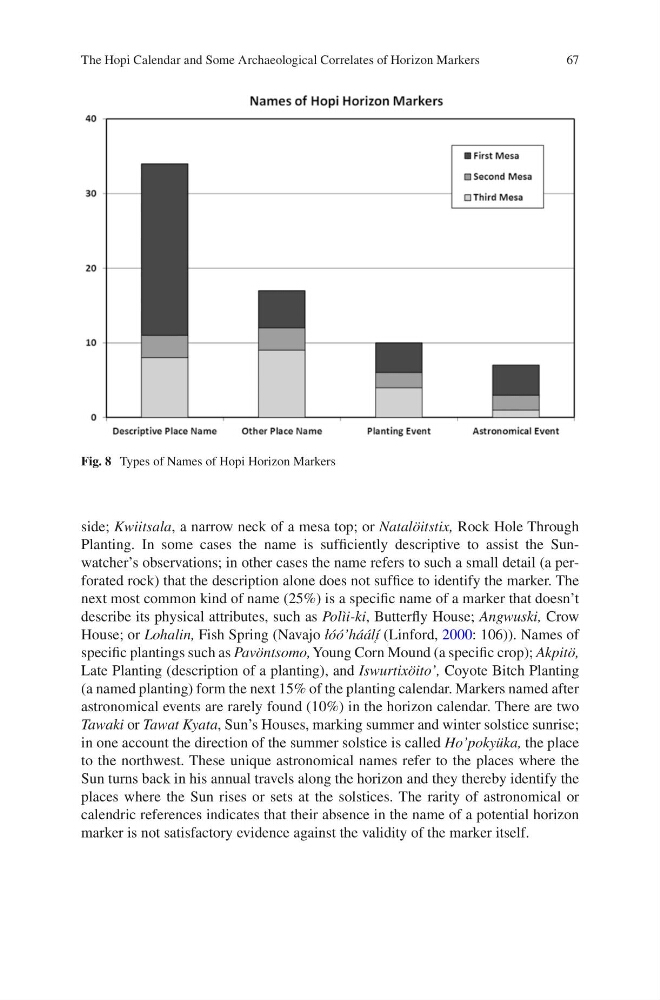
next most common kind of name (25%) is a specific name of a marker that doesn’t
describe its physical attributes, such as Polìi-ki, Butterfly House; Angwuski, Crow
House; or Lohalin, Fish Spring (Navajo łóó’háálí̜ (Linford, 2000: 106)). Names of
specific plantings such as Pavöntsomo, Young Corn Mound (a specific crop); Akpitö,
Late Planting (description of a planting), and Iswurtixöito’, Coyote Bitch Planting
(a named planting) form the next 15% of the planting calendar. Markers named after
astronomical events are rarely found (10%) in the horizon calendar. There are two
Tawaki or Tawat Kyata, Sun’s Houses, marking summer and winter solstice sunrise;
in one account the direction of the summer solstice is called Ho’pokyüka, the place
to the northwest. These unique astronomical names refer to the places where the
Sun turns back in his annual travels along the horizon and they thereby identify the
places where the Sun rises or sets at the solstices. The rarity of astronomical or
calendric references indicates that their absence in the name of a potential horizon
marker is not satisfactory evidence against the validity of the marker itself.
Fig. 8 Types of Names of Hopi Horizon Markers
The Hopi Calendar and Some Archaeological Correlates of Horizon Markers
side; Kwiitsala, a narrow neck of a mesa top; or Natalöitstix, Rock Hole Through
Planting. In some cases the name is sufficiently descriptive to assist the Sunwatcher’s observations; in other cases the name refers to such a small detail (a perforated rock) that the description alone does not suffice to identify the marker. The
next most common kind of name (25%) is a specific name of a marker that doesn’t
describe its physical attributes, such as Polìi-ki, Butterfly House; Angwuski, Crow
House; or Lohalin, Fish Spring (Navajo łóó’háálí̜ (Linford, 2000: 106)). Names of
specific plantings such as Pavöntsomo, Young Corn Mound (a specific crop); Akpitö,
Late Planting (description of a planting), and Iswurtixöito’, Coyote Bitch Planting
(a named planting) form the next 15% of the planting calendar. Markers named after
astronomical events are rarely found (10%) in the horizon calendar. There are two
Tawaki or Tawat Kyata, Sun’s Houses, marking summer and winter solstice sunrise;
in one account the direction of the summer solstice is called Ho’pokyüka, the place
to the northwest. These unique astronomical names refer to the places where the
Sun turns back in his annual travels along the horizon and they thereby identify the
places where the Sun rises or sets at the solstices. The rarity of astronomical or
calendric references indicates that their absence in the name of a potential horizon
marker is not satisfactory evidence against the validity of the marker itself.
Fig. 8 Types of Names of Hopi Horizon Markers
The Hopi Calendar and Some Archaeological Correlates of Horizon Markers