

309
kind of instruments (e.g. meridian circles) or made by the same firm like Repsold,
Merz, Steinheil, Grubb, Zeiss or French instruments.
Of great importance is also contemporary astronomy (e.g. radio astronomy, new
wavelength astronomy and new technology telescopes or space heritage), which
ought to be discussed in more detail. The Jodrell Bank Observatory in Manchester,
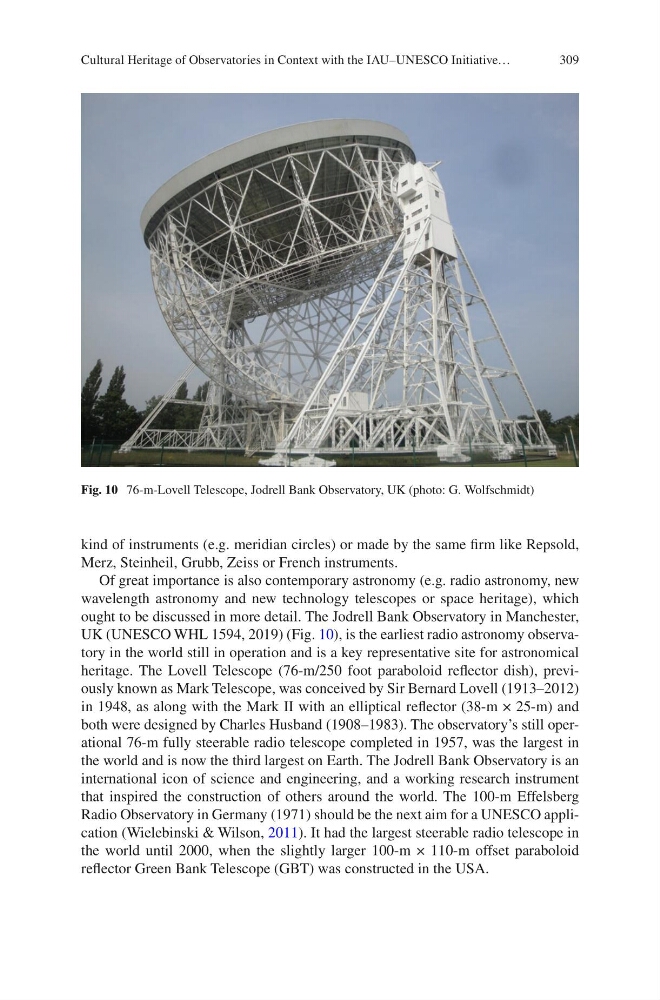
UK (UNESCO WHL 1594, 2019) (Fig. 10), is the earliest radio astronomy observatory in the world still in operation and is a key representative site for astronomical
heritage. The Lovell Telescope (76-m/250 foot paraboloid reflector dish), previously known as Mark Telescope, was conceived by Sir Bernard Lovell (1913–2012)
in 1948, as along with the Mark II with an elliptical reflector (38-m × 25-m) and
both were designed by Charles Husband (1908–1983). The observatory’s still operational 76-m fully steerable radio telescope completed in 1957, was the largest in
the world and is now the third largest on Earth. The Jodrell Bank Observatory is an
international icon of science and engineering, and a working research instrument
that inspired the construction of others around the world. The 100-m Effelsberg
Radio Observatory in Germany (1971) should be the next aim for a UNESCO application (Wielebinski & Wilson, 2011). It had the largest steerable radio telescope in
the world until 2000, when the slightly larger 100-m × 110-m offset paraboloid
reflector Green Bank Telescope (GBT) was constructed in the USA.
Fig. 10 76-m-Lovell Telescope, Jodrell Bank Observatory, UK (photo: G. Wolfschmidt)
Cultural Heritage of Observatories in Context with the IAU–UNESCO Initiative…
kind of instruments (e.g. meridian circles) or made by the same firm like Repsold,
Merz, Steinheil, Grubb, Zeiss or French instruments.
Of great importance is also contemporary astronomy (e.g. radio astronomy, new
wavelength astronomy and new technology telescopes or space heritage), which
ought to be discussed in more detail. The Jodrell Bank Observatory in Manchester,
UK (UNESCO WHL 1594, 2019) (Fig. 10), is the earliest radio astronomy observatory in the world still in operation and is a key representative site for astronomical
heritage. The Lovell Telescope (76-m/250 foot paraboloid reflector dish), previously known as Mark Telescope, was conceived by Sir Bernard Lovell (1913–2012)
in 1948, as along with the Mark II with an elliptical reflector (38-m × 25-m) and
both were designed by Charles Husband (1908–1983). The observatory’s still operational 76-m fully steerable radio telescope completed in 1957, was the largest in
the world and is now the third largest on Earth. The Jodrell Bank Observatory is an
international icon of science and engineering, and a working research instrument
that inspired the construction of others around the world. The 100-m Effelsberg
Radio Observatory in Germany (1971) should be the next aim for a UNESCO application (Wielebinski & Wilson, 2011). It had the largest steerable radio telescope in
the world until 2000, when the slightly larger 100-m × 110-m offset paraboloid
reflector Green Bank Telescope (GBT) was constructed in the USA.
Fig. 10 76-m-Lovell Telescope, Jodrell Bank Observatory, UK (photo: G. Wolfschmidt)
Cultural Heritage of Observatories in Context with the IAU–UNESCO Initiative…