

304
(Fig. 8); Brazil, Rio de Janeiro; UK, Greenwich; Estonia, Tartu; France, ParisMeudon; France, Nice; Germany, Hamburg-Bergedorf; India, Kodaikanal; Portugal,
Lisbon; Russia, Pulkovo, St. Petersburg; USA, Naval Observatory Washington
D.C. In the meantime, I would like to add to this list of typical observatories of
around 1900 with the mentioned features the old and new observatory in Kazan,
Russia, and the Dominion Observatory, Ottawa, Ontario, Canada (1902–1970),
together with the Dominion Astrophysical Observatory (DAO), Victoria, British
Columbia, Canada (1918) with the 1.8-m Plaskett telescope for spectroscopy.
5.2 International Cooperation and Instruments
I would like to present two more examples for “serial transnational applications”.
“Large meridian instruments not only tell us a lot about basics of the motion of
heavenly bodies, but because of their size and proximity to different types of powers,
they are also deeply connected to their cultural and historical context.” (Benoist, Le
Guet Tully, & Davoigneau, 2016: 164). Around 1800 meridian circles, associated to
precise clocks, superseded the large mural quadrants (made by Sisson, Bird) or large
circles (made by Cary) like in Palermo, in providing the most precise measurements of
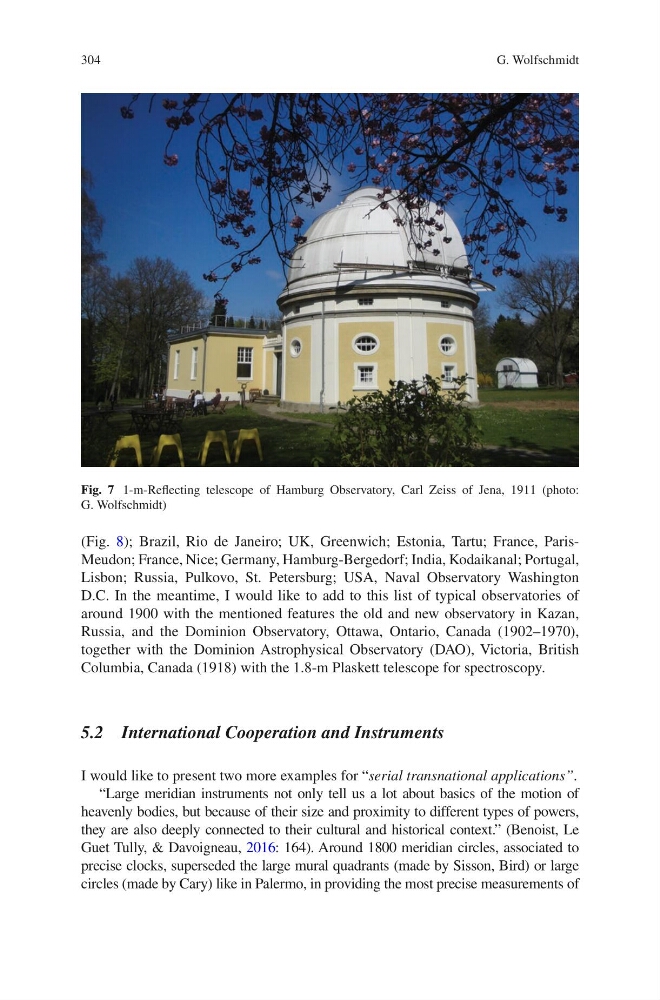
Fig. 7 1-m-Reflecting telescope of Hamburg Observatory, Carl Zeiss of Jena, 1911 (photo:
G. Wolfschmidt)
G. Wolfschmidt
(Fig. 8); Brazil, Rio de Janeiro; UK, Greenwich; Estonia, Tartu; France, ParisMeudon; France, Nice; Germany, Hamburg-Bergedorf; India, Kodaikanal; Portugal,
Lisbon; Russia, Pulkovo, St. Petersburg; USA, Naval Observatory Washington
D.C. In the meantime, I would like to add to this list of typical observatories of
around 1900 with the mentioned features the old and new observatory in Kazan,
Russia, and the Dominion Observatory, Ottawa, Ontario, Canada (1902–1970),
together with the Dominion Astrophysical Observatory (DAO), Victoria, British
Columbia, Canada (1918) with the 1.8-m Plaskett telescope for spectroscopy.
5.2 International Cooperation and Instruments
I would like to present two more examples for “serial transnational applications”.
“Large meridian instruments not only tell us a lot about basics of the motion of
heavenly bodies, but because of their size and proximity to different types of powers,
they are also deeply connected to their cultural and historical context.” (Benoist, Le
Guet Tully, & Davoigneau, 2016: 164). Around 1800 meridian circles, associated to
precise clocks, superseded the large mural quadrants (made by Sisson, Bird) or large
circles (made by Cary) like in Palermo, in providing the most precise measurements of
Fig. 7 1-m-Reflecting telescope of Hamburg Observatory, Carl Zeiss of Jena, 1911 (photo:
G. Wolfschmidt)
G. Wolfschmidt