

299
– Cape of Good Hope, Royal Observatory, since 1972 South African Astronomical
Observatory (SAAO) together with the Republic Observatory Johannesburg,
Cape Town (Afrikaans Kaapstad), South Africa (1820)
12
;
– Christiania/Oslo Observatory, Norway
13
(1831)—architect Christian Heinrich
Grosch (1801–1865);
– Berlin (1835, dismantled in 1915)—architect Karl Friedrich Schinkel
(1781–1841);
– Bonn (1844)—architect Karl Friedrich Schinkel (1781–1841);
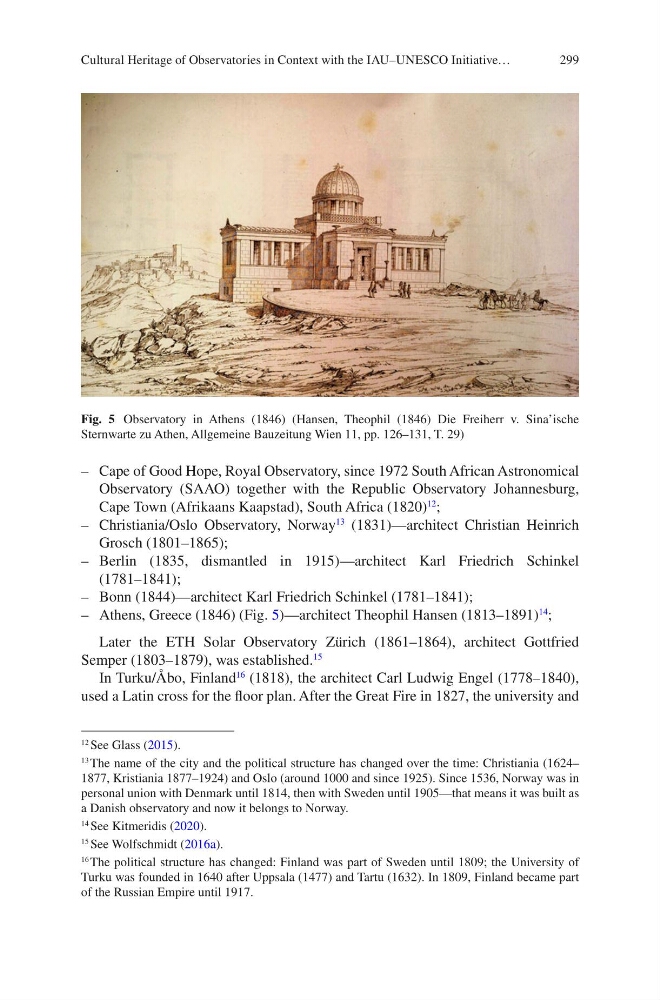
– Athens, Greece (1846) (Fig. 5)—architect Theophil Hansen (1813–1891)
14
;
Later the ETH Solar Observatory Zürich (1861–1864), architect Gottfried
Semper (1803–1879), was established.
15
In Turku/Åbo, Finland
16
(1818), the architect Carl Ludwig Engel (1778–1840),
used a Latin cross for the floor plan. After the Great Fire in 1827, the university and
12 See Glass (2015).
13 The name of the city and the political structure has changed over the time: Christiania (1624–
1877, Kristiania 1877–1924) and Oslo (around 1000 and since 1925). Since 1536, Norway was in
personal union with Denmark until 1814, then with Sweden until 1905—that means it was built as
a Danish observatory and now it belongs to Norway.
14 See Kitmeridis (2020).
15 See Wolfschmidt (2016a).
16 The political structure has changed: Finland was part of Sweden until 1809; the University of
Turku was founded in 1640 after Uppsala (1477) and Tartu (1632). In 1809, Finland became part
of the Russian Empire until 1917.
Fig. 5 Observatory in Athens (1846) (Hansen, Theophil (1846) Die Freiherr v. Sina’ische
Sternwarte zu Athen, Allgemeine Bauzeitung Wien 11, pp. 126–131, T. 29)
Cultural Heritage of Observatories in Context with the IAU–UNESCO Initiative…
– Cape of Good Hope, Royal Observatory, since 1972 South African Astronomical
Observatory (SAAO) together with the Republic Observatory Johannesburg,
Cape Town (Afrikaans Kaapstad), South Africa (1820)
12
;
– Christiania/Oslo Observatory, Norway
13
(1831)—architect Christian Heinrich
Grosch (1801–1865);
– Berlin (1835, dismantled in 1915)—architect Karl Friedrich Schinkel
(1781–1841);
– Bonn (1844)—architect Karl Friedrich Schinkel (1781–1841);
– Athens, Greece (1846) (Fig. 5)—architect Theophil Hansen (1813–1891)
14
;
Later the ETH Solar Observatory Zürich (1861–1864), architect Gottfried
Semper (1803–1879), was established.
15
In Turku/Åbo, Finland
16
(1818), the architect Carl Ludwig Engel (1778–1840),
used a Latin cross for the floor plan. After the Great Fire in 1827, the university and
12 See Glass (2015).
13 The name of the city and the political structure has changed over the time: Christiania (1624–
1877, Kristiania 1877–1924) and Oslo (around 1000 and since 1925). Since 1536, Norway was in
personal union with Denmark until 1814, then with Sweden until 1905—that means it was built as
a Danish observatory and now it belongs to Norway.
14 See Kitmeridis (2020).
15 See Wolfschmidt (2016a).
16 The political structure has changed: Finland was part of Sweden until 1809; the University of
Turku was founded in 1640 after Uppsala (1477) and Tartu (1632). In 1809, Finland became part
of the Russian Empire until 1917.
Fig. 5 Observatory in Athens (1846) (Hansen, Theophil (1846) Die Freiherr v. Sina’ische
Sternwarte zu Athen, Allgemeine Bauzeitung Wien 11, pp. 126–131, T. 29)
Cultural Heritage of Observatories in Context with the IAU–UNESCO Initiative…