

274
intentionally destroyed and buried under a layer of rubble, an event probably due to
a violent conflict with some external power, which ended with the defeat of
Chankillo and the abrupt abandonment of the site (Ghezzi, 2006, 2007).
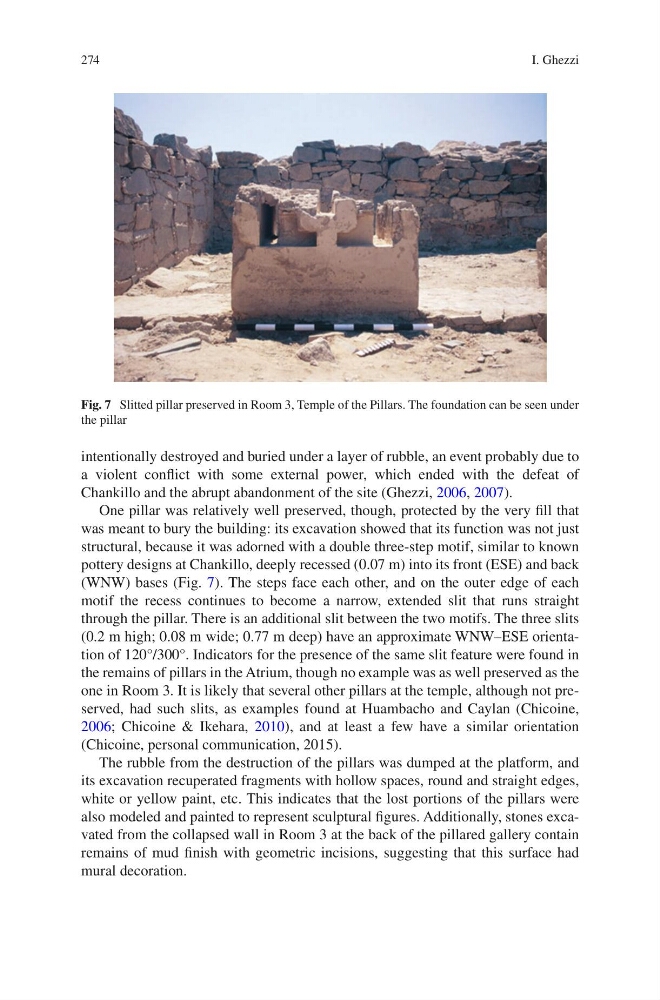
One pillar was relatively well preserved, though, protected by the very fill that
was meant to bury the building: its excavation showed that its function was not just
structural, because it was adorned with a double three-step motif, similar to known
pottery designs at Chankillo, deeply recessed (0.07 m) into its front (ESE) and back
(WNW) bases (Fig. 7). The steps face each other, and on the outer edge of each
motif the recess continues to become a narrow, extended slit that runs straight
through the pillar. There is an additional slit between the two motifs. The three slits
(0.2 m high; 0.08 m wide; 0.77 m deep) have an approximate WNW–ESE orientation of 120°/300°. Indicators for the presence of the same slit feature were found in
the remains of pillars in the Atrium, though no example was as well preserved as the
one in Room 3. It is likely that several other pillars at the temple, although not preserved, had such slits, as examples found at Huambacho and Caylan (Chicoine,
2006; Chicoine & Ikehara, 2010), and at least a few have a similar orientation
(Chicoine, personal communication, 2015).
The rubble from the destruction of the pillars was dumped at the platform, and
its excavation recuperated fragments with hollow spaces, round and straight edges,
white or yellow paint, etc. This indicates that the lost portions of the pillars were
also modeled and painted to represent sculptural figures. Additionally, stones excavated from the collapsed wall in Room 3 at the back of the pillared gallery contain
remains of mud finish with geometric incisions, suggesting that this surface had
mural decoration.
Fig. 7 Slitted pillar preserved in Room 3, Temple of the Pillars. The foundation can be seen under
the pillar
I. Ghezzi
intentionally destroyed and buried under a layer of rubble, an event probably due to
a violent conflict with some external power, which ended with the defeat of
Chankillo and the abrupt abandonment of the site (Ghezzi, 2006, 2007).
One pillar was relatively well preserved, though, protected by the very fill that
was meant to bury the building: its excavation showed that its function was not just
structural, because it was adorned with a double three-step motif, similar to known
pottery designs at Chankillo, deeply recessed (0.07 m) into its front (ESE) and back
(WNW) bases (Fig. 7). The steps face each other, and on the outer edge of each
motif the recess continues to become a narrow, extended slit that runs straight
through the pillar. There is an additional slit between the two motifs. The three slits
(0.2 m high; 0.08 m wide; 0.77 m deep) have an approximate WNW–ESE orientation of 120°/300°. Indicators for the presence of the same slit feature were found in
the remains of pillars in the Atrium, though no example was as well preserved as the
one in Room 3. It is likely that several other pillars at the temple, although not preserved, had such slits, as examples found at Huambacho and Caylan (Chicoine,
2006; Chicoine & Ikehara, 2010), and at least a few have a similar orientation
(Chicoine, personal communication, 2015).
The rubble from the destruction of the pillars was dumped at the platform, and
its excavation recuperated fragments with hollow spaces, round and straight edges,
white or yellow paint, etc. This indicates that the lost portions of the pillars were
also modeled and painted to represent sculptural figures. Additionally, stones excavated from the collapsed wall in Room 3 at the back of the pillared gallery contain
remains of mud finish with geometric incisions, suggesting that this surface had
mural decoration.
Fig. 7 Slitted pillar preserved in Room 3, Temple of the Pillars. The foundation can be seen under
the pillar
I. Ghezzi