

267
2.1 Chankillo Solar Observatory
It is composed of the Thirteen Towers, the Observatory Building, which includes
the Western Observing Point or WOP, and a small building that includes the Eastern
Observing Point or EOP (Fig. 2b).
2.1.1 The Thirteen Towers
The towers are a row of thirteen cuboidal constructions built of stone and mortar,
regularly spaced and running broadly N–S along a low ridge roughly at the centre
of Chankillo, although Towers 11 through 13 turn noticeably southwest to become
perpendicular to the site axis. Since 2007, it has been recognized that the towers
were horizon markers enabling privileged observers to track accurately the seasonal
passage of the sun throughout the year. From two observing points to the W and E,
the towers span, respectively, the entire range of sunrise and sunset positions as the
sun moves between its limits at the solstices, including a part of Cerro Mucho Malo
to complete the profile in the former case (Ghezzi & Ruggles, 2007).
The towers are well preserved, except Towers 4 and 13, whose east walls and fills
have largely collapsed, but enough of their fabric survives to recognize the main
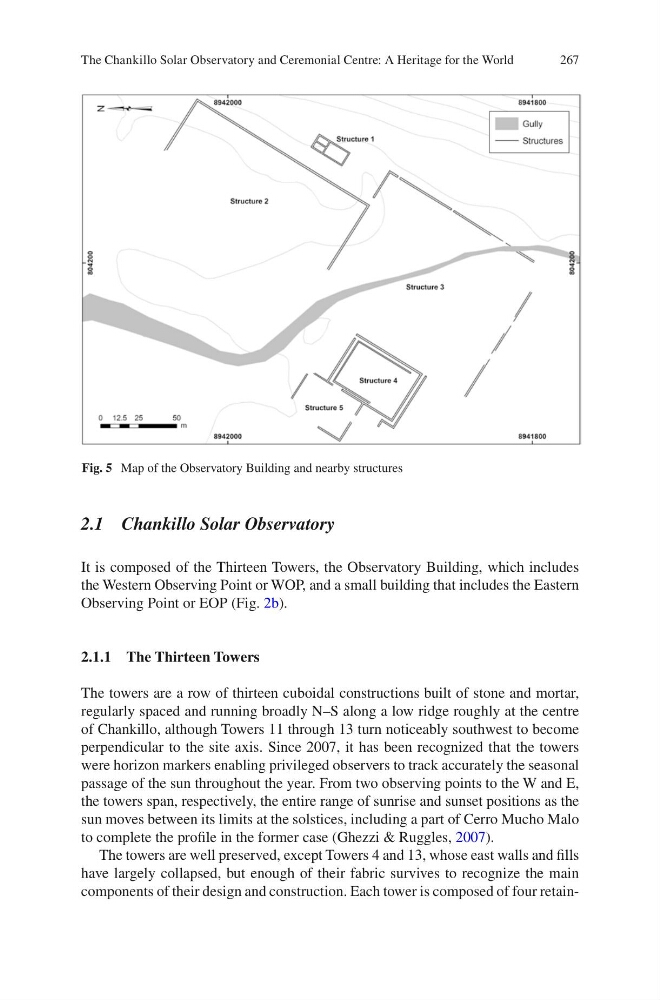
components of their design and construction. Each tower is composed of four retainFig. 5 Map of the Observatory Building and nearby structures
The Chankillo Solar Observatory and Ceremonial Centre: A Heritage for the World
2.1 Chankillo Solar Observatory
It is composed of the Thirteen Towers, the Observatory Building, which includes
the Western Observing Point or WOP, and a small building that includes the Eastern
Observing Point or EOP (Fig. 2b).
2.1.1 The Thirteen Towers
The towers are a row of thirteen cuboidal constructions built of stone and mortar,
regularly spaced and running broadly N–S along a low ridge roughly at the centre
of Chankillo, although Towers 11 through 13 turn noticeably southwest to become
perpendicular to the site axis. Since 2007, it has been recognized that the towers
were horizon markers enabling privileged observers to track accurately the seasonal
passage of the sun throughout the year. From two observing points to the W and E,
the towers span, respectively, the entire range of sunrise and sunset positions as the
sun moves between its limits at the solstices, including a part of Cerro Mucho Malo
to complete the profile in the former case (Ghezzi & Ruggles, 2007).
The towers are well preserved, except Towers 4 and 13, whose east walls and fills
have largely collapsed, but enough of their fabric survives to recognize the main
components of their design and construction. Each tower is composed of four retainFig. 5 Map of the Observatory Building and nearby structures
The Chankillo Solar Observatory and Ceremonial Centre: A Heritage for the World