

246
Bonampak ruler Yajaw Chan Muwan II, who reigned between 776 and 795 (Bíró,
2011: 252–259).
The date 9.18.0.3.4 (790) falls 64 days after the celebration of k’atun ending at
9.18.0.0.0 and is associated with the Lunar Series. What makes the text even more
interesting is that this date is 148 days (5 lunar months) after the solar eclipse
recorded at Santa Elena Poco Uinic (Schele & Grube, 1995: 158). These
circumstances allow a new insight, at the regional level, into the complexity of the
moon reckoning. As is usual, the reading of the record is not fully legible. It probably gives no numerical statement to describe the moon age. Since the descriptive
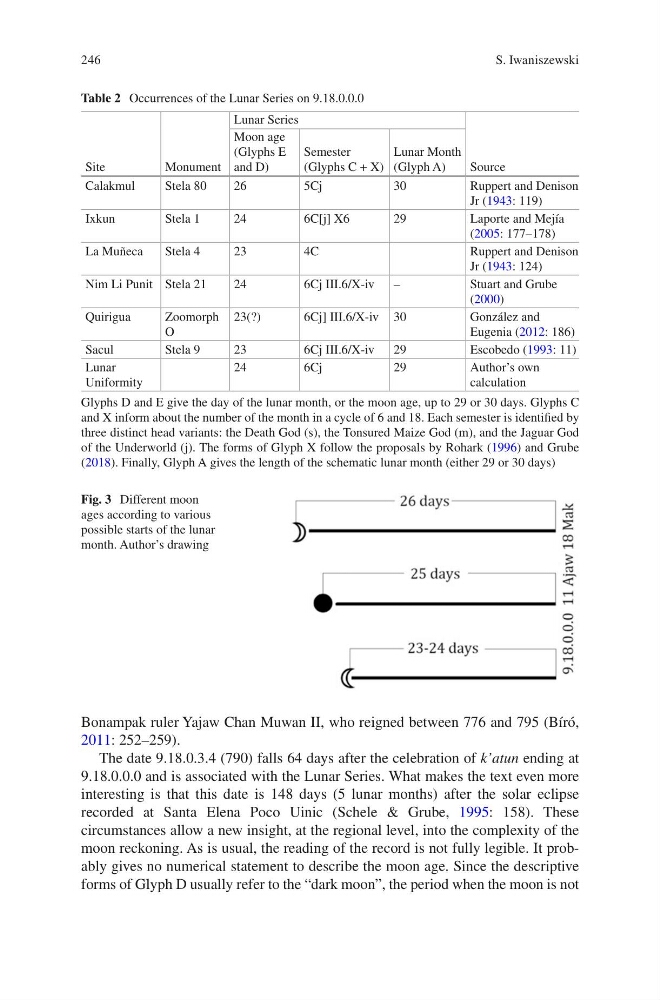
forms of Glyph D usually refer to the “dark moon”, the period when the moon is not
Fig. 3 Different moon
ages according to various
possible starts of the lunar
month. Author’s drawing
Table 2 Occurrences of the Lunar Series on 9.18.0.0.0
Site
Monument
Lunar Series
Source
Moon age
(Glyphs E
and D)
Semester
(Glyphs C + X)
Lunar Month
(Glyph A)
Calakmul
Stela 80
26
5Cj
30
Ruppert and Denison
Jr (1943: 119)
Ixkun
Stela 1
24
6C[j] X6
29
Laporte and Mejía
(2005: 177–178)
La Muñeca
Stela 4
23
4C
Ruppert and Denison
Jr (1943: 124)
Nim Li Punit Stela 21
24
6Cj III.6/X-iv –
Stuart and Grube
(2000)
Quirigua
Zoomorph
O
23(?)
6Cj] III.6/X-iv 30
González and
Eugenia (2012: 186)
Sacul
Stela 9
23
6Cj III.6/X-iv 29
Escobedo (1993: 11)
Lunar
Uniformity
24
6Cj
29
Author’s own
calculation
Glyphs D and E give the day of the lunar month, or the moon age, up to 29 or 30 days. Glyphs C
and X inform about the number of the month in a cycle of 6 and 18. Each semester is identified by
three distinct head variants: the Death God (s), the Tonsured Maize God (m), and the Jaguar God
of the Underworld (j). The forms of Glyph X follow the proposals by Rohark (1996) and Grube
(2018). Finally, Glyph A gives the length of the schematic lunar month (either 29 or 30 days)
S. Iwaniszewski
Bonampak ruler Yajaw Chan Muwan II, who reigned between 776 and 795 (Bíró,
2011: 252–259).
The date 9.18.0.3.4 (790) falls 64 days after the celebration of k’atun ending at
9.18.0.0.0 and is associated with the Lunar Series. What makes the text even more
interesting is that this date is 148 days (5 lunar months) after the solar eclipse
recorded at Santa Elena Poco Uinic (Schele & Grube, 1995: 158). These
circumstances allow a new insight, at the regional level, into the complexity of the
moon reckoning. As is usual, the reading of the record is not fully legible. It probably gives no numerical statement to describe the moon age. Since the descriptive
forms of Glyph D usually refer to the “dark moon”, the period when the moon is not
Fig. 3 Different moon
ages according to various
possible starts of the lunar
month. Author’s drawing
Table 2 Occurrences of the Lunar Series on 9.18.0.0.0
Site
Monument
Lunar Series
Source
Moon age
(Glyphs E
and D)
Semester
(Glyphs C + X)
Lunar Month
(Glyph A)
Calakmul
Stela 80
26
5Cj
30
Ruppert and Denison
Jr (1943: 119)
Ixkun
Stela 1
24
6C[j] X6
29
Laporte and Mejía
(2005: 177–178)
La Muñeca
Stela 4
23
4C
Ruppert and Denison
Jr (1943: 124)
Nim Li Punit Stela 21
24
6Cj III.6/X-iv –
Stuart and Grube
(2000)
Quirigua
Zoomorph
O
23(?)
6Cj] III.6/X-iv 30
González and
Eugenia (2012: 186)
Sacul
Stela 9
23
6Cj III.6/X-iv 29
Escobedo (1993: 11)
Lunar
Uniformity
24
6Cj
29
Author’s own
calculation
Glyphs D and E give the day of the lunar month, or the moon age, up to 29 or 30 days. Glyphs C
and X inform about the number of the month in a cycle of 6 and 18. Each semester is identified by
three distinct head variants: the Death God (s), the Tonsured Maize God (m), and the Jaguar God
of the Underworld (j). The forms of Glyph X follow the proposals by Rohark (1996) and Grube
(2018). Finally, Glyph A gives the length of the schematic lunar month (either 29 or 30 days)
S. Iwaniszewski