

226
B stars are often variable (e.g. Waelkens & Rufener, 1985) and the variability of
the Pleiades has been well-studied (e.g. White, Pope, Antoci, et al., 2017). Several
have been observed to be variable, and Pleione is known to be an irregular variable,
varying by as much as 0.5 magnitude in the last century (Burnham Jr., 1978).
However, such studies are only sensitive to short-term variability (on a timescale of
days to years). On a timescale of tens of millions of years, comparable to the lifetime of the star, the star is expected to gradually increase in luminosity because of
its expansion as it moves across the main sequence (Langer, 2012), but the change
over a period of 100,000 years is probably still too small to be visible to the human
eye. Additional variability may also be caused by motion of the obscuring dust that
veils the Pleiades. Because of these unknown factors, we have no information on
how the brightness of these stars varies on timescales of thousands of years.
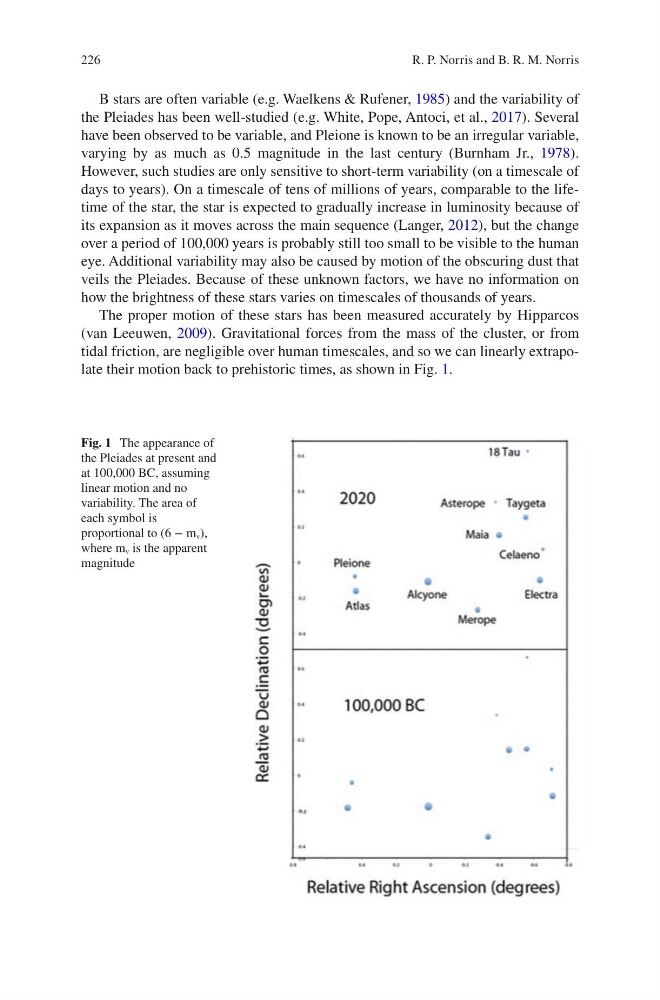
The proper motion of these stars has been measured accurately by Hipparcos
(van Leeuwen, 2009). Gravitational forces from the mass of the cluster, or from
tidal friction, are negligible over human timescales, and so we can linearly extrapolate their motion back to prehistoric times, as shown in Fig. 1.
Fig. 1 The appearance of
the Pleiades at present and
at 100,000 BC, assuming
linear motion and no
variability. The area of
each symbol is
proportional to (6 − m v ),
where m v is the apparent
magnitude
R. P. Norris and B. R. M. Norris
B stars are often variable (e.g. Waelkens & Rufener, 1985) and the variability of
the Pleiades has been well-studied (e.g. White, Pope, Antoci, et al., 2017). Several
have been observed to be variable, and Pleione is known to be an irregular variable,
varying by as much as 0.5 magnitude in the last century (Burnham Jr., 1978).
However, such studies are only sensitive to short-term variability (on a timescale of
days to years). On a timescale of tens of millions of years, comparable to the lifetime of the star, the star is expected to gradually increase in luminosity because of
its expansion as it moves across the main sequence (Langer, 2012), but the change
over a period of 100,000 years is probably still too small to be visible to the human
eye. Additional variability may also be caused by motion of the obscuring dust that
veils the Pleiades. Because of these unknown factors, we have no information on
how the brightness of these stars varies on timescales of thousands of years.
The proper motion of these stars has been measured accurately by Hipparcos
(van Leeuwen, 2009). Gravitational forces from the mass of the cluster, or from
tidal friction, are negligible over human timescales, and so we can linearly extrapolate their motion back to prehistoric times, as shown in Fig. 1.
Fig. 1 The appearance of
the Pleiades at present and
at 100,000 BC, assuming
linear motion and no
variability. The area of
each symbol is
proportional to (6 − m v ),
where m v is the apparent
magnitude
R. P. Norris and B. R. M. Norris