

114
ἀπαρκτίαν τοὺς ὑπὲρ Θρᾴκην Σκύθας, κατὰ δὲ βορρᾶν Πόντον, Μαιῶτιν, Σαρμάτας·
κατὰ καικίαν Κασπίαν θάλασσαν καὶ Σάκας.
29
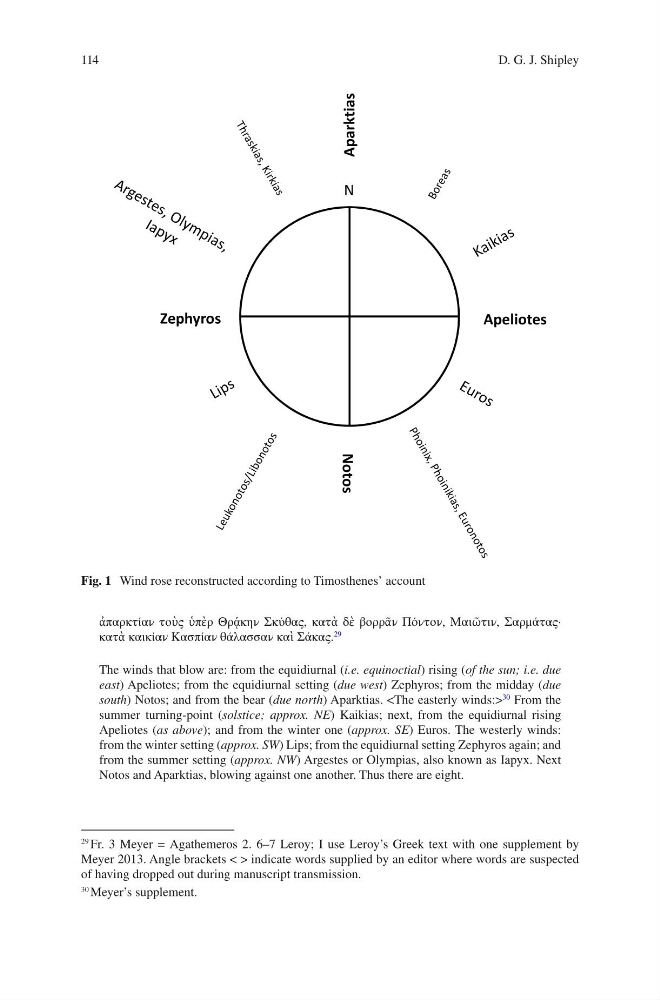
The winds that blow are: from the equidiurnal (i.e. equinoctial) rising (of the sun; i.e. due
east) Apeliotes; from the equidiurnal setting (due west) Zephyros; from the midday (due
south) Notos; and from the bear (due north) Aparktias.
30 From the
summer turning-point (solstice; approx. NE) Kaikias; next, from the equidiurnal rising
Apeliotes (as above); and from the winter one (approx. SE) Euros. The westerly winds:
from the winter setting (approx. SW) Lips; from the equidiurnal setting Zephyros again; and
from the summer setting (approx. NW) Argestes or Olympias, also known as Iapyx. Next
Notos and Aparktias, blowing against one another. Thus there are eight.
29 Fr. 3 Meyer = Agathemeros 2. 6–7 Leroy; I use Leroy’s Greek text with one supplement by
Meyer 2013. Angle brackets < > indicate words supplied by an editor where words are suspected
of having dropped out during manuscript transmission.
30 Meyer’s supplement.
Fig. 1 Wind rose reconstructed according to Timosthenes’ account
D. G. J. Shipley
ἀπαρκτίαν τοὺς ὑπὲρ Θρᾴκην Σκύθας, κατὰ δὲ βορρᾶν Πόντον, Μαιῶτιν, Σαρμάτας·
κατὰ καικίαν Κασπίαν θάλασσαν καὶ Σάκας.
29
The winds that blow are: from the equidiurnal (i.e. equinoctial) rising (of the sun; i.e. due
east) Apeliotes; from the equidiurnal setting (due west) Zephyros; from the midday (due
south) Notos; and from the bear (due north) Aparktias.
30 From the
summer turning-point (solstice; approx. NE) Kaikias; next, from the equidiurnal rising
Apeliotes (as above); and from the winter one (approx. SE) Euros. The westerly winds:
from the winter setting (approx. SW) Lips; from the equidiurnal setting Zephyros again; and
from the summer setting (approx. NW) Argestes or Olympias, also known as Iapyx. Next
Notos and Aparktias, blowing against one another. Thus there are eight.
29 Fr. 3 Meyer = Agathemeros 2. 6–7 Leroy; I use Leroy’s Greek text with one supplement by
Meyer 2013. Angle brackets < > indicate words supplied by an editor where words are suspected
of having dropped out during manuscript transmission.
30 Meyer’s supplement.
Fig. 1 Wind rose reconstructed according to Timosthenes’ account
D. G. J. Shipley