

112
of meanings for which the all-purpose preposition ‘upon’ will usually serve), kata
(‘against’, ‘opposite’), and pros (‘towards’, ‘on/from the side of’). The last three
have different meanings depending on the grammatical case of the noun that follows them.
26
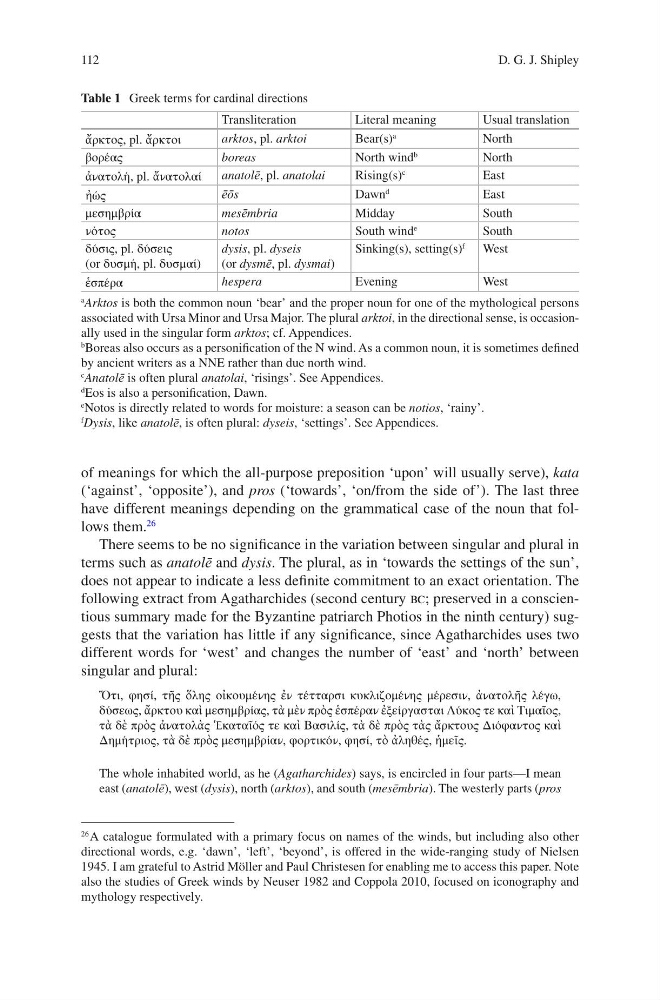
There seems to be no significance in the variation between singular and plural in
terms such as anatolē and dysis. The plural, as in ‘towards the settings of the sun’,
does not appear to indicate a less definite commitment to an exact orientation. The
following extract from Agatharchides (second century bc; preserved in a conscientious summary made for the Byzantine patriarch Photios in the ninth century) suggests that the variation has little if any significance, since Agatharchides uses two
different words for ‘west’ and changes the number of ‘east’ and ‘north’ between
singular and plural:
Ὅτι, φησί, τῆς ὅλης οἰκουμένης ἐν τέτταρσι κυκλιζομένης μέρεσιν, ἀνατολῆς λέγω,
δύσεως, ἄρκτου καὶ μεσημβρίας, τὰ μὲν πρὸς ἑσπέραν ἐξείργασται Λύκος τε καὶ Τιμαῖος,
τὰ δὲ πρὸς ἀνατολὰς Ἑκαταῖός τε καὶ Βασιλίς, τὰ δὲ πρὸς τὰς ἄρκτους Διόφαντος καὶ
Δημήτριος, τὰ δὲ πρὸς μεσημβρίαν, φορτικόν, φησί, τὸ ἀληθές, ἡμεῖς.
The whole inhabited world, as he (Agatharchides) says, is encircled in four parts—I mean
east (anatolē), west (dysis), north (arktos), and south (mesēmbria). The westerly parts (pros
26 A catalogue formulated with a primary focus on names of the winds, but including also other
directional words, e.g. ‘dawn’, ‘left’, ‘beyond’, is offered in the wide-ranging study of Nielsen
1945. I am grateful to Astrid Möller and Paul Christesen for enabling me to access this paper. Note
also the studies of Greek winds by Neuser 1982 and Coppola 2010, focused on iconography and
mythology respectively.
Table 1 Greek terms for cardinal directions
Transliteration
Literal meaning
Usual translation
ἄρκτος, pl. ἄρκτοι
arktos, pl. arktoi
Bear(s)
a
North
βορέας
boreas
North wind
b
North
ἀνατολή, pl. ἄνατολαί
anatolē, pl. anatolai
Rising(s)
c
East
ἠώς
ēōs
Dawn
d
East
μεσημβρία
mesēmbria
Midday
South
νότος
notos
South wind
e
South
δύσις, pl. δύσεις
(or δυσμή, pl. δυσμαί)
dysis, pl. dyseis
(or dysmē, pl. dysmai)
Sinking(s), setting(s)
f
West
ἑσπέρα
hespera
Evening
West
a Arktos is both the common noun ‘bear’ and the proper noun for one of the mythological persons
associated with Ursa Minor and Ursa Major. The plural arktoi, in the directional sense, is occasionally used in the singular form arktos; cf. Appendices.
b
Boreas also occurs as a personification of the N wind. As a common noun, it is sometimes defined
by ancient writers as a NNE rather than due north wind.
c
Anatolē is often plural anatolai, ‘risings’. See Appendices.
d
Eos is also a personification, Dawn.
e
Notos is directly related to words for moisture: a season can be notios, ‘rainy’.
f
Dysis, like anatolē, is often plural: dyseis, ‘settings’. See Appendices.
D. G. J. Shipley
of meanings for which the all-purpose preposition ‘upon’ will usually serve), kata
(‘against’, ‘opposite’), and pros (‘towards’, ‘on/from the side of’). The last three
have different meanings depending on the grammatical case of the noun that follows them.
26
There seems to be no significance in the variation between singular and plural in
terms such as anatolē and dysis. The plural, as in ‘towards the settings of the sun’,
does not appear to indicate a less definite commitment to an exact orientation. The
following extract from Agatharchides (second century bc; preserved in a conscientious summary made for the Byzantine patriarch Photios in the ninth century) suggests that the variation has little if any significance, since Agatharchides uses two
different words for ‘west’ and changes the number of ‘east’ and ‘north’ between
singular and plural:
Ὅτι, φησί, τῆς ὅλης οἰκουμένης ἐν τέτταρσι κυκλιζομένης μέρεσιν, ἀνατολῆς λέγω,
δύσεως, ἄρκτου καὶ μεσημβρίας, τὰ μὲν πρὸς ἑσπέραν ἐξείργασται Λύκος τε καὶ Τιμαῖος,
τὰ δὲ πρὸς ἀνατολὰς Ἑκαταῖός τε καὶ Βασιλίς, τὰ δὲ πρὸς τὰς ἄρκτους Διόφαντος καὶ
Δημήτριος, τὰ δὲ πρὸς μεσημβρίαν, φορτικόν, φησί, τὸ ἀληθές, ἡμεῖς.
The whole inhabited world, as he (Agatharchides) says, is encircled in four parts—I mean
east (anatolē), west (dysis), north (arktos), and south (mesēmbria). The westerly parts (pros
26 A catalogue formulated with a primary focus on names of the winds, but including also other
directional words, e.g. ‘dawn’, ‘left’, ‘beyond’, is offered in the wide-ranging study of Nielsen
1945. I am grateful to Astrid Möller and Paul Christesen for enabling me to access this paper. Note
also the studies of Greek winds by Neuser 1982 and Coppola 2010, focused on iconography and
mythology respectively.
Table 1 Greek terms for cardinal directions
Transliteration
Literal meaning
Usual translation
ἄρκτος, pl. ἄρκτοι
arktos, pl. arktoi
Bear(s)
a
North
βορέας
boreas
North wind
b
North
ἀνατολή, pl. ἄνατολαί
anatolē, pl. anatolai
Rising(s)
c
East
ἠώς
ēōs
Dawn
d
East
μεσημβρία
mesēmbria
Midday
South
νότος
notos
South wind
e
South
δύσις, pl. δύσεις
(or δυσμή, pl. δυσμαί)
dysis, pl. dyseis
(or dysmē, pl. dysmai)
Sinking(s), setting(s)
f
West
ἑσπέρα
hespera
Evening
West
a Arktos is both the common noun ‘bear’ and the proper noun for one of the mythological persons
associated with Ursa Minor and Ursa Major. The plural arktoi, in the directional sense, is occasionally used in the singular form arktos; cf. Appendices.
b
Boreas also occurs as a personification of the N wind. As a common noun, it is sometimes defined
by ancient writers as a NNE rather than due north wind.
c
Anatolē is often plural anatolai, ‘risings’. See Appendices.
d
Eos is also a personification, Dawn.
e
Notos is directly related to words for moisture: a season can be notios, ‘rainy’.
f
Dysis, like anatolē, is often plural: dyseis, ‘settings’. See Appendices.
D. G. J. Shipley