

97
confer to humans who encounter them, as intermediaries of the poderosos.
Furthermore, touching or rubbing meteoric fragments transmits strength and resistance. These fragments are thus included within a wide set of power-bearing objects
that are given the generic name of ‘santitos’ (little saints figurines), Nqolac in Moqoit.
55
These ‘santitos’ can also be crosses, statuettes of Christian saints or other objects. It is
said that in the past, some introduced these objects under their chest’s skin, protecting
themselves from bullets. As in the case of meteoric fragments, the protection conferred by these objects is related to the ‘powerful being’ involved, and they are found
in the field by those who are destined to find them. In regional Spanish, the Moqoit
sometimes refer to the power carried by these objects with the Christian term ‘bendición’ (blessing).
56
Particular types of power-bearing items are thunder stones
(Soxonaxa Naqa’). These present very striking analogies and contrasts with the meteoric fragments. Like the latter, their origin is linked to the celestial sphere; they are
objects that look like stones, charged with power and linked to water (not only because
of their relationship with thunder, which produces them, but because their manipulation summons rain). Unlike meteoric fragments (which bring luck), thunder stones are
hard to tell apart and even harmful if the one who manipulates them is not a pi’xonaq.
57
55 Pastor Buckwalter’s dictionary translates this term as ‘ídolo’(idol). (Buckwalter, 1995).
56 Nqouagaxa: its blessing, favor or received privilege (Buckwalter, 1995).
57 Even if Buckwalter affirms these are objects of power (according to him, they provide strength
in the handling of the ax), he does not refer to that restriction (Buckwalter, 1995).
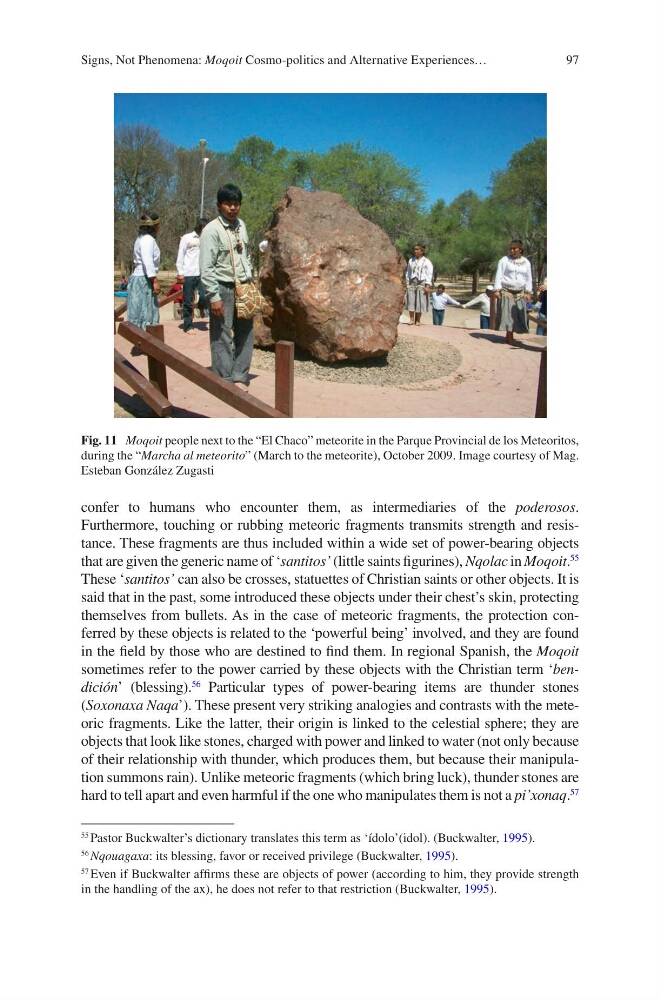
Fig. 11 Moqoit people next to the “El Chaco” meteorite in the Parque Provincial de los Meteoritos,
during the “Marcha al meteorito” (March to the meteorite), October 2009. Image courtesy of Mag.
Esteban González Zugasti
Signs, Not Phenomena: Moqoit Cosmo-politics and Alternative Experiences…
confer to humans who encounter them, as intermediaries of the poderosos.
Furthermore, touching or rubbing meteoric fragments transmits strength and resistance. These fragments are thus included within a wide set of power-bearing objects
that are given the generic name of ‘santitos’ (little saints figurines), Nqolac in Moqoit.
55
These ‘santitos’ can also be crosses, statuettes of Christian saints or other objects. It is
said that in the past, some introduced these objects under their chest’s skin, protecting
themselves from bullets. As in the case of meteoric fragments, the protection conferred by these objects is related to the ‘powerful being’ involved, and they are found
in the field by those who are destined to find them. In regional Spanish, the Moqoit
sometimes refer to the power carried by these objects with the Christian term ‘bendición’ (blessing).
56
Particular types of power-bearing items are thunder stones
(Soxonaxa Naqa’). These present very striking analogies and contrasts with the meteoric fragments. Like the latter, their origin is linked to the celestial sphere; they are
objects that look like stones, charged with power and linked to water (not only because
of their relationship with thunder, which produces them, but because their manipulation summons rain). Unlike meteoric fragments (which bring luck), thunder stones are
hard to tell apart and even harmful if the one who manipulates them is not a pi’xonaq.
57
55 Pastor Buckwalter’s dictionary translates this term as ‘ídolo’(idol). (Buckwalter, 1995).
56 Nqouagaxa: its blessing, favor or received privilege (Buckwalter, 1995).
57 Even if Buckwalter affirms these are objects of power (according to him, they provide strength
in the handling of the ax), he does not refer to that restriction (Buckwalter, 1995).
Fig. 11 Moqoit people next to the “El Chaco” meteorite in the Parque Provincial de los Meteoritos,
during the “Marcha al meteorito” (March to the meteorite), October 2009. Image courtesy of Mag.
Esteban González Zugasti
Signs, Not Phenomena: Moqoit Cosmo-politics and Alternative Experiences…