

75
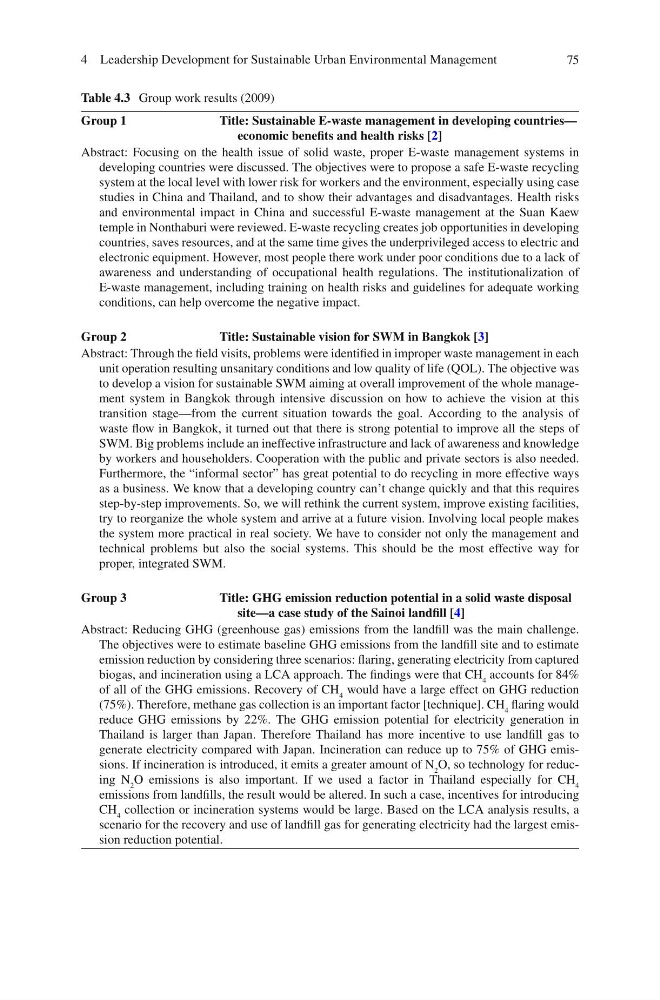
Table 4.3 Group work results (2009)
Group 1
Title: Sustainable E-waste management in developing countries—
economic benefi ts and health risks [ 2 ]
Abstract: Focusing on the health issue of solid waste, proper E-waste management systems in
developing countries were discussed. The objectives were to propose a safe E-waste recycling
system at the local level with lower risk for workers and the environment, especially using case
studies in China and Thailand, and to show their advantages and disadvantages. Health risks
and environmental impact in China and successful E-waste management at the Suan Kaew
temple in Nonthaburi were reviewed. E-waste recycling creates job opportunities in developing
countries, saves resources, and at the same time gives the underprivileged access to electric and
electronic equipment. However, most people there work under poor conditions due to a lack of
awareness and understanding of occupational health regulations. The institutionalization of
E-waste management, including training on health risks and guidelines for adequate working
conditions, can help overcome the negative impact.
Group 2
Title: Sustainable vision for SWM in Bangkok [ 3 ]
Abstract: Through the fi eld visits, problems were identifi ed in improper waste management in each
unit operation resulting unsanitary conditions and low quality of life (QOL). The objective was
to develop a vision for sustainable SWM aiming at overall improvement of the whole management system in Bangkok through intensive discussion on how to achieve the vision at this
transition stage—from the current situation towards the goal. According to the analysis of
waste fl ow in Bangkok, it turned out that there is strong potential to improve all the steps of
SWM. Big problems include an ineffective infrastructure and lack of awareness and knowledge
by workers and householders. Cooperation with the public and private sectors is also needed.
Furthermore, the “informal sector” has great potential to do recycling in more effective ways
as a business. We know that a developing country can’t change quickly and that this requires
step-by-step improvements. So, we will rethink the current system, improve existing facilities,
try to reorganize the whole system and arrive at a future vision. Involving local people makes
the system more practical in real society. We have to consider not only the management and
technical problems but also the social systems. This should be the most effective way for
proper, integrated SWM.
Group 3
Title: GHG emission reduction potential in a solid waste disposal
site—a case study of the Sainoi landfi ll [ 4 ]
Abstract: Reducing GHG (greenhouse gas) emissions from the landfi ll was the main challenge.
The objectives were to estimate baseline GHG emissions from the landfi ll site and to estimate
emission reduction by considering three scenarios: fl aring, generating electricity from captured
biogas, and incineration using a LCA approach. The fi ndings were that CH 4 accounts for 84%
of all of the GHG emissions. Recovery of CH 4 would have a large effect on GHG reduction
(75%). Therefore, methane gas collection is an important factor [technique]. CH 4 fl aring would
reduce GHG emissions by 22%. The GHG emission potential for electricity generation in
Thailand is larger than Japan. Therefore Thailand has more incentive to use landfi ll gas to
generate electricity compared with Japan. Incineration can reduce up to 75% of GHG emissions. If incineration is introduced, it emits a greater amount of N 2 O, so technology for reducing N 2 O emissions is also important. If we used a factor in Thailand especially for CH 4
emissions from landfi lls, the result would be altered. In such a case, incentives for introducing
CH 4 collection or incineration systems would be large. Based on the LCA analysis results, a
scenario for the recovery and use of landfi ll gas for generating electricity had the largest emission reduction potential.
4 Leadership Development for Sustainable Urban Environmental Management
Table 4.3 Group work results (2009)
Group 1
Title: Sustainable E-waste management in developing countries—
economic benefi ts and health risks [ 2 ]
Abstract: Focusing on the health issue of solid waste, proper E-waste management systems in
developing countries were discussed. The objectives were to propose a safe E-waste recycling
system at the local level with lower risk for workers and the environment, especially using case
studies in China and Thailand, and to show their advantages and disadvantages. Health risks
and environmental impact in China and successful E-waste management at the Suan Kaew
temple in Nonthaburi were reviewed. E-waste recycling creates job opportunities in developing
countries, saves resources, and at the same time gives the underprivileged access to electric and
electronic equipment. However, most people there work under poor conditions due to a lack of
awareness and understanding of occupational health regulations. The institutionalization of
E-waste management, including training on health risks and guidelines for adequate working
conditions, can help overcome the negative impact.
Group 2
Title: Sustainable vision for SWM in Bangkok [ 3 ]
Abstract: Through the fi eld visits, problems were identifi ed in improper waste management in each
unit operation resulting unsanitary conditions and low quality of life (QOL). The objective was
to develop a vision for sustainable SWM aiming at overall improvement of the whole management system in Bangkok through intensive discussion on how to achieve the vision at this
transition stage—from the current situation towards the goal. According to the analysis of
waste fl ow in Bangkok, it turned out that there is strong potential to improve all the steps of
SWM. Big problems include an ineffective infrastructure and lack of awareness and knowledge
by workers and householders. Cooperation with the public and private sectors is also needed.
Furthermore, the “informal sector” has great potential to do recycling in more effective ways
as a business. We know that a developing country can’t change quickly and that this requires
step-by-step improvements. So, we will rethink the current system, improve existing facilities,
try to reorganize the whole system and arrive at a future vision. Involving local people makes
the system more practical in real society. We have to consider not only the management and
technical problems but also the social systems. This should be the most effective way for
proper, integrated SWM.
Group 3
Title: GHG emission reduction potential in a solid waste disposal
site—a case study of the Sainoi landfi ll [ 4 ]
Abstract: Reducing GHG (greenhouse gas) emissions from the landfi ll was the main challenge.
The objectives were to estimate baseline GHG emissions from the landfi ll site and to estimate
emission reduction by considering three scenarios: fl aring, generating electricity from captured
biogas, and incineration using a LCA approach. The fi ndings were that CH 4 accounts for 84%
of all of the GHG emissions. Recovery of CH 4 would have a large effect on GHG reduction
(75%). Therefore, methane gas collection is an important factor [technique]. CH 4 fl aring would
reduce GHG emissions by 22%. The GHG emission potential for electricity generation in
Thailand is larger than Japan. Therefore Thailand has more incentive to use landfi ll gas to
generate electricity compared with Japan. Incineration can reduce up to 75% of GHG emissions. If incineration is introduced, it emits a greater amount of N 2 O, so technology for reducing N 2 O emissions is also important. If we used a factor in Thailand especially for CH 4
emissions from landfi lls, the result would be altered. In such a case, incentives for introducing
CH 4 collection or incineration systems would be large. Based on the LCA analysis results, a
scenario for the recovery and use of landfi ll gas for generating electricity had the largest emission reduction potential.
4 Leadership Development for Sustainable Urban Environmental Management