

66
fi nding” strategy during the proposal on a development plan for 2030. We expected
students to have a clearer image to act as environmental leaders in their actual future.
For group work, students were divided into three groups looking for a good
balance of the three universities to share their different backgrounds. In line with the
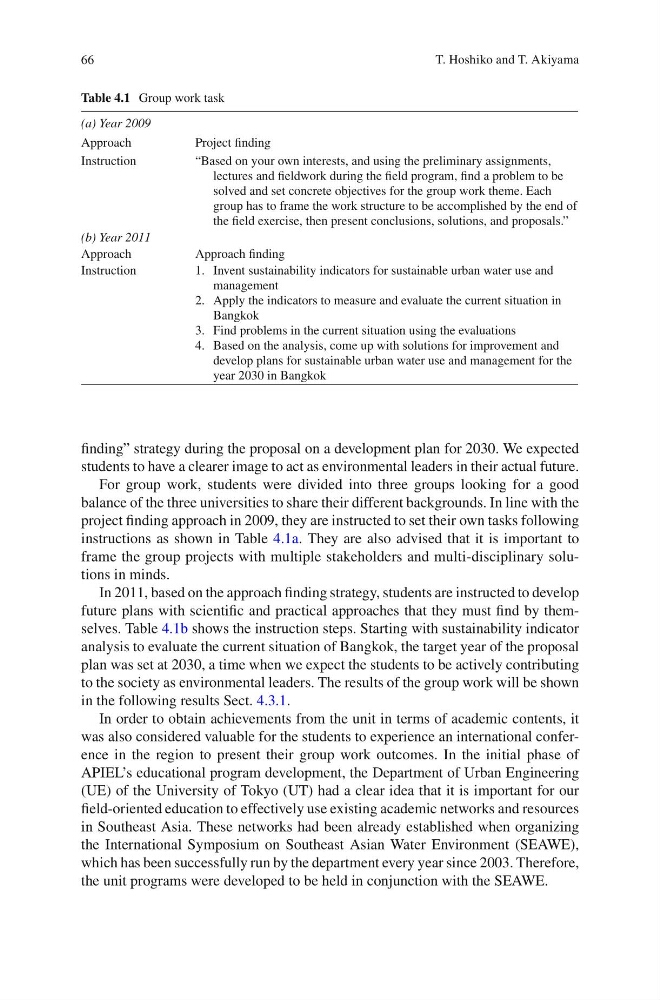
project fi nding approach in 2009, they are instructed to set their own tasks following
instructions as shown in Table 4.1a . They are also advised that it is important to
frame the group projects with multiple stakeholders and multi-disciplinary solutions in minds.
In 2011, based on the approach fi nding strategy, students are instructed to develop
future plans with scientifi c and practical approaches that they must fi nd by themselves. Table 4.1b shows the instruction steps. Starting with sustainability indicator
analysis to evaluate the current situation of Bangkok, the target year of the proposal
plan was set at 2030, a time when we expect the students to be actively contributing
to the society as environmental leaders. The results of the group work will be shown
in the following results Sect. 4.3.1 .
In order to obtain achievements from the unit in terms of academic contents, it
was also considered valuable for the students to experience an international conference in the region to present their group work outcomes. In the initial phase of
APIEL’s educational program development, the Department of Urban Engineering
(UE) of the University of Tokyo (UT) had a clear idea that it is important for our
fi eld-oriented education to effectively use existing academic networks and resources
in Southeast Asia. These networks had been already established when organizing
the International Symposium on Southeast Asian Water Environment (SEAWE),
which has been successfully run by the department every year since 2003. Therefore,
the unit programs were developed to be held in conjunction with the SEAWE.
Table 4.1 Group work task
(a) Year 2009
Approach
Project fi nding
Instruction
“Based on your own interests, and using the preliminary assignments,
lectures and fi eldwork during the fi eld program, fi nd a problem to be
solved and set concrete objectives for the group work theme. Each
group has to frame the work structure to be accomplished by the end of
the fi eld exercise, then present conclusions, solutions, and proposals.”
(b) Year 2011
Approach
Approach fi nding
Instruction
1. Invent sustainability indicators for sustainable urban water use and
management
2. Apply the indicators to measure and evaluate the current situation in
Bangkok
3. Find problems in the current situation using the evaluations
4. Based on the analysis, come up with solutions for improvement and
develop plans for sustainable urban water use and management for the
year 2030 in Bangkok
T. Hoshiko and T. Akiyama
fi nding” strategy during the proposal on a development plan for 2030. We expected
students to have a clearer image to act as environmental leaders in their actual future.
For group work, students were divided into three groups looking for a good
balance of the three universities to share their different backgrounds. In line with the
project fi nding approach in 2009, they are instructed to set their own tasks following
instructions as shown in Table 4.1a . They are also advised that it is important to
frame the group projects with multiple stakeholders and multi-disciplinary solutions in minds.
In 2011, based on the approach fi nding strategy, students are instructed to develop
future plans with scientifi c and practical approaches that they must fi nd by themselves. Table 4.1b shows the instruction steps. Starting with sustainability indicator
analysis to evaluate the current situation of Bangkok, the target year of the proposal
plan was set at 2030, a time when we expect the students to be actively contributing
to the society as environmental leaders. The results of the group work will be shown
in the following results Sect. 4.3.1 .
In order to obtain achievements from the unit in terms of academic contents, it
was also considered valuable for the students to experience an international conference in the region to present their group work outcomes. In the initial phase of
APIEL’s educational program development, the Department of Urban Engineering
(UE) of the University of Tokyo (UT) had a clear idea that it is important for our
fi eld-oriented education to effectively use existing academic networks and resources
in Southeast Asia. These networks had been already established when organizing
the International Symposium on Southeast Asian Water Environment (SEAWE),
which has been successfully run by the department every year since 2003. Therefore,
the unit programs were developed to be held in conjunction with the SEAWE.
Table 4.1 Group work task
(a) Year 2009
Approach
Project fi nding
Instruction
“Based on your own interests, and using the preliminary assignments,
lectures and fi eldwork during the fi eld program, fi nd a problem to be
solved and set concrete objectives for the group work theme. Each
group has to frame the work structure to be accomplished by the end of
the fi eld exercise, then present conclusions, solutions, and proposals.”
(b) Year 2011
Approach
Approach fi nding
Instruction
1. Invent sustainability indicators for sustainable urban water use and
management
2. Apply the indicators to measure and evaluate the current situation in
Bangkok
3. Find problems in the current situation using the evaluations
4. Based on the analysis, come up with solutions for improvement and
develop plans for sustainable urban water use and management for the
year 2030 in Bangkok
T. Hoshiko and T. Akiyama