

46
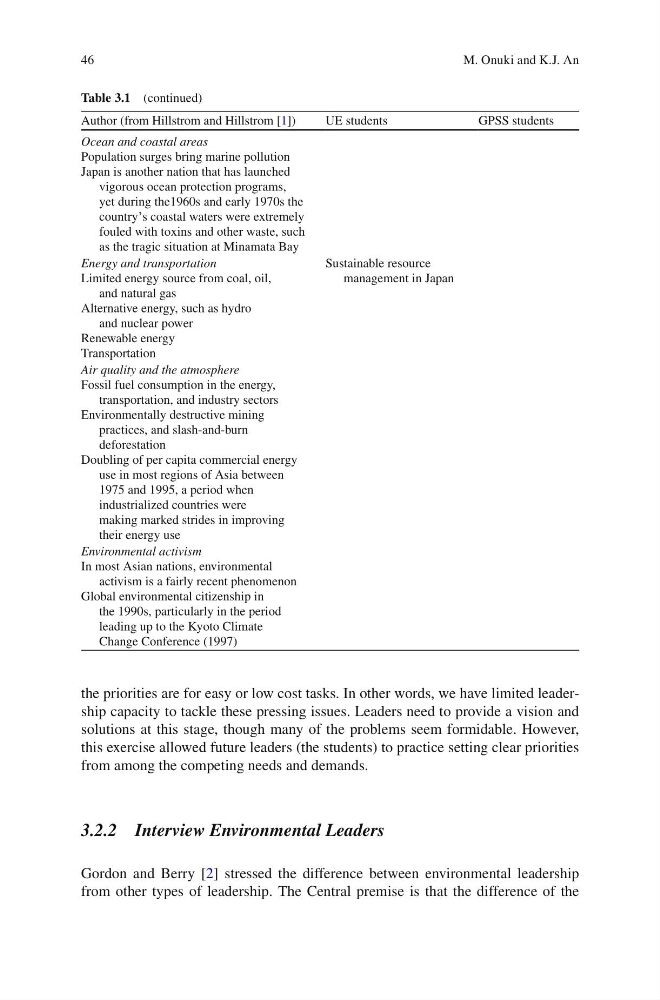
Table 3.1 (continued)
Author (from Hillstrom and Hillstrom [ 1 ])
UE students
GPSS students
Ocean and coastal areas
Population surges bring marine pollution
Japan is another nation that has launched
vigorous ocean protection programs,
yet during the1960s and early 1970s the
country’s coastal waters were extremely
fouled with toxins and other waste, such
as the tragic situation at Minamata Bay
Energy and transportation
Limited energy source from coal, oil,
and natural gas
Alternative energy, such as hydro
and nuclear power
Renewable energy
Transportation
Sustainable resource
management in Japan
Air quality and the atmosphere
Fossil fuel consumption in the energy,
transportation, and industry sectors
Environmentally destructive mining
practices, and slash-and-burn
deforestation
Doubling of per capita commercial energy
use in most regions of Asia between
1975 and 1995, a period when
industrialized countries were
making marked strides in improving
their energy use
Environmental activism
In most Asian nations, environmental
activism is a fairly recent phenomenon
Global environmental citizenship in
the 1990s, particularly in the period
leading up to the Kyoto Climate
Change Conference (1997)
the priorities are for easy or low cost tasks. In other words, we have limited leadership capacity to tackle these pressing issues. Leaders need to provide a vision and
solutions at this stage, though many of the problems seem formidable. However,
this exercise allowed future leaders (the students) to practice setting clear priorities
from among the competing needs and demands.
3.2.2 Interview Environmental Leaders
Gordon and Berry [ 2 ] stressed the difference between environmental leadership
from other types of leadership. The Central premise is that the difference of the
M. Onuki and K.J. An
Table 3.1 (continued)
Author (from Hillstrom and Hillstrom [ 1 ])
UE students
GPSS students
Ocean and coastal areas
Population surges bring marine pollution
Japan is another nation that has launched
vigorous ocean protection programs,
yet during the1960s and early 1970s the
country’s coastal waters were extremely
fouled with toxins and other waste, such
as the tragic situation at Minamata Bay
Energy and transportation
Limited energy source from coal, oil,
and natural gas
Alternative energy, such as hydro
and nuclear power
Renewable energy
Transportation
Sustainable resource
management in Japan
Air quality and the atmosphere
Fossil fuel consumption in the energy,
transportation, and industry sectors
Environmentally destructive mining
practices, and slash-and-burn
deforestation
Doubling of per capita commercial energy
use in most regions of Asia between
1975 and 1995, a period when
industrialized countries were
making marked strides in improving
their energy use
Environmental activism
In most Asian nations, environmental
activism is a fairly recent phenomenon
Global environmental citizenship in
the 1990s, particularly in the period
leading up to the Kyoto Climate
Change Conference (1997)
the priorities are for easy or low cost tasks. In other words, we have limited leadership capacity to tackle these pressing issues. Leaders need to provide a vision and
solutions at this stage, though many of the problems seem formidable. However,
this exercise allowed future leaders (the students) to practice setting clear priorities
from among the competing needs and demands.
3.2.2 Interview Environmental Leaders
Gordon and Berry [ 2 ] stressed the difference between environmental leadership
from other types of leadership. The Central premise is that the difference of the
M. Onuki and K.J. An