

29
families. However, reunions with old friends have become diffi cult in recent years.
Many families are not living on their pasture land anymore. This is not because they
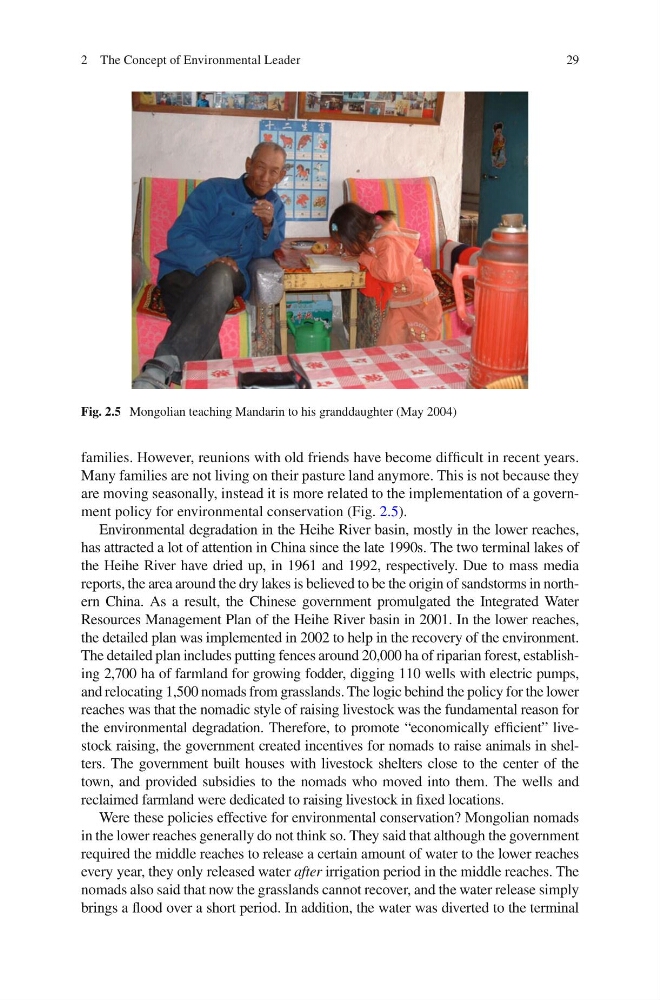
are moving seasonally, instead it is more related to the implementation of a government policy for environmental conservation (Fig. 2.5 ).
Environmental degradation in the Heihe River basin, mostly in the lower reaches,
has attracted a lot of attention in China since the late 1990s. The two terminal lakes of
the Heihe River have dried up, in 1961 and 1992, respectively. Due to mass media
reports, the area around the dry lakes is believed to be the origin of sandstorms in northern China. As a result, the Chinese government promulgated the Integrated Water
Resources Management Plan of the Heihe River basin in 2001. In the lower reaches,
the detailed plan was implemented in 2002 to help in the recovery of the environment.
The detailed plan includes putting fences around 20,000 ha of riparian forest, establishing 2,700 ha of farmland for growing fodder, digging 110 wells with electric pumps,
and relocating 1,500 nomads from grasslands. The logic behind the policy for the lower
reaches was that the nomadic style of raising livestock was the fundamental reason for
the environmental degradation. Therefore, to promote “economically effi cient” livestock raising, the government created incentives for nomads to raise animals in shelters. The government built houses with livestock shelters close to the center of the
town, and provided subsidies to the nomads who moved into them. The wells and
reclaimed farmland were dedicated to raising livestock in fi xed locations.
Were these policies effective for environmental conservation? Mongolian nomads
in the lower reaches generally do not think so. They said that although the government
required the middle reaches to release a certain amount of water to the lower reaches
every year, they only released water after irrigation period in the middle reaches. The
nomads also said that now the grasslands cannot recover, and the water release simply
brings a fl ood over a short period. In addition, the water was diverted to the terminal
Fig. 2.5 Mongolian teaching Mandarin to his granddaughter (May 2004)
2 The Concept of Environmental Leader
families. However, reunions with old friends have become diffi cult in recent years.
Many families are not living on their pasture land anymore. This is not because they
are moving seasonally, instead it is more related to the implementation of a government policy for environmental conservation (Fig. 2.5 ).
Environmental degradation in the Heihe River basin, mostly in the lower reaches,
has attracted a lot of attention in China since the late 1990s. The two terminal lakes of
the Heihe River have dried up, in 1961 and 1992, respectively. Due to mass media
reports, the area around the dry lakes is believed to be the origin of sandstorms in northern China. As a result, the Chinese government promulgated the Integrated Water
Resources Management Plan of the Heihe River basin in 2001. In the lower reaches,
the detailed plan was implemented in 2002 to help in the recovery of the environment.
The detailed plan includes putting fences around 20,000 ha of riparian forest, establishing 2,700 ha of farmland for growing fodder, digging 110 wells with electric pumps,
and relocating 1,500 nomads from grasslands. The logic behind the policy for the lower
reaches was that the nomadic style of raising livestock was the fundamental reason for
the environmental degradation. Therefore, to promote “economically effi cient” livestock raising, the government created incentives for nomads to raise animals in shelters. The government built houses with livestock shelters close to the center of the
town, and provided subsidies to the nomads who moved into them. The wells and
reclaimed farmland were dedicated to raising livestock in fi xed locations.
Were these policies effective for environmental conservation? Mongolian nomads
in the lower reaches generally do not think so. They said that although the government
required the middle reaches to release a certain amount of water to the lower reaches
every year, they only released water after irrigation period in the middle reaches. The
nomads also said that now the grasslands cannot recover, and the water release simply
brings a fl ood over a short period. In addition, the water was diverted to the terminal
Fig. 2.5 Mongolian teaching Mandarin to his granddaughter (May 2004)
2 The Concept of Environmental Leader