

23
mutual interest. Although, there are many leadership theories, none are universally
accepted in environmental leadership. However, transformational leadership has
often been featured strongly in studies of environmental leaders [ 10 ] and this theory
is helpful in understanding and explaining the behaviors of environmental leaders.
For instance, Burns [ 11 ] defi nes leadership as transformational leaders inducing
followers to act for certain goals that represent the values and the motivations of
both leaders and followers. Greenleaf [ 12 ]’s servant leader is more explicitly visionary than the transforming leader, in that leaders must also have a prophetic vision of
the future state into which followers are being led. Collective leadership that
includes cultural and social perspectives to deal with complex environmental issues
is addressed in following Sect. 2.2 . We depend on leaders to respond to time and
place in a situation of diminishing natural resources and growing environmental
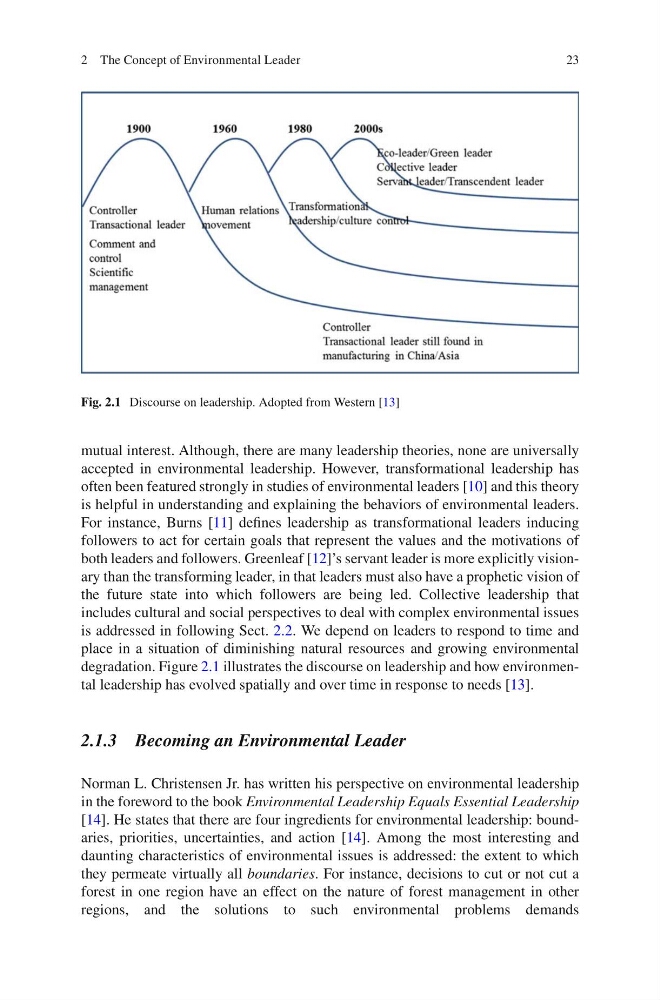
degradation. Figure 2.1 illustrates the discourse on leadership and how environmental leadership has evolved spatially and over time in response to needs [ 13 ].
2.1.3 Becoming an Environmental Leader
Norman L. Christensen Jr. has written his perspective on environmental leadership
in the foreword to the book Environmental Leadership Equals Essential Leadership
[ 14 ]. He states that there are four ingredients for environmental leadership: boundaries, priorities, uncertainties, and action [ 14 ]. Among the most interesting and
daunting characteristics of environmental issues is addressed: the extent to which
they permeate virtually all boundaries . For instance, decisions to cut or not cut a
forest in one region have an effect on the nature of forest management in other
regions, and the solutions to such environmental problems demands
Fig. 2.1 Discourse on leadership. Adopted from Western [ 13 ]
2 The Concept of Environmental Leader
mutual interest. Although, there are many leadership theories, none are universally
accepted in environmental leadership. However, transformational leadership has
often been featured strongly in studies of environmental leaders [ 10 ] and this theory
is helpful in understanding and explaining the behaviors of environmental leaders.
For instance, Burns [ 11 ] defi nes leadership as transformational leaders inducing
followers to act for certain goals that represent the values and the motivations of
both leaders and followers. Greenleaf [ 12 ]’s servant leader is more explicitly visionary than the transforming leader, in that leaders must also have a prophetic vision of
the future state into which followers are being led. Collective leadership that
includes cultural and social perspectives to deal with complex environmental issues
is addressed in following Sect. 2.2 . We depend on leaders to respond to time and
place in a situation of diminishing natural resources and growing environmental
degradation. Figure 2.1 illustrates the discourse on leadership and how environmental leadership has evolved spatially and over time in response to needs [ 13 ].
2.1.3 Becoming an Environmental Leader
Norman L. Christensen Jr. has written his perspective on environmental leadership
in the foreword to the book Environmental Leadership Equals Essential Leadership
[ 14 ]. He states that there are four ingredients for environmental leadership: boundaries, priorities, uncertainties, and action [ 14 ]. Among the most interesting and
daunting characteristics of environmental issues is addressed: the extent to which
they permeate virtually all boundaries . For instance, decisions to cut or not cut a
forest in one region have an effect on the nature of forest management in other
regions, and the solutions to such environmental problems demands
Fig. 2.1 Discourse on leadership. Adopted from Western [ 13 ]
2 The Concept of Environmental Leader