

21
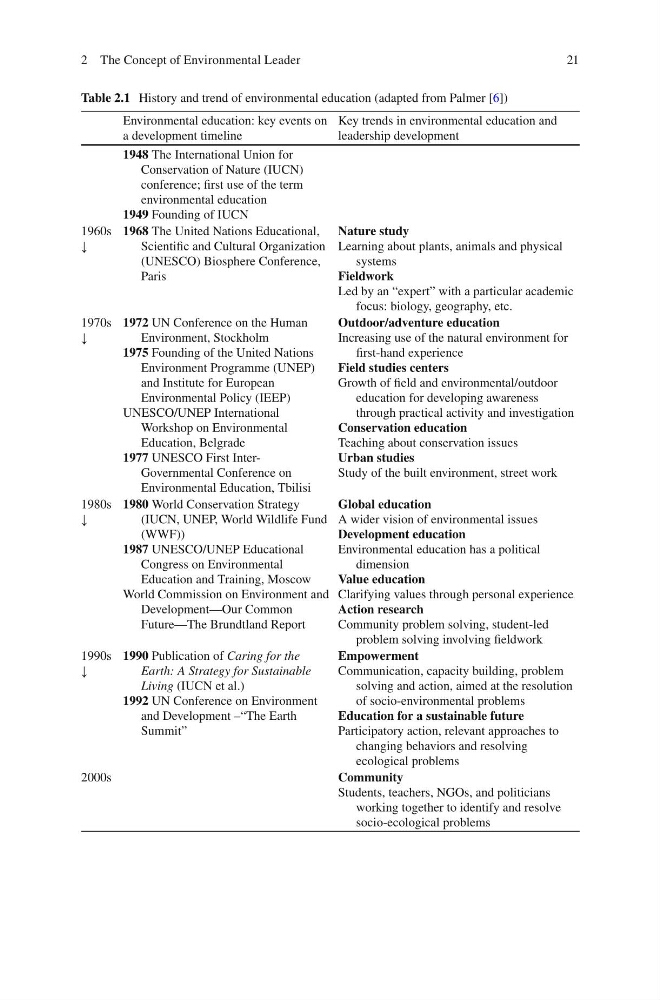
Table 2.1 History and trend of environmental education (adapted from Palmer [ 6 ])
Environmental education: key events on
a development timeline
Key trends in environmental education and
leadership development
1948 The International Union for
Conservation of Nature (IUCN)
conference; fi rst use of the term
environmental education
1949 Founding of IUCN
1960s
↓
1968 The United Nations Educational,
Scientifi c and Cultural Organization
(UNESCO) Biosphere Conference,
Paris
Nature study
Learning about plants, animals and physical
systems
Fieldwork
Led by an “expert” with a particular academic
focus: biology, geography, etc.
1970s
↓
1972 UN Conference on the Human
Environment, Stockholm
1975 Founding of the United Nations
Environment Programme (UNEP)
and Institute for European
Environmental Policy (IEEP)
UNESCO/UNEP International
Workshop on Environmental
Education, Belgrade
1977 UNESCO First InterGovernmental Conference on
Environmental Education, Tbilisi
Outdoor/adventure education
Increasing use of the natural environment for
fi rst-hand experience
Field studies centers
Growth of fi eld and environmental/outdoor
education for developing awareness
through practical activity and investigation
Conservation education
Teaching about conservation issues
Urban studies
Study of the built environment, street work
1980s
↓
1980 World Conservation Strategy
(IUCN, UNEP, World Wildlife Fund
(WWF))
1987 UNESCO/UNEP Educational
Congress on Environmental
Education and Training, Moscow
World Commission on Environment and
Development—Our Common
Future—The Brundtland Report
Global education
A wider vision of environmental issues
Development education
Environmental education has a political
dimension
Value education
Clarifying values through personal experience
Action research
Community problem solving, student-led
problem solving involving fi eldwork
1990s
↓
1990 Publication of Caring for the
Earth: A Strategy for Sustainable
Living (IUCN et al.)
1992 UN Conference on Environment
and Development –“The Earth
Summit”
Empowerment
Communication, capacity building, problem
solving and action, aimed at the resolution
of socio-environmental problems
Education for a sustainable future
Participatory action, relevant approaches to
changing behaviors and resolving
ecological problems
2000s
Community
Students, teachers, NGOs, and politicians
working together to identify and resolve
socio-ecological problems
2 The Concept of Environmental Leader
Table 2.1 History and trend of environmental education (adapted from Palmer [ 6 ])
Environmental education: key events on
a development timeline
Key trends in environmental education and
leadership development
1948 The International Union for
Conservation of Nature (IUCN)
conference; fi rst use of the term
environmental education
1949 Founding of IUCN
1960s
↓
1968 The United Nations Educational,
Scientifi c and Cultural Organization
(UNESCO) Biosphere Conference,
Paris
Nature study
Learning about plants, animals and physical
systems
Fieldwork
Led by an “expert” with a particular academic
focus: biology, geography, etc.
1970s
↓
1972 UN Conference on the Human
Environment, Stockholm
1975 Founding of the United Nations
Environment Programme (UNEP)
and Institute for European
Environmental Policy (IEEP)
UNESCO/UNEP International
Workshop on Environmental
Education, Belgrade
1977 UNESCO First InterGovernmental Conference on
Environmental Education, Tbilisi
Outdoor/adventure education
Increasing use of the natural environment for
fi rst-hand experience
Field studies centers
Growth of fi eld and environmental/outdoor
education for developing awareness
through practical activity and investigation
Conservation education
Teaching about conservation issues
Urban studies
Study of the built environment, street work
1980s
↓
1980 World Conservation Strategy
(IUCN, UNEP, World Wildlife Fund
(WWF))
1987 UNESCO/UNEP Educational
Congress on Environmental
Education and Training, Moscow
World Commission on Environment and
Development—Our Common
Future—The Brundtland Report
Global education
A wider vision of environmental issues
Development education
Environmental education has a political
dimension
Value education
Clarifying values through personal experience
Action research
Community problem solving, student-led
problem solving involving fi eldwork
1990s
↓
1990 Publication of Caring for the
Earth: A Strategy for Sustainable
Living (IUCN et al.)
1992 UN Conference on Environment
and Development –“The Earth
Summit”
Empowerment
Communication, capacity building, problem
solving and action, aimed at the resolution
of socio-environmental problems
Education for a sustainable future
Participatory action, relevant approaches to
changing behaviors and resolving
ecological problems
2000s
Community
Students, teachers, NGOs, and politicians
working together to identify and resolve
socio-ecological problems
2 The Concept of Environmental Leader