

105
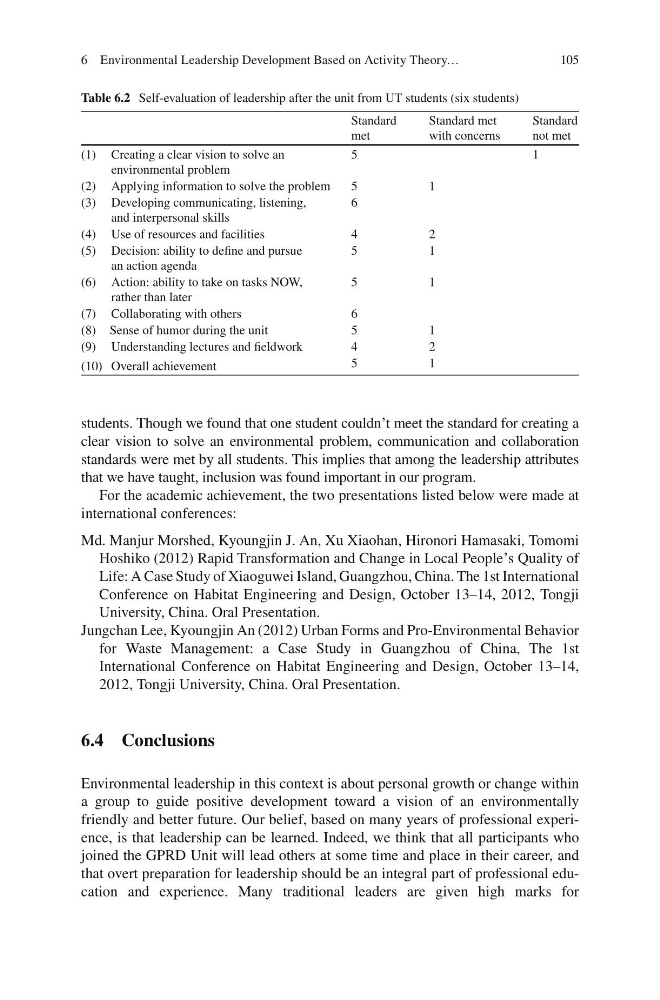
students. Though we found that one student couldn’t meet the standard for creating a
clear vision to solve an environmental problem, communication and collaboration
standards were met by all students. This implies that among the leadership attributes
that we have taught, inclusion was found important in our program.
For the academic achievement, the two presentations listed below were made at
international conferences:
Md. Manjur Morshed, Kyoungjin J. An, Xu Xiaohan, Hironori Hamasaki, Tomomi
Hoshiko (2012) Rapid Transformation and Change in Local People’s Quality of
Life: A Case Study of Xiaoguwei Island, Guangzhou, China. The 1st International
Conference on Habitat Engineering and Design, October 13–14, 2012, Tongji
University, China. Oral Presentation.
Jungchan Lee, Kyoungjin An (2012) Urban Forms and Pro-Environmental Behavior
for Waste Management: a Case Study in Guangzhou of China, The 1st
International Conference on Habitat Engineering and Design, October 13–14,
2012, Tongji University, China. Oral Presentation.
6.4 Conclusions
Environmental leadership in this context is about personal growth or change within
a group to guide positive development toward a vision of an environmentally
friendly and better future. Our belief, based on many years of professional experience, is that leadership can be learned. Indeed, we think that all participants who
joined the GPRD Unit will lead others at some time and place in their career, and
that overt preparation for leadership should be an integral part of professional education and experience. Many traditional leaders are given high marks for
Table 6.2 Self-evaluation of leadership after the unit from UT students (six students)
Standard
met
Standard met
with concerns
Standard
not met
(1) Creating a clear vision to solve an
environmental problem
5
1
(2) Applying information to solve the problem
5
1
(3) Developing communicating, listening,
and interpersonal skills
6
(4) Use of resources and facilities
4
2
(5) Decision: ability to defi ne and pursue
an action agenda
5
1
(6) Action: ability to take on tasks NOW,
rather than later
5
1
(7) Collaborating with others
6
(8) Sense of humor during the unit
5
1
(9) Understanding lectures and fi eldwork
4
2
(10) Overall achievement
5
1
6 Environmental Leadership Development Based on Activity Theory…
students. Though we found that one student couldn’t meet the standard for creating a
clear vision to solve an environmental problem, communication and collaboration
standards were met by all students. This implies that among the leadership attributes
that we have taught, inclusion was found important in our program.
For the academic achievement, the two presentations listed below were made at
international conferences:
Md. Manjur Morshed, Kyoungjin J. An, Xu Xiaohan, Hironori Hamasaki, Tomomi
Hoshiko (2012) Rapid Transformation and Change in Local People’s Quality of
Life: A Case Study of Xiaoguwei Island, Guangzhou, China. The 1st International
Conference on Habitat Engineering and Design, October 13–14, 2012, Tongji
University, China. Oral Presentation.
Jungchan Lee, Kyoungjin An (2012) Urban Forms and Pro-Environmental Behavior
for Waste Management: a Case Study in Guangzhou of China, The 1st
International Conference on Habitat Engineering and Design, October 13–14,
2012, Tongji University, China. Oral Presentation.
6.4 Conclusions
Environmental leadership in this context is about personal growth or change within
a group to guide positive development toward a vision of an environmentally
friendly and better future. Our belief, based on many years of professional experience, is that leadership can be learned. Indeed, we think that all participants who
joined the GPRD Unit will lead others at some time and place in their career, and
that overt preparation for leadership should be an integral part of professional education and experience. Many traditional leaders are given high marks for
Table 6.2 Self-evaluation of leadership after the unit from UT students (six students)
Standard
met
Standard met
with concerns
Standard
not met
(1) Creating a clear vision to solve an
environmental problem
5
1
(2) Applying information to solve the problem
5
1
(3) Developing communicating, listening,
and interpersonal skills
6
(4) Use of resources and facilities
4
2
(5) Decision: ability to defi ne and pursue
an action agenda
5
1
(6) Action: ability to take on tasks NOW,
rather than later
5
1
(7) Collaborating with others
6
(8) Sense of humor during the unit
5
1
(9) Understanding lectures and fi eldwork
4
2
(10) Overall achievement
5
1
6 Environmental Leadership Development Based on Activity Theory…