

102
Street village), and an urban village (Xiadu village) for newcomers seeking economic opportunities, as shown in Fig. 6.6 .
The selection of a study area for each group was based on the vision created by
the group members through communication, knowledge creation, and objectives.
This process was challenging because students from different backgrounds, countries, major subjects of study, and personal characteristics had to build trust through
exchange and then divide up roles, as illustrated in Fig. 6.3 . Through the lens of
QOL, each urban form for Guangzhou’s urban development was measured and
extended to the pro-environmental behavior of the residents. Learning occurred
through the interaction of the learner with the components of social sustainability in
the fi eld. The creation of a vision, division of labor, and generating a knowledge
base through reconnaissance and sample surveys, were used for arriving at particular policy-level outcomes.
6.3.4 Creating Vision: Challenges from Student’s Feedback
This section was abstracted from student reports expressing the challenges they
faced during the unit. First, most students said that arriving at a consensus for a
common goal was a challenge. A student wrote in her fi nal report that the group’s
decision on the vision was a spontaneous process of continuous discussion, and that
a systematic division of roles was the next step in the process. In her group, vision
creation was done through personal interest, then a tree of functions was drawn and
every member of the team was asked to write their names beside their choice for
work. This approach was then later adopted as a common methodology. Postanalysis and brainstorming were used in her group to focus on waste management
-60%
-40%
-20%
0%
20%
40%
60%
80%
100%
Built-up area
Arable land
Transportation
Forest
Water
Bare Land
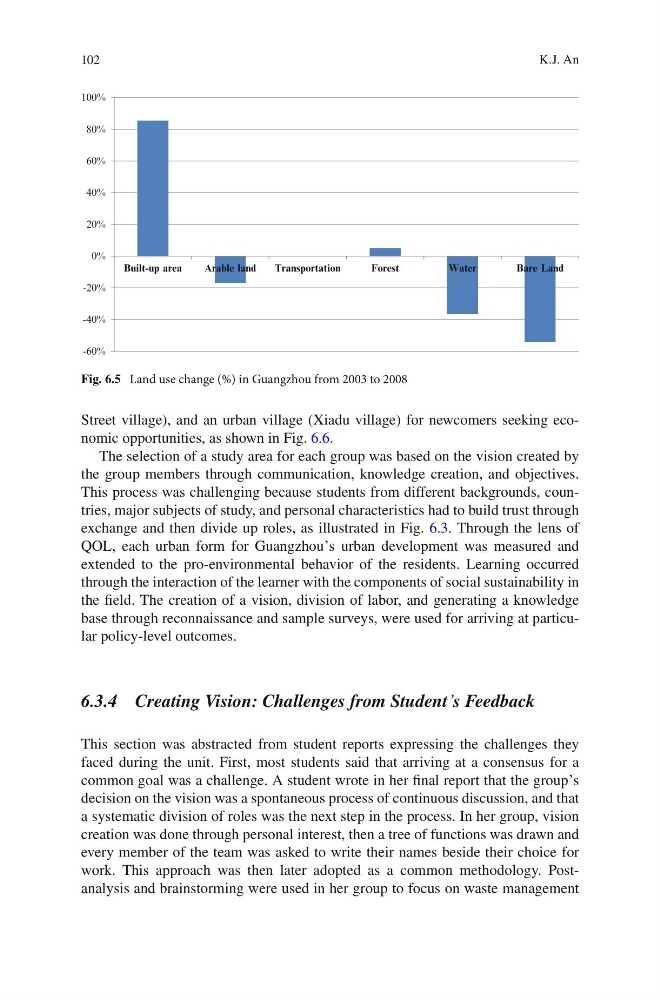
Fig. 6.5 Land use change (%) in Guangzhou from 2003 to 2008
K.J. An
Street village), and an urban village (Xiadu village) for newcomers seeking economic opportunities, as shown in Fig. 6.6 .
The selection of a study area for each group was based on the vision created by
the group members through communication, knowledge creation, and objectives.
This process was challenging because students from different backgrounds, countries, major subjects of study, and personal characteristics had to build trust through
exchange and then divide up roles, as illustrated in Fig. 6.3 . Through the lens of
QOL, each urban form for Guangzhou’s urban development was measured and
extended to the pro-environmental behavior of the residents. Learning occurred
through the interaction of the learner with the components of social sustainability in
the fi eld. The creation of a vision, division of labor, and generating a knowledge
base through reconnaissance and sample surveys, were used for arriving at particular policy-level outcomes.
6.3.4 Creating Vision: Challenges from Student’s Feedback
This section was abstracted from student reports expressing the challenges they
faced during the unit. First, most students said that arriving at a consensus for a
common goal was a challenge. A student wrote in her fi nal report that the group’s
decision on the vision was a spontaneous process of continuous discussion, and that
a systematic division of roles was the next step in the process. In her group, vision
creation was done through personal interest, then a tree of functions was drawn and
every member of the team was asked to write their names beside their choice for
work. This approach was then later adopted as a common methodology. Postanalysis and brainstorming were used in her group to focus on waste management
-60%
-40%
-20%
0%
20%
40%
60%
80%
100%
Built-up area
Arable land
Transportation
Forest
Water
Bare Land
Fig. 6.5 Land use change (%) in Guangzhou from 2003 to 2008
K.J. An