

98
6.3.2 Applying Activity Theory to GPRD Field Exercise
As learning activities are dynamic and may have multiple connections among
their own elements and with other activity systems, we carefully applied activity
theory to design the APIEL education program for urban development in the
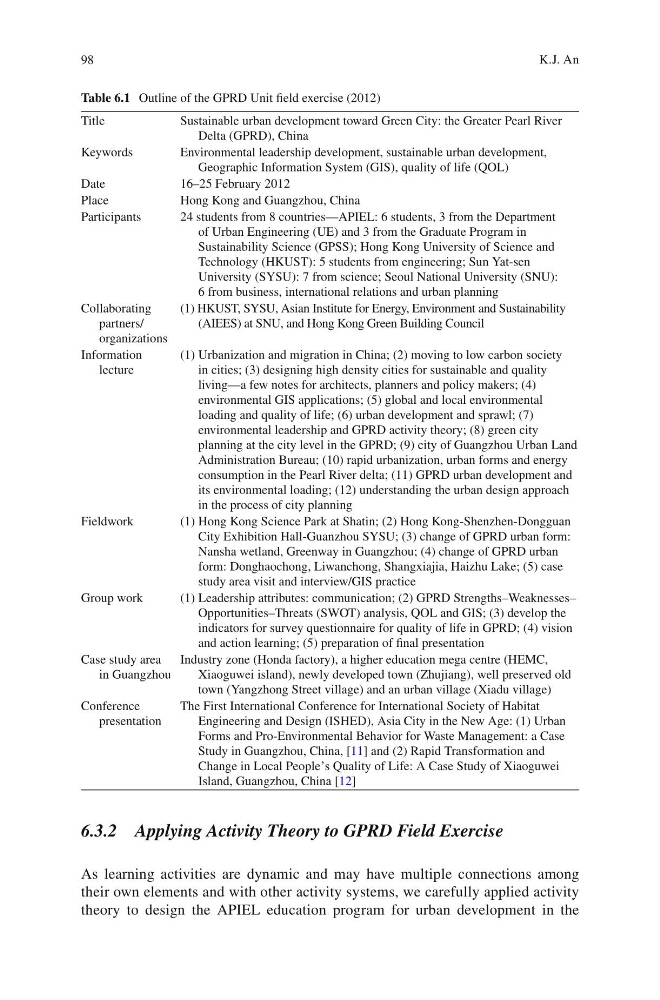
Table 6.1 Outline of the GPRD Unit fi eld exercise (2012)
Title
Sustainable urban development toward Green City: the Greater Pearl River
Delta (GPRD), China
Keywords
Environmental leadership development, sustainable urban development,
Geographic Information System (GIS), quality of life (QOL)
Date
16–25 February 2012
Place
Hong Kong and Guangzhou, China
Participants
24 students from 8 countries—APIEL: 6 students, 3 from the Department
of Urban Engineering (UE) and 3 from the Graduate Program in
Sustainability Science (GPSS); Hong Kong University of Science and
Technology (HKUST): 5 students from engineering; Sun Yat-sen
University (SYSU): 7 from science; Seoul National University (SNU):
6 from business, international relations and urban planning
Collaborating
partners/
organizations
(1) HKUST, SYSU, Asian Institute for Energy, Environment and Sustainability
(AIEES) at SNU, and Hong Kong Green Building Council
Information
lecture
(1) Urbanization and migration in China; (2) moving to low carbon society
in cities; (3) designing high density cities for sustainable and quality
living—a few notes for architects, planners and policy makers; (4)
environmental GIS applications; (5) global and local environmental
loading and quality of life; (6) urban development and sprawl; (7)
environmental leadership and GPRD activity theory; (8) green city
planning at the city level in the GPRD; (9) city of Guangzhou Urban Land
Administration Bureau; (10) rapid urbanization, urban forms and energy
consumption in the Pearl River delta; (11) GPRD urban development and
its environmental loading; (12) understanding the urban design approach
in the process of city planning
Fieldwork
(1) Hong Kong Science Park at Shatin; (2) Hong Kong- Shenzhen-Dongguan
City Exhibition Hall-Guanzhou SYSU; (3) change of GPRD urban form:
Nansha wetland, Greenway in Guangzhou; (4) change of GPRD urban
form: Donghaochong, Liwanchong, Shangxiajia, Haizhu Lake; (5) case
study area visit and interview/GIS practice
Group work
(1) Leadership attributes: communication; (2) GPRD Strengths–Weaknesses–
Opportunities–Threats (SWOT) analysis, QOL and GIS; (3) develop the
indicators for survey questionnaire for quality of life in GPRD; (4) vision
and action learning; (5) preparation of fi nal presentation
Case study area
in Guangzhou
Industry zone (Honda factory), a higher education mega centre (HEMC,
Xiaoguwei island), newly developed town (Zhujiang), well preserved old
town (Yangzhong Street village) and an urban village (Xiadu village)
Conference
presentation
The First International Conference for International Society of Habitat
Engineering and Design (ISHED), Asia City in the New Age: (1) Urban
Forms and Pro-Environmental Behavior for Waste Management: a Case
Study in Guangzhou, China, [ 11 ] and (2) Rapid Transformation and
Change in Local People’s Quality of Life: A Case Study of Xiaoguwei
Island, Guangzhou, China [ 12 ]
K.J. An
6.3.2 Applying Activity Theory to GPRD Field Exercise
As learning activities are dynamic and may have multiple connections among
their own elements and with other activity systems, we carefully applied activity
theory to design the APIEL education program for urban development in the
Table 6.1 Outline of the GPRD Unit fi eld exercise (2012)
Title
Sustainable urban development toward Green City: the Greater Pearl River
Delta (GPRD), China
Keywords
Environmental leadership development, sustainable urban development,
Geographic Information System (GIS), quality of life (QOL)
Date
16–25 February 2012
Place
Hong Kong and Guangzhou, China
Participants
24 students from 8 countries—APIEL: 6 students, 3 from the Department
of Urban Engineering (UE) and 3 from the Graduate Program in
Sustainability Science (GPSS); Hong Kong University of Science and
Technology (HKUST): 5 students from engineering; Sun Yat-sen
University (SYSU): 7 from science; Seoul National University (SNU):
6 from business, international relations and urban planning
Collaborating
partners/
organizations
(1) HKUST, SYSU, Asian Institute for Energy, Environment and Sustainability
(AIEES) at SNU, and Hong Kong Green Building Council
Information
lecture
(1) Urbanization and migration in China; (2) moving to low carbon society
in cities; (3) designing high density cities for sustainable and quality
living—a few notes for architects, planners and policy makers; (4)
environmental GIS applications; (5) global and local environmental
loading and quality of life; (6) urban development and sprawl; (7)
environmental leadership and GPRD activity theory; (8) green city
planning at the city level in the GPRD; (9) city of Guangzhou Urban Land
Administration Bureau; (10) rapid urbanization, urban forms and energy
consumption in the Pearl River delta; (11) GPRD urban development and
its environmental loading; (12) understanding the urban design approach
in the process of city planning
Fieldwork
(1) Hong Kong Science Park at Shatin; (2) Hong Kong- Shenzhen-Dongguan
City Exhibition Hall-Guanzhou SYSU; (3) change of GPRD urban form:
Nansha wetland, Greenway in Guangzhou; (4) change of GPRD urban
form: Donghaochong, Liwanchong, Shangxiajia, Haizhu Lake; (5) case
study area visit and interview/GIS practice
Group work
(1) Leadership attributes: communication; (2) GPRD Strengths–Weaknesses–
Opportunities–Threats (SWOT) analysis, QOL and GIS; (3) develop the
indicators for survey questionnaire for quality of life in GPRD; (4) vision
and action learning; (5) preparation of fi nal presentation
Case study area
in Guangzhou
Industry zone (Honda factory), a higher education mega centre (HEMC,
Xiaoguwei island), newly developed town (Zhujiang), well preserved old
town (Yangzhong Street village) and an urban village (Xiadu village)
Conference
presentation
The First International Conference for International Society of Habitat
Engineering and Design (ISHED), Asia City in the New Age: (1) Urban
Forms and Pro-Environmental Behavior for Waste Management: a Case
Study in Guangzhou, China, [ 11 ] and (2) Rapid Transformation and
Change in Local People’s Quality of Life: A Case Study of Xiaoguwei
Island, Guangzhou, China [ 12 ]
K.J. An