

89
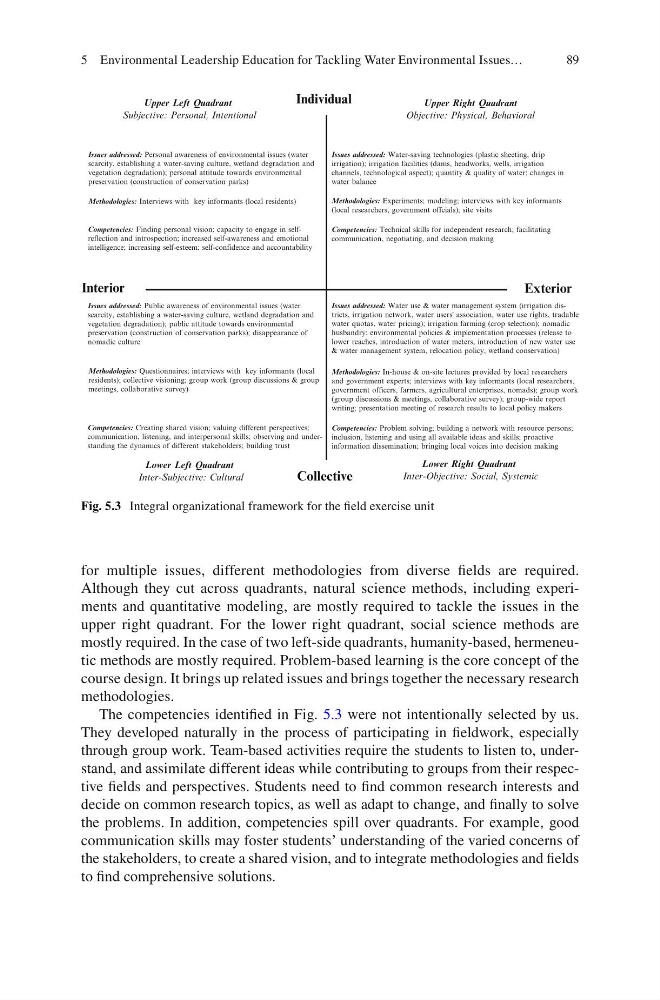
for multiple issues, different methodologies from diverse fi elds are required.
Although they cut across quadrants, natural science methods, including experiments and quantitative modeling, are mostly required to tackle the issues in the
upper right quadrant. For the lower right quadrant, social science methods are
mostly required. In the case of two left-side quadrants, humanity-based, hermeneutic methods are mostly required. Problem-based learning is the core concept of the
course design. It brings up related issues and brings together the necessary research
methodologies.
The competencies identifi ed in Fig. 5.3 were not intentionally selected by us.
They developed naturally in the process of participating in fi eldwork, especially
through group work. Team-based activities require the students to listen to, understand, and assimilate different ideas while contributing to groups from their respective fi elds and perspectives. Students need to fi nd common research interests and
decide on common research topics, as well as adapt to change, and fi nally to solve
the problems. In addition, competencies spill over quadrants. For example, good
communication skills may foster students’ understanding of the varied concerns of
the stakeholders, to create a shared vision, and to integrate methodologies and fi elds
to fi nd comprehensive solutions.
Interior
Exterior
Individual
Collective
Upper Left Quadrant
Subjective: Personal, Intentional
Upper Right Quadrant
Objective: Physical, Behavioral
Lower Left Quadrant
Inter-Subjective: Cultural
Lower Right Quadrant
Inter-Objective: Social, Systemic
Issues addressed: Personal awareness of environmental issues (water
scarcity, establishing a water-saving culture, wetland degradation and
vegetation degradation); personal attitude towards environmental
preservation (construction of conservation parks)
Methodologies: Interviews with key informants (local residents)
Competencies: Finding personal vision; capacity to engage in selfreflection and introspection; increased self-awareness and emotional
intelligence; increasing self-esteem; self-confidence and accountability
Issues addressed: Water-saving technologies (plastic sheeting, drip
irrigation); irrigation facilities (dams, headworks, wells, irrigation
channels, technological aspect); quantity & quality of water; changes in
water balance
Methodologies: Experiments; modeling; interviews with key informants
(local researchers, government offcials); site visits
Competencies: Technical skills for independent research; facilitating
communication, negotiating, and decision making
Issues addressed: Public awareness of environmental issues (water
scarcity, establishing a water-saving culture, wetland degradation and
vegetation degradation); public attitude towards environmental
preservation (construction of conservation parks); disappearance of
nomadic culture
Methodologies: Questionnaires; interviews with key informants (local
residents); collective visioning; group work (group discussions & group
meetings, collaborative survey)
Competencies: Creating shared vision; valuing different perspectives;
communication, listening, and interpersonal skills; observing and understanding the dynamics of different stakeholders; building trust
Issues addressed: Water use & water management system (irrigation districts, irrigation network, water users' association, water use rights, tradable
water quotas, water pricing); irrigation farming (crop selection); nomadic
husbandry; environmental policies & implementation processes (release to
lower reaches, introduction of water meters, introduction of new water use
& water management system, relocation policy, wetland conservation)
Methodologies: In-house & on-site lectures provided by local researchers
and government experts; interviews with key informants (local researchers,
government officers, farmers, agricultural enterprises, nomads); group work
(group discussions & meetings, collaborative survey); group-wide report
writing; presentation meeting of research results to local policy makers
Competencies: Problem solving; building a network with resource persons;
inclusion, listening and using all available ideas and skills; proactive
information dissemination; bringing local voices into decision making
Fig. 5.3 Integral organizational framework for the fi eld exercise unit
5 Environmental Leadership Education for Tackling Water Environmental Issues…
for multiple issues, different methodologies from diverse fi elds are required.
Although they cut across quadrants, natural science methods, including experiments and quantitative modeling, are mostly required to tackle the issues in the
upper right quadrant. For the lower right quadrant, social science methods are
mostly required. In the case of two left-side quadrants, humanity-based, hermeneutic methods are mostly required. Problem-based learning is the core concept of the
course design. It brings up related issues and brings together the necessary research
methodologies.
The competencies identifi ed in Fig. 5.3 were not intentionally selected by us.
They developed naturally in the process of participating in fi eldwork, especially
through group work. Team-based activities require the students to listen to, understand, and assimilate different ideas while contributing to groups from their respective fi elds and perspectives. Students need to fi nd common research interests and
decide on common research topics, as well as adapt to change, and fi nally to solve
the problems. In addition, competencies spill over quadrants. For example, good
communication skills may foster students’ understanding of the varied concerns of
the stakeholders, to create a shared vision, and to integrate methodologies and fi elds
to fi nd comprehensive solutions.
Interior
Exterior
Individual
Collective
Upper Left Quadrant
Subjective: Personal, Intentional
Upper Right Quadrant
Objective: Physical, Behavioral
Lower Left Quadrant
Inter-Subjective: Cultural
Lower Right Quadrant
Inter-Objective: Social, Systemic
Issues addressed: Personal awareness of environmental issues (water
scarcity, establishing a water-saving culture, wetland degradation and
vegetation degradation); personal attitude towards environmental
preservation (construction of conservation parks)
Methodologies: Interviews with key informants (local residents)
Competencies: Finding personal vision; capacity to engage in selfreflection and introspection; increased self-awareness and emotional
intelligence; increasing self-esteem; self-confidence and accountability
Issues addressed: Water-saving technologies (plastic sheeting, drip
irrigation); irrigation facilities (dams, headworks, wells, irrigation
channels, technological aspect); quantity & quality of water; changes in
water balance
Methodologies: Experiments; modeling; interviews with key informants
(local researchers, government offcials); site visits
Competencies: Technical skills for independent research; facilitating
communication, negotiating, and decision making
Issues addressed: Public awareness of environmental issues (water
scarcity, establishing a water-saving culture, wetland degradation and
vegetation degradation); public attitude towards environmental
preservation (construction of conservation parks); disappearance of
nomadic culture
Methodologies: Questionnaires; interviews with key informants (local
residents); collective visioning; group work (group discussions & group
meetings, collaborative survey)
Competencies: Creating shared vision; valuing different perspectives;
communication, listening, and interpersonal skills; observing and understanding the dynamics of different stakeholders; building trust
Issues addressed: Water use & water management system (irrigation districts, irrigation network, water users' association, water use rights, tradable
water quotas, water pricing); irrigation farming (crop selection); nomadic
husbandry; environmental policies & implementation processes (release to
lower reaches, introduction of water meters, introduction of new water use
& water management system, relocation policy, wetland conservation)
Methodologies: In-house & on-site lectures provided by local researchers
and government experts; interviews with key informants (local researchers,
government officers, farmers, agricultural enterprises, nomads); group work
(group discussions & meetings, collaborative survey); group-wide report
writing; presentation meeting of research results to local policy makers
Competencies: Problem solving; building a network with resource persons;
inclusion, listening and using all available ideas and skills; proactive
information dissemination; bringing local voices into decision making
Fig. 5.3 Integral organizational framework for the fi eld exercise unit
5 Environmental Leadership Education for Tackling Water Environmental Issues…