

84
L. Acosta-Soto and S. Hosseini
that its mechanism of operation provides a reliable means for detection of analyte
even though the signal was not comparable to that of EFP. This shortcoming was due
to the lack of control over the orientation of fibers within the paper structure, resulting
in unfavorable bonds with orientations that did not lend themselves to predetermined
bindings hence dramatically decreasing the sensitivity of the device.
Dry eye disease (DED) is a condition that affects patients by causing complications
in the production of lactoferrin, a chemical secreted in tears that protects the eye from
an array of threats. This pathology is often diagnosed after a number of tests including
ELISA. The µPAD proposed by Sonobe et al. (2019) operates on the basis of detection
of lactoferrin in tear fluid. For fabrication of this device, WFP was embedded with
terbium (Tb). Tb
3+ reacts to lactoferrin and its conformation provides a fluorescent
response to an excitation source. This response can be measured in terms of relative
intensity, and, along with the linear design of the device, the height to which the
column shows a fluorescent stain prior to excitation is indicative of the concentration
of lactoferrin within the sample. Thus, an antibody-free method for detection of
lactoferrin in tear fluid was proposed and experimentally validated (Sonobe 2019).
One of the main objectives of BioMEMS biosensors is to optimize the assay
time. One of the methods for achieving a shorter analysis time is simultaneous
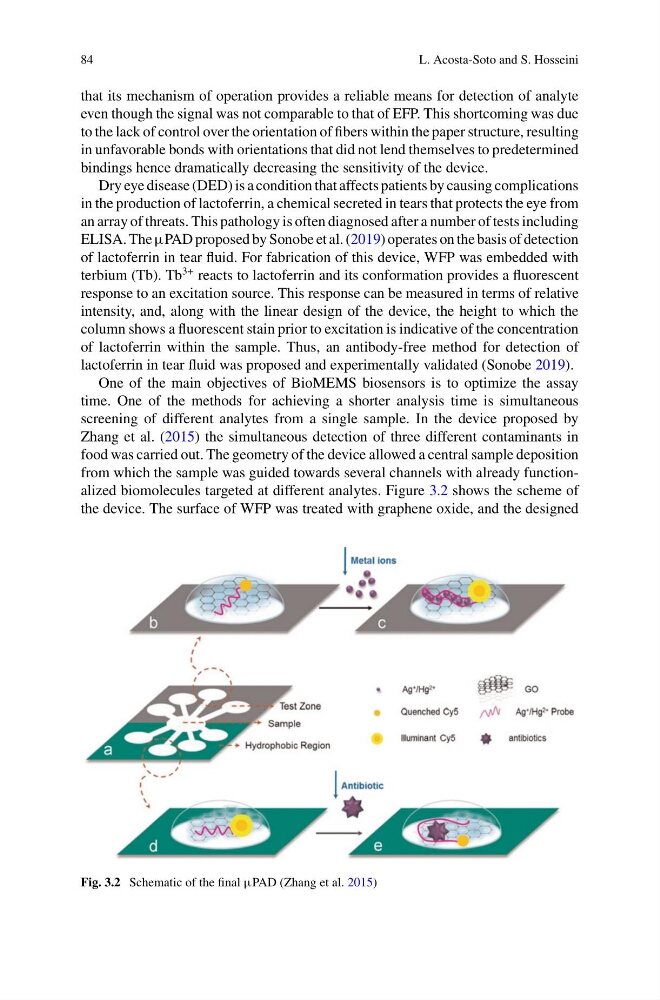
screening of different analytes from a single sample. In the device proposed by
Zhang et al. (2015) the simultaneous detection of three different contaminants in
food was carried out. The geometry of the device allowed a central sample deposition
from which the sample was guided towards several channels with already functionalized biomolecules targeted at different analytes. Figure 3.2 shows the scheme of
the device. The surface of WFP was treated with graphene oxide, and the designed
Fig. 3.2 Schematic of the final µPAD (Zhang et al. 2015)
L. Acosta-Soto and S. Hosseini
that its mechanism of operation provides a reliable means for detection of analyte
even though the signal was not comparable to that of EFP. This shortcoming was due
to the lack of control over the orientation of fibers within the paper structure, resulting
in unfavorable bonds with orientations that did not lend themselves to predetermined
bindings hence dramatically decreasing the sensitivity of the device.
Dry eye disease (DED) is a condition that affects patients by causing complications
in the production of lactoferrin, a chemical secreted in tears that protects the eye from
an array of threats. This pathology is often diagnosed after a number of tests including
ELISA. The µPAD proposed by Sonobe et al. (2019) operates on the basis of detection
of lactoferrin in tear fluid. For fabrication of this device, WFP was embedded with
terbium (Tb). Tb
3+ reacts to lactoferrin and its conformation provides a fluorescent
response to an excitation source. This response can be measured in terms of relative
intensity, and, along with the linear design of the device, the height to which the
column shows a fluorescent stain prior to excitation is indicative of the concentration
of lactoferrin within the sample. Thus, an antibody-free method for detection of
lactoferrin in tear fluid was proposed and experimentally validated (Sonobe 2019).
One of the main objectives of BioMEMS biosensors is to optimize the assay
time. One of the methods for achieving a shorter analysis time is simultaneous
screening of different analytes from a single sample. In the device proposed by
Zhang et al. (2015) the simultaneous detection of three different contaminants in
food was carried out. The geometry of the device allowed a central sample deposition
from which the sample was guided towards several channels with already functionalized biomolecules targeted at different analytes. Figure 3.2 shows the scheme of
the device. The surface of WFP was treated with graphene oxide, and the designed
Fig. 3.2 Schematic of the final µPAD (Zhang et al. 2015)