

48
M. A. Espinosa-Hernandez et al.
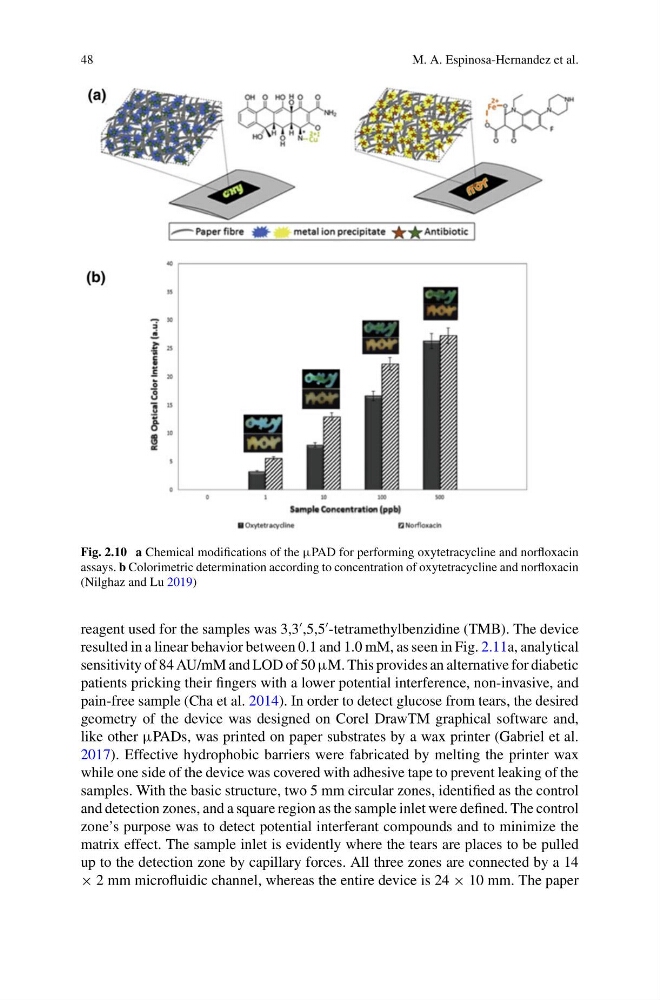
Fig. 2.10 a Chemical modifications of the μPAD for performing oxytetracycline and norfloxacin
assays. b Colorimetric determination according to concentration of oxytetracycline and norfloxacin
(Nilghaz and Lu 2019)
reagent used for the samples was 3,3
,5,5
-tetramethylbenzidine (TMB). The device
resulted in a linear behavior between 0.1 and 1.0 mM, as seen in Fig. 2.11a, analytical
sensitivity of 84 AU/mM and LOD of 50 μM. This provides an alternative for diabetic
patients pricking their fingers with a lower potential interference, non-invasive, and
pain-free sample (Cha et al. 2014). In order to detect glucose from tears, the desired
geometry of the device was designed on Corel DrawTM graphical software and,
like other μPADs, was printed on paper substrates by a wax printer (Gabriel et al.
2017). Effective hydrophobic barriers were fabricated by melting the printer wax
while one side of the device was covered with adhesive tape to prevent leaking of the
samples. With the basic structure, two 5 mm circular zones, identified as the control
and detection zones, and a square region as the sample inlet were defined. The control
zone’s purpose was to detect potential interferant compounds and to minimize the
matrix effect. The sample inlet is evidently where the tears are places to be pulled
up to the detection zone by capillary forces. All three zones are connected by a 14
× 2 mm microfluidic channel, whereas the entire device is 24 × 10 mm. The paper
M. A. Espinosa-Hernandez et al.
Fig. 2.10 a Chemical modifications of the μPAD for performing oxytetracycline and norfloxacin
assays. b Colorimetric determination according to concentration of oxytetracycline and norfloxacin
(Nilghaz and Lu 2019)
reagent used for the samples was 3,3
,5,5
-tetramethylbenzidine (TMB). The device
resulted in a linear behavior between 0.1 and 1.0 mM, as seen in Fig. 2.11a, analytical
sensitivity of 84 AU/mM and LOD of 50 μM. This provides an alternative for diabetic
patients pricking their fingers with a lower potential interference, non-invasive, and
pain-free sample (Cha et al. 2014). In order to detect glucose from tears, the desired
geometry of the device was designed on Corel DrawTM graphical software and,
like other μPADs, was printed on paper substrates by a wax printer (Gabriel et al.
2017). Effective hydrophobic barriers were fabricated by melting the printer wax
while one side of the device was covered with adhesive tape to prevent leaking of the
samples. With the basic structure, two 5 mm circular zones, identified as the control
and detection zones, and a square region as the sample inlet were defined. The control
zone’s purpose was to detect potential interferant compounds and to minimize the
matrix effect. The sample inlet is evidently where the tears are places to be pulled
up to the detection zone by capillary forces. All three zones are connected by a 14
× 2 mm microfluidic channel, whereas the entire device is 24 × 10 mm. The paper