

3 Bio-microelectromechanical Systems (BioMEMS) in Bio-sensing …
91
temperature (32–38 °C) and pH (5–8). Benefiting from the dependence of Rhodamine
B’s emission response on temperature, and the independence of it on pH levels, this
compound was used for the calibration of the temperature within the medium. This
information was then accounted for identifying the temperature dependence of the
emission response generated by FITC, in order to accurately to identify the pH and
its change in the experiment. The response to cyclic stimulation was observed to be
remarkably consistent, as the beads gave the same response for a given configuration
of the independent variables several times.
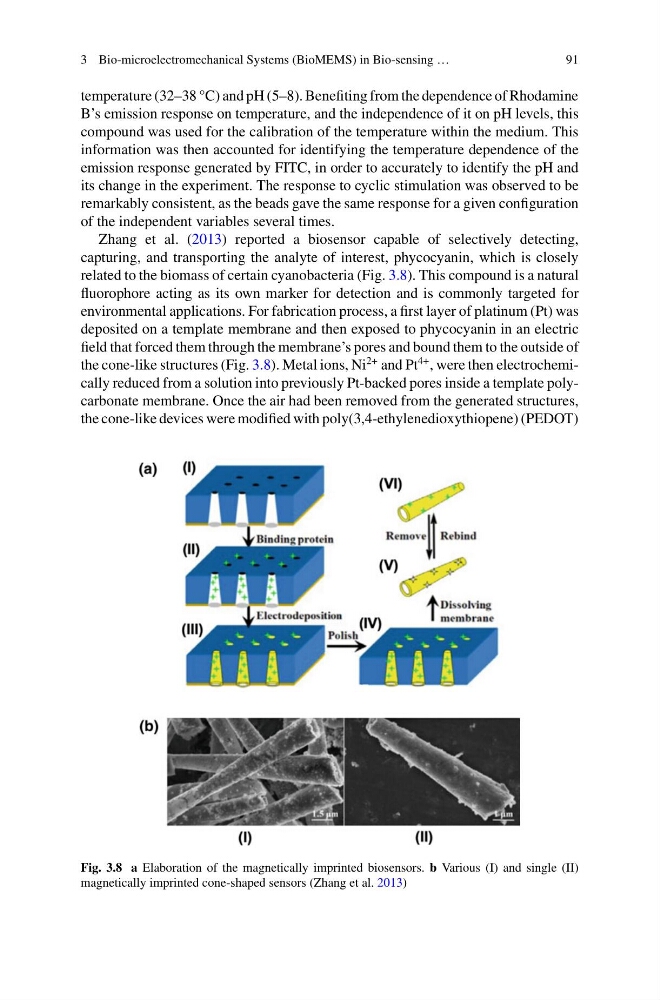
Zhang et al. (2013) reported a biosensor capable of selectively detecting,
capturing, and transporting the analyte of interest, phycocyanin, which is closely
related to the biomass of certain cyanobacteria (Fig. 3.8). This compound is a natural
fluorophore acting as its own marker for detection and is commonly targeted for
environmental applications. For fabrication process, a first layer of platinum (Pt) was
deposited on a template membrane and then exposed to phycocyanin in an electric
field that forced them through the membrane’s pores and bound them to the outside of
the cone-like structures (Fig. 3.8). Metal ions, Ni
2+ and Pt
4+ , were then electrochemically reduced from a solution into previously Pt-backed pores inside a template polycarbonate membrane. Once the air had been removed from the generated structures,
the cone-like devices were modified with poly(3,4-ethylenedioxythiopene) (PEDOT)
Fig. 3.8 a Elaboration of the magnetically imprinted biosensors. b Various (I) and single (II)
magnetically imprinted cone-shaped sensors (Zhang et al. 2013)
91
temperature (32–38 °C) and pH (5–8). Benefiting from the dependence of Rhodamine
B’s emission response on temperature, and the independence of it on pH levels, this
compound was used for the calibration of the temperature within the medium. This
information was then accounted for identifying the temperature dependence of the
emission response generated by FITC, in order to accurately to identify the pH and
its change in the experiment. The response to cyclic stimulation was observed to be
remarkably consistent, as the beads gave the same response for a given configuration
of the independent variables several times.
Zhang et al. (2013) reported a biosensor capable of selectively detecting,
capturing, and transporting the analyte of interest, phycocyanin, which is closely
related to the biomass of certain cyanobacteria (Fig. 3.8). This compound is a natural
fluorophore acting as its own marker for detection and is commonly targeted for
environmental applications. For fabrication process, a first layer of platinum (Pt) was
deposited on a template membrane and then exposed to phycocyanin in an electric
field that forced them through the membrane’s pores and bound them to the outside of
the cone-like structures (Fig. 3.8). Metal ions, Ni
2+ and Pt
4+ , were then electrochemically reduced from a solution into previously Pt-backed pores inside a template polycarbonate membrane. Once the air had been removed from the generated structures,
the cone-like devices were modified with poly(3,4-ethylenedioxythiopene) (PEDOT)
Fig. 3.8 a Elaboration of the magnetically imprinted biosensors. b Various (I) and single (II)
magnetically imprinted cone-shaped sensors (Zhang et al. 2013)